
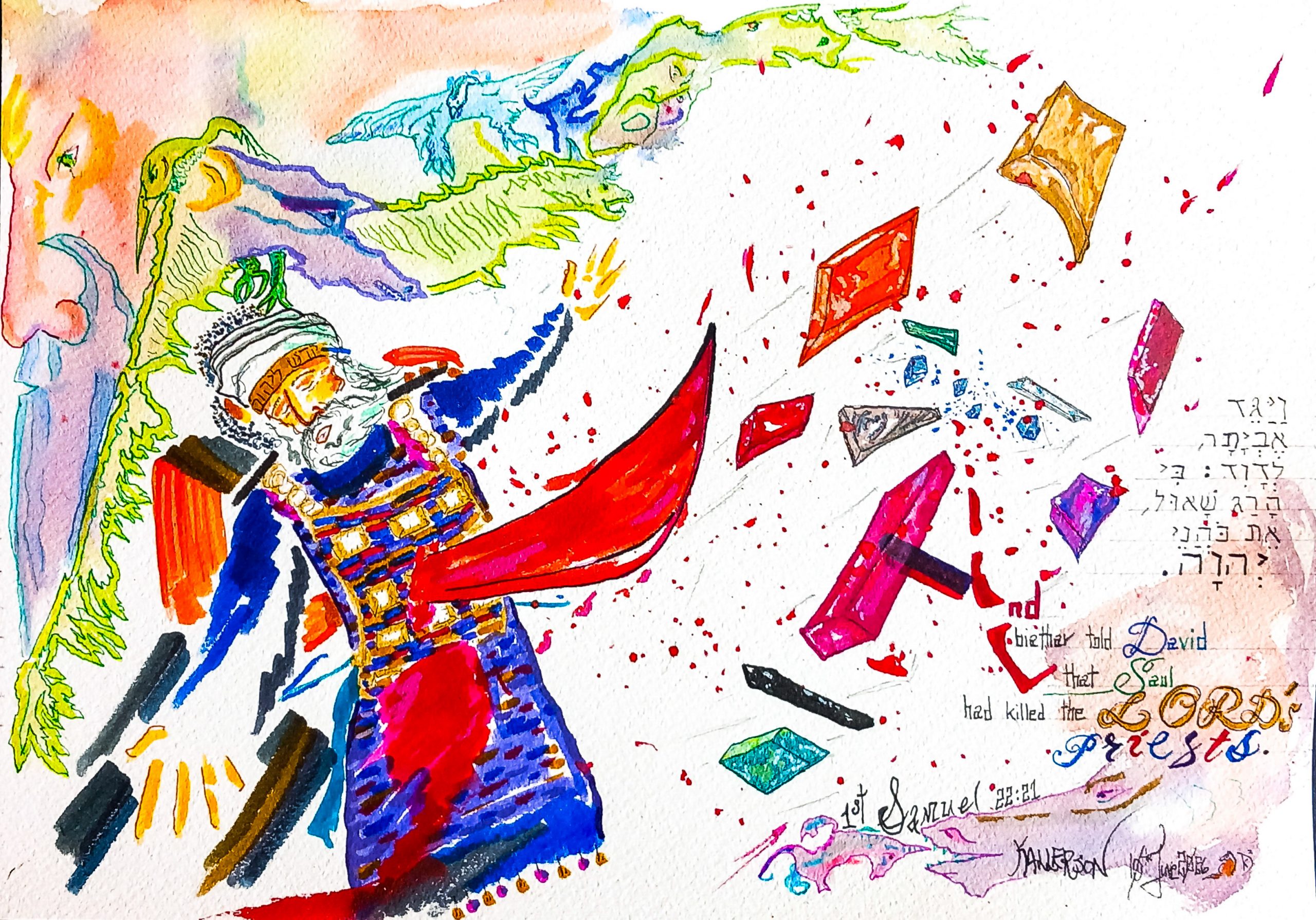
Artwork by Douglas Kallerson
1 Samuel 22:14-23
Doeg the Adomite, Part II
(Typed 2 & 3 February 2026) One of the astonishing things that happens in the minds of all people, and I mean ALL people, is that we shut out things that we don’t agree with. We mentally ignore them, even if they are self-evident truths or clearly expressed.
At the same time, we take our own beliefs and elevate them to a place above others. They appear as truth to us, even while we accept another belief that contradicts the first. This is known as cognitive dissonance.
It results in mental unsettledness, and we work against one belief or the other, trying to resolve what we so desperately want to be true concerning both thoughts. An example that fills churches around the world is the matter of law versus grace.
We say we accept God’s grace, and then we turn around and reinstate the law into our lives in some form or another, believing that it is compatible with trusting in God’s grace.
For example, “I am a saved believer! Saved by God’s grace! But I know it is wrong to eat pork, so I never do.” Who said it was wrong to eat pork? “I know I must tithe, so I faithfully do each week.” Who said you needed to tithe? Our church observes the law. Even Paul says the law is good. In what manner is the law good? For whom is the law good?
Text Verse: “But we know that the law is good if one uses it lawfully.” 1 Timothy 1:8
Oh well, Paul said it. It’s in black and white. The law is good. Everyone, listen up! Next week, don’t bring any ham or bacon (oh, bacon!) or pork chops to church for lunch. Oh, and be sure to bring a tenth of everything you have. I will take good care of it. And if any of you doesn’t show up with tzitzits on your clothes, you are out of here.
Context! What does Paul say next in 1 Timothy? I mean, the very next words. What do they say?
“…knowing this: that the law is not made for a righteous person, but for the lawless and insubordinate, for the ungodly and for sinners, for the unholy and profane, for murderers of fathers and murderers of mothers, for manslayers, 10 for fornicators, for sodomites, for kidnappers, for liars, for perjurers, and if there is any other thing that is contrary to sound doctrine, 11 according to the glorious gospel of the blessed God which was committed to my trust.” 1 Timothy 1:9-11
Oh. I see. Everyone, listen up! Be sure to bring ham, bacon (oh, bacon!), and pork chops for lunch next week. And no need to wear tzitzits. But I still insist on the tithe. Bring that. I already planned it into the budget.
Context is important. It is a really important part of His superior word. And so, let us turn to that precious word once again, and… May God speak to us through His word today, and may His glorious name ever be praised.
I. Dying, You Will Die (verses 14-17)
14 So Ahimelech answered the king
vayaan akhimelekh eth ha’melekh – “And he answered, Ahimelech, the king.” This is based on the last verses evaluated in the previous sermon –
“And he sent, the king, to call Ahimelech, son Ahitub the priest, and all house his father, the priests who in Nob. And they came, they all, unto the king. 12And he said, Saul, ‘You must hear, I pray, son Ahitub.’”
And he said, ‘Behold me, my lord.’
13And he said unto him [k.], Saul, ‘To why you tied upon me, you and son Jesse, in your giving to him bread and sword, and asking to him in God, to rise unto me to lurk according to the day, the this?’” 1 Samuel 22:11-13 (CG)
Saul’s mind is set on destroying David. Anyone who gets between him and that goal is a perceived enemy, including the high priest of Israel. He has laid a charge of conspiracy at the feet of Ahimelech. Ahimelech means My Brother Is King. He is set to give his defense…
14 (con’t) and said, “And who among all your servants is as faithful as David,
vayomar u-mi bekhal avadekha kedavid neeman – “And he said, ‘And who in all your servants according to David ‘being established’.’’’ To be established means he is a fixed, faithful, and firm pillar within the house of Saul. Out of all the established people under Saul, Ahimelech knows that there is none more firmly established than David.
As such, there would be no reason for Ahimelech to suspect David of any hint of conspiring against his king. Unless he had been told in advance of such a matter, he could not be blamed for helping, rather than harming, Saul’s authority to govern. And more…
14 (con’t) who is the king’s son-in-law, who goes at your bidding, and is honorable in your house?
va’khathan ha’melekh vesar el mishmartekha venikhbad bevetekha – “and affinity the king, and veering unto your ‘what hearing’, and ‘being enweighed’ in your house?” Ahimelech provides three additional reasons why helping David was logical and appropriate.
The first is that David is a son in law of the king. Unless that had changed and the priests had not yet been notified, there was no way they could question David’s right to conduct both civil and family matters for Saul.
The second is that David aligned himself (veered unto) the what-hearing of Saul. This is a new word, mishmaath, the feminine form of mishma found in Isaiah 11:3. The prefix mi signifies who, what, why, etc. The word shama means “to hear.”
That is converted to the noun form, a hearing. Thus, this word is translated as a “what hearing,” as in being obedient to the spoken word. One might say, “David is the epitome of doing the what-hearing of the king.” It refers to an obedient audience of one or more subjects who report to the king.
The third reason is that David is “being enweighed” in Saul’s house. The participle indicates ongoing action. The weight of David’s authority was set in place and, unless it has changed, it continued unabated in the eyes of the priests.
They could not be held responsible for any change that took place of which they were uninformed. Everything about David made it right and appropriate for them to assist him. To not do so would be an act of rebellion against the king himself.
Notice the structure and similarity of thought from Saul in verse 13 –
Verse 13 – “To why you tied upon me, you and son Jesse, in your
giving to him bread,
and sword,
and asking to him in God,
to rise unto me to lurk according to the day, the this?”
Verse 14 – “And who in all your servants according to David
‘being established’,
and affinity, the king,
and veering unto your ‘what hearing’,
and being enweighed in your house?”
Ahimelech brilliantly responds to each confused accusation with a corresponding point of clarity. And yet, there is more…
15 Did I then begin to inquire of God for him?
ha’yom hakhilothi leshaol lo belohim – “The day, I caused to begin to ‘Saul’ [k.] to him in God!” The written and the spoken Hebrew differ. The written says the seemingly nonsensical, “…to ‘Saul’ to him.” The oral amends it to say, “…to ask to him.” But nothing in God’s word is nonsensical.
The words “I caused to begin” signify to inquire or seek. The word khalal means to bore. When something bores into something else, what is inside is exposed. As such, the word is translated as “begin.” Ahimelech is “boring” into the unknown, seeking from God concerning a matter. Saul’s name means Asked. Thus, he is making a pun by saying he asked of the Lord in the name of Saul because David is Saul’s representative.
Therefore, his pun means, “Today, I asked of God under Saul’s authority for David!” Some translations make it a question as with the NKJV. As such, it would beg a negative response. “Is this the first time I inquired of God for David?”
This is possible with the oral rendering, but the written is correct as it stands. The exclamation point at the end is my way of making the statement emphatic, as Ahimelech’s use of “to Saul” implies.
David asked for a divine word, and Ahimelech readily gave it. Why should he not do so? Without a word directly from the king, it would be wholly inappropriate to withhold such assistance. Therefore…
15 (con’t) Far be it from me! Let not the king impute anything to his servant, or to any in the house of my father.
khalilah li al yasem ha’melekh beavdo davar bekhal beith avi – “(Surely) Profane to me! Not may you put, the king, in your servant – word in all ‘house, my father’.” The high priest’s words could be paraphrased as, “Absolutely not! You have completely misunderstood the situation, and it is wholly inappropriate that you should malign the name of my father’s house.”
Ahimelech has taken Saul’s malignant address to him and responded at the same level as his accusation –
Verse 12 – “You must hear, I pray, son Ahitub.”
Verse 15 – “Not may you put, the king, in your servant word in all house my father.”
15 (con’t) For your servant knew nothing of all this, little or much.”
ki lo yada avdekha bekhal zoth davar qaton o gadol – “For not he knew, your servant, in all this word, diminutive or great.” Ahimelech has provided abundant evidence that what he did was proper and honoring of the king. Any matter which may have removed David from the king’s favor was never disclosed to him. As such, he could not be imputed any charge of wrongdoing. However…
16 And the king said, “You shall surely die, Ahimelech, you and all your father’s house!”
vayomer ha’melekh moth tamuth akhimelekh atah vekhal beith avikha – “And he said, the king, ‘Dying, you will die, Ahimelech. You and all ‘house, your father’.’” The emphatic repetition is not good news for Ahimelech. Saul’s mind is made up that he is a co-conspirator with David and is worthy of death.
Adding in “all house your father” is an undeserved sentence. Despite that, it is Saul’s edict. He sees this as a just sentence because of the severity of the matter. His initial accusation was against “son Ahitub.” Ahimelech reiterated “all house my father.” This may have been what put Saul over the edge and caused the sentence.
Despite Saul summoning all of the priests, it may have been that an admission by Ahimelech alone saved the others, but with the adamant refusal, any chance of that was gone.
17 Then the king said to the guards who stood about him,
vayomer ha’melekh laratsim hanitsavim alav – “And he said, the king, to the runners, the ‘being stationed upon him’.” The meaning of “runners” is not certain. Some think it refers to those who carry messages for the king. More likely, it refers to those who ran before Saul bearing weapons, meaning his personal bodyguards. They are to…
17 (con’t) “Turn and kill the priests of the Lord, because their hand also is with David, and because they knew when he fled and did not tell it to me.”
sobu vehamithu kohane Yehovah ki gam yadam im David vekhi yadeu ki voreakh hu velo galu eth azeno – “You must revolve, and you must cause to kill ‘priests, Yehovah’, for also their hand, with David, and that they knew that bolted, he, and not they denuded his ear [k.].” The written text reads, “his ear,” while the oral reads, “my ear.”
As clunky as it sounds, the written is acceptable. In Saul’s haste to accuse the priests to his men, he skips parts of his own sentence. This is something we all do when hurrying through our words. “Kill them! Kill all the priests! They are all in it with David. They knew he was running, but they didn’t denude his (the king’s) ear.”
Such a confused rant goes well with his confused, erratic thinking. David means Beloved.
17 (con’t) But the servants of the king would not lift their hands to strike the priests of the Lord.
velo avu avde ha’melekh lishloakh eth yadam liphgoa bekohane Yehovah – “And not they acquiesced, ‘servants, the king’, to send their hand to impinge in ‘priests, Yehovah’.” Despite the command, the king’s servants knew that what Saul was saying was unreasonable and ungodly.
Saul had made his judgment based on personal bias without any evidence to support his accusations. Therefore, they would not participate in the murder of the priests of Israel. Undeterred, Saul knows someone who will comply…
Doeg, I’ve got a job for you
You’re just the guy to get it done
You never question what you’re told to do
You take my orders and run
See these priests! Here’s what you are to do
I know you are the guy to get it done
Pull out your sword and run them through
Get on with it! Take my orders and run
You’re a brutal one, Doeg, this is true
But when a job needs doin’, you get it done
You followed through with what I told you
You’re the man, Doeg, a real son of a gun
II. Abiathar (verses 18-23)
18 And the king said to Doeg, “You turn and kill the priests!”
vayomer ha’melekh ledoyeg sov atah uphega bakohanim – “And he said, the king, to Doyeg [k.], ‘You must revolve, you, and you must impinge in the priests.’” The written and oral disagree on the spelling of his name. The written says Doeg. The oral says Doyeg.
He is mentioned six times in Scripture. The first two times his name is spelled d-a-g. After that, all four instances include the additional letter vav. However, in this chapter, all three change the aleph to a yod: d-v-y-g. In Psalm 51, it reads d-v-a-g.
The addition of the vav, the sixth letter of the aleph-beth, is given to indicate his fallen nature, six being the number of man, especially fallen man. The change of the aleph to a yod is likely to indicate the thing he agreed to that the others refused, “to send their hand (yad) to impinge.” The meaning and ancient pictograph of yod is “hand.” The instances are as follows:
21:8 & 22:9 – דאג
22:18 (x2) & 22:22 – דויג
Psalm 52:1 – דואג
The Hebrew is telling more than a surface story. It is conveying information that clarifies what is on God’s mind as the story unfolds. The name, regardless of spelling, means Fearful or Anxious.
18 (con’t) So Doeg the Edomite turned and struck the priests,
The words are emphatic: vayisov doyeg ha’adomi vayiphga hu ba’kohanim – “And he revolved, Doyeg [k.] the Adomite, and he impinged, he, in the priests.” The wording is set in parallel with Saul’s bonkers order –
You must revolve, you, and you must impinge in the priests.
And he revolved, Doyeg the Adomite, and he impinged, he, in the priests.
In a scene that makes Inigo Montoya seem like child’s play, Doyeg rushed into the killing with the same maniacal delight as Saul had in giving the order. Adomi means red or ruddy. He is the Red One.
18 (con’t) and killed on that day eighty-five men who wore a linen ephod.
vayameth bayom ha’hu shemonim va’khamishah ish nose ephod bad – “and he caused to kill in the day, the it, eighties and five man lifting ‘ephod, linen’.” Despite the killing, eighty-five is a cool number. It is the product of five (grace) and seventeen, a number Bullinger was excited about. It is the seventh of the prime numbers. He says –
“…it partakes of and intensifies the significance of the number seven. Indeed, it is the combination or sum of two perfect numbers—seven and ten—seven being the number of spiritual perfection, and ten of ordinal perfection. Contrasted together the significance of these two numbers is clear; and when united in the number seventeen we have a union of their respective meanings, viz., spiritual perfection, plus ordinal perfection, or the perfection of spiritual order.”
These men have been highlighted as “priests, Yehovah,” and “lifting ‘ephod, linen’.” There was a total disregard on the part of Saul and Doeg for the sanctity of the priestly office and the duties they performed. As for the terminology used, this does not necessarily mean that the priests were wearing their linen ephods at the time. Being a participle, it indicates that as priests, this was their regular habit.
19 Also Nob, the city of the priests, he struck with the edge of the sword,
veeth nov ir ha’kohanim hikah lephi kherev – “And Nob, ‘city, the priests’, he caused to strike to ‘mouth, sword’.” Saul didn’t stop at killing the priests at his location in Gibeah. Instead, he had Doeg march to Nob and strike the city where they dwelt.
Nob means Fruit. The sword is emblematic of the law, being the same spelling as Horeb, the mountain of the law. The killing wasn’t isolated to just a few people. Rather…
19 (con’t) both men and women, children and nursing infants, oxen and donkeys and sheep—with the edge of the sword.
meish vead ishah meolel vead yoneq veshor va’khamor va’seh lepi kharev – “from man and until woman, from suckling and until being suckled, and jack, and sheep to ‘mouth, sword’.” What was done here, at the direction of Saul, was a complete anathematization of the city. Think of it! Notice the contrast –
“Now, you must walk, and you caused to strike Amalek, and you caused to anathematize them, all which to him. And not you will commiserate upon him. And you caused to die, from man until woman, from suckling and until being suckled, from ox and until sheep, from camel and until jack. … 8And he manipulated Agag, king Amalek, alive. And all the people, he caused to anathematize to mouth sword. 9And he commiserated, Saul, and the people, upon Agag, and upon best the flock, and the cattle, and the doubles, and upon the lambs, and upon all the good, and not they acquiesced – caused to anathematize them. And all the deputyship – disesteemed and being wasted, it they caused to anathematize.” 1 Samuel 15:3 & 8, 9 (CG)
“And he revolved, Doyeg, the Adomite, and he impinged, he, in the priests, and he caused to kill in the day, the it, eighties and five man lifting ephod linen. 19And Nob, city the priests, he caused to strike to mouth sword, from man and until woman, from suckling and until being suckled, and jack, and sheep to mouth sword.” 1 Samuel 22:18, 19 (CG)
Despite the word of the Lord, Saul was unwilling to kill Agag. And yet, for his own vengeful purposes, he killed eighty-five priests, including the high priest. He was also unwilling to kill the best of the animals of Amalek, but he sought out and killed everything belonging to the priestly city, a city of the Lord.
20 Now one of the sons of Ahimelech the son of Ahitub, named Abiathar, escaped and fled after David.
vayimalet ben ekhad la’akhimelekh ben akhituv u-shemo evyathar vayivrakh akhare David – “And he was eluded, ‘son, one’ to Ahimelech, ‘son, Ahitub’. And his name, Abiathar. And he bolted after David.” During the carnage and destruction of Nob, Abiathar was able to get away.
In Chapter 23, it says that he bolted to David in Keilah. It doesn’t say how he knew where David was. But it would be easy enough for him to find out, because when he went there, he descended with an ephod. Thus, he could inquire of the Lord.
Abiathar will be seen with David throughout much of his life. However, he aligned himself against Solomon, David’s chosen successor, when David was old. Therefore, when Solomon ascended to the throne, he removed Abiathar from serving as priest to the Lord.
Ahitub means My Brother Is Goodness or Brother of Goodness. Abiathar comes from av, father, and yathar, to jut over or exceed. It is that which remains, is abundant, is left over, etc. Therefore, the name means Father of a Remnant, Father of Preeminence, Father of Plenty, The Great One Is Father, Father of Superfluity, or something along those lines.
21 And Abiathar told David that Saul had killed the Lord’s priests.
vayaged evyarthar ledavid ki harag shaul eth kohane Yehovah – “And he caused to declare, Abiathar, to David, that he slayed, Saul, ‘priests, Yehovah’.” When Abiathar found David, he relayed the details of the massacre. It would have been a tragic blow to David, and we can speculate that David wrote, or at least got the inspiration to write, Psalm 52 at this time.
22 So David said to Abiathar, “I knew that day, when Doeg the Edomite was there, that he would surely tell Saul.
vayomer David leevyathar yadati bayom ha’hu ki sham doyeg ha’admoni ki haged yagid leshaul – “And he said, David, to Abiathar, ‘I knew in the day, the it, for there Doyeg [k.] the Adomite, for causing to declare, he will cause to declare to Saul.” The emphatic repetition of the verb highlights David’s remorse.
Unless you’re Saul, you can’t just kill someone based on a sneaking suspicion, but the memory of that sneaking suspicion will grow in one’s mind when it proves to be correct. This is what happened with David. He took the calamity personally, acknowledging that his actions brought about the tragic events…
22 (con’t) I have caused the death of all the persons of your father’s house.
Again, the words are emphatic, highlighting David’s remorse: anokhi sabothi bekhal nephesh beith avikha – “I myself, I revolved in all soul ‘house, your father’.’” The word savav signifies to revolve or surround. In this case, David is saying that his actions caused the events to revolve around, coming back to the place where they started.
David took every one of their deaths personally. However, he has a way of easing the distress…
23 Stay with me; do not fear. For he who seeks my life seeks your life,
shevah iti al tira ki asher yevaqesh eth napshi yevaqesh eth napshekha – “You must (surely) sit with me. Not you will fear. For whom he will seek my soul, he will seek your soul.” What David says is logical. Saul will search for both of them. If he discovered Doeg missed someone when he anathematized the city, he would feel obligated to pursue that person as much as he desired to eliminate David.
Despite this, there would be safety if the two remained together, as is seen in the final words of the chapter…
*23 (fin) but with me you shall be safe.”
Rather: ki mishmereth atah imadi – “For guarding, you, with me.” Almost every translation reads as the NKJV, that being with David would ensure Abiathar’s safety. Only Young’s correctly identifies the meaning, “for a charge art thou with me.” The noun mishmereth means a sentry, a guarding, or a watch (the act). David says “guarding, you, with me.”
Together, they will be a guarding, a sentry. David is the military man with men under his command to physically watch for threats. Abiathar is the priest with an ephod who will spiritually monitor the threats that cannot be seen –
“And he knew, David, for upon him Saul causing to scratch the evilness. And he said unto Abiathar the priest, ‘You must cause to (surely) near the ephod.’ 10And he said, David, ‘Yehovah God Israel, hearing, he heard, your servant, for seeking, Saul, to come unto Keilah to decay the city in my crossing. 11They will cause to shut me, masters Keilah, in his hand? He will descend, Saul, according to which he heard, Your servant? Yehovah God Israel, You must cause to declare, I pray, to Your servant.’
And He said, Yehovah, ‘He will descend.’” 1 Samuel 23:9-11 (CG)
Together, trusting in the direction of the Lord while watching and performing against the earthly forces, they would form a sentry ready for any challenge. David saw the hand of the Lord in what occurred and employed what was provided accordingly.
The law is good, it is true
But in what way shall we call it good?
Is it good for me and you?
Clearly not! That should be understood
The law is good innately because it is from God
But it is definitely harmful to you and me
Under the law, we must toil and plod
But in the grace of Christ, we are set free
The law is good in how it instructs as well
Showing us how we need Jesus Christ
Trying to earn eternity through law will only earn hell
Heaven is given through grace. Thus, your soul is priced
III. Salvation in Christ, Death from the Law
Verses 1-5 may or may not be chronological, but they are intended to be a categorical note. In verse 1, it said that David, picturing accepting the doctrines of Christ, walked “from there.”
If that is chronological, it means from Gath. He escaped to Cave Adullam, Until Vanishment, meaning until what is being referred to ceases. If it is something that never ceases, it is eternal. A cave signifies that which is exposed. Thus, this is the place where eternity is exposed.
While at the cave, it said that his brothers and all his father’s house went down there to him. Along with them (verse 2), many discontented souls also joined him. It didn’t say why they were discontented, just that they were men of scrunch, indebted, and bitter of soul.
Saul, Asked, represents Sheol calling out for the souls of men. Being their king, one would assume their state is based on that. There is the pressure of dying, there is the issue of having a debt, and they are bitter about their situation. Each of these would apply to those who need redemption from the call of the pit.
David, accepting the doctrines of Christ, is said to become captain over a cohort. They are in line with David, and they number four hundred, (4x10x10), or (5 x 8 x 10). Either way, the result is found in the way one calculates forty –
“It is the product of 5 and 8, and points to the action of grace (5), leading to and ending in revival and renewal (8). This is certainly the case where forty relates to a period of evident probation. But where it relates to enlarged dominion, or to renewed or extended rule, then it does so in virtue of its factors 4 and 10, and in harmony with their signification.” Bullinger
As such, this refers to a period of grace (5) leading to revival and renewal (8) where nothing is wanting and the whole cycle is complete (10).
In verse 3, David went to Mizpah Moab, Watchtower of From Father. It signifies that the process of salvation, which is from God the Father, is watched over.
While there, David petitioned the king of Moab to tend to his parents until God gave him direction. The king agreed to this all the time David remained in the stronghold, a structure intended for defense. The parents of accepting the doctrines of Christ must picture something. My speculation is based on Romans 10:9 –
“…that if you confess with your mouth the Lord Jesus and believe in your heart that God has raised Him from the dead, you will be saved.”
In Greek, the mouth is neuter. Hebrew does not have a neuter person, but in Hebrew mouth is masculine. The doctrine of accepting Christ is watched over by God as the only acceptable means of becoming a believer.
In verse 5, the prophet Gad, Fortune, told David not to stay in the stronghold, but to walk to the land of Judah, Praise. David complied and walked to the Forest of Hareth, Engraved. Typologically, a forest is a place where the fruits of the Spirit are available.
Thus, the meaning of the Forest of Hareth is explained by Paul in 2 Corinthians 3, where he uses the word eggraphó, to engrave, to explain what is being conveyed –
“You are our epistle written [eggraphó] in our hearts, known and read by all men; 3 clearly you are an epistle of Christ, ministered by us, written [eggraphó] not with ink but by the Spirit of the living God, not on tablets of stone but on tablets of flesh, that is, of the heart.” 2 Corinthians 3:2, 3
With this necessary inclusion concerning salvation and how it is procured completed, the narrative proceeded to the continued account of Saul pursuing David.
In verse 6, Saul, Asked, was sitting in the Gibeah, a word etymologically connected to Gabbatha, under the tamarisk in Ramah, the Height.
The tamarisk is a symbol of permanence and reliability. Being preceded by the definite article, it signifies the state of those things. It said that while there, he had his spear, khanith, in his hand. This is the same as the feminine word for grace.
Verse 6 does not logically fit with the rest of the account. Everything about it signifies the hope-filled aspect of a person who possesses eternal salvation. And that is purposeful. Saul was a picture of a saved person in the past. That has not changed.
However, he has also taken on another typology, Sheol, asking for the souls of men. He is the king of that realm. Including this typological picture of Saul being saved helps to contrast the rest of the typology.
What was the purpose of the law? What was the nature of the law? What validity, if any, does the law have today? These are concepts that are explained in verses 7-23.
Verse 7 noted that Saul was surrounded by his servants, whom he called “sons Right.” He asked his servants if the son of Jesse, Yehovah Exists, would give them fields and vineyards and appoint them to high positions.
The “sons Right” picture those seeking the truth, whether they are saved or not. Though only mentioned indirectly after this, that is seen when they did not do as directed.
In verse 8, Saul continued to moan about how his servants were unwilling to stand by him. They didn’t even tell him about David and Jonathan cutting a covenant. He also moaned that nobody felt sorry for him. Sheol is miffed about the prospect of being emptied of believers someday.
In verse 9, however, Doeg the Edomite, Fearful the Red One, spoke up. He told Saul that he saw the son of Jesse going Nob-ward, Fruit, to Ahimelech, My Brother Is King (the law anticipating Christ), son of Ahitub, Brother of Goodness. Ahitub represents the nature of the law –
“Has then what is good become death to me? Certainly not! But sin, that it might appear sin, was producing death in me through what is good, so that sin through the commandment might become exceedingly sinful. 14 For we know that the law is spiritual, but I am carnal, sold under sin. 15 For what I am doing, I do not understand. For what I will to do, that I do not practice; but what I hate, that I do. 16 If, then, I do what I will not to do, I agree with the law that it is good. 17 But now, it is no longer I who do it, but sin that dwells in me. 18 For I know that in me (that is, in my flesh) nothing good dwells; for to will is present with me, but how to perform what is good I do not find. 19 For the good that I will to do, I do not do; but the evil I will not to do, that I practice. 20 Now if I do what I will not to do, it is no longer I who do it, but sin that dwells in me.” Romans 7:13-20
Ahitub pictures the good nature of the law, and Ahimelech, the law anticipating Christ. Both look to Christ as the end of the law. Doeg said (verse 10) that at that time, Ahimelech, the law anticipating Christ, inquired of the Lord for David, gave him provisions, and gave him the sword (symbolizing law) of Goliath (Exposer/Exiler).
In Chapter 21, this was explained with Paul’s words from Galatians –
“What purpose then does the law serve? It was added because of transgressions, till the Seed should come to whom the promise was made; and it was appointed through angels by the hand of a mediator. 20 Now a mediator does not mediate for one only, but God is one.” Galatians 3:19, 20
Despite being good, law is what got man into the mess he is in. The law of Moses only added to transgressions before God. Because of what he was told by Doeg (verse 11), Saul summoned Ahimelech and the other priests to him, claiming that they were in league (verses 12 & 13) with the son of Jesse. Ahimelech, however, responded in an exacting manner to each accusation, as noted earlier –
Verse 13 – “To why you tied upon me, you and son Jesse, in your
giving to him bread,
and sword,
and asking to him in God,
to rise unto me to lurk according to the day, the this?”
Verse 14 – “And who in all your servants according to David
‘being established’,
and affinity, the king,
and veering unto your ‘what hearing’,
and being enweighed in your house?”
In verse 15, Ahimelech went further and told Saul that he had “caused to begin to ‘Saul’ to him in God.” The very thing that Saul thought was treasonous was done in his name to God. Therefore, how could Saul assume Ahimelech was conspiring against him?
To get this, think of the law anticipating Christ asking God about Sheol for those who accept the doctrines of Christ. How could Sheol be miffed if he is the subject of the question?
Because of this, Ahimelech’s refutation met Saul’s accusation –
Verse 12 – “You must hear, I pray, son Ahitub.”
Verse 15 – “Not may you put, the king, in your servant word in all house my father.”
Saul called Ahimelech son of Brother of Goodness, the good law. Ahimelech, the law anticipating Christ, said that Saul was incorrectly placing blame on the house of his father. Both he and his father were of the same purpose, which is that they lead to Christ.
Despite his defense, Saul condemned Ahimelech to death, instructing his men to kill the priests. When Saul’s servants would not, he turned to Doyeg, Fearful, spelled with the additional vav to indicate his fallen state, separate from Christ, who used his yad, his hand, the symbol of power and authority, to strike the priests of the Lord.
Fallen man, without understanding the purpose of the law, is intent on destroying it. And this is exactly what mankind did in crucifying Christ without even realizing that crucifying Him would end the law because He embodies it!
In other words, Doyeg striking Ahimelech (the law anticipating Christ) along with the priests with him, is a picture of Christ dying in fulfillment of the law. That is made clear in the number of priests destroyed, eighty-five.
The death of the eighty-five priests of the law symbolizes grace combined with spiritual and ordinal perfection, and thus, the perfection of spiritual order. The death of law on Christ’s cross came through God’s grace and is exactingly described by the perfection of spiritual order.
Doyeg also struck Nob, Fruit, and everything in the city. Everything about the law that bore fruit in anticipating Christ finds its end in Christ. It was only a shadow of what He actually provides. Despite that, and even though the law is dead, it still serves a purpose, even today. That is seen in the escape of Abiathar.
Verse 20 noted that Abiathar, Father of Superfluity, fled to David, accepting the doctrines of Christ. His name signifies excess, but not as unwanted or without a purpose. It is that which goes beyond the needs of the original thing. The law, despite being dead, still serves a purpose, even to this day.
Its purpose is to instruct us on its original purpose. For example, we have been using the law at the Superior Word for over a dozen years, page by page, line by line, and word by word, to show how it points to Christ. Even though it is no longer what God is doing, it still has a purpose beyond its main objective.
Abiathar told David what occurred in verse 21. In verse 22, David acknowledged that he knew Doyeg would tell Saul about his visit to Ahimelech and, therefore, he revolved in “all soul house your father.” David’s actions led to the death of Ahimelech’s house.
It is a true statement in Christ as well. Accepting the doctrines of Christ revolves and comes back to destroy the very thing that necessitated Christ’s coming, meaning law.
Verse 23 finished the chapter, with David’s words to Abiathar that Saul would seek after him just as he sought David, but that together they would be a sentinel. The last thing Sheol wants is to be filled with people who will be snatched out of it someday.
But by accepting the doctrines of Christ and understanding how law can instruct us based on our faith in Christ, we have an unstoppable tag team. When people are uninformed about the law, it can entrap them all over again, just as it did with those in Galatia, and just as it does in churches all over the world today.
People who were saved but later get caught up in law observance will have nothing to show for their lives after that time. The rest of their lives will be wasted and without reward. And the people they instruct who were not saved will fill Sheol with souls that will stay put when the rapture takes place. Death’s victory will remain complete in them.
It is not surprising that the account about Doyeg killing Ahimelech, the priests, and the inhabitants of Nob came after a very short review of the process and nature of salvation in a set of verses that otherwise seem to have no proper place in the ongoing narrative.
The contents of the Doyeg narrative clearly show that the law is good. That is agreed to in Paul’s writings, but it does not mean that law is good for us. It is innately good, but it also brought about man’s fall. And more, it highlighted and multiplied sin when the Law of Moses was introduced.
Thus, God placed a short explanation concerning salvation in this chapter to ensure that we don’t misunderstand what Paul says concerning the law.
And even though what Paul writes is perfectly understandable when taken in context, law observers still claim that when Paul says the law is “good,” it means that we must observe the law. People cannot simply let go of themselves and the pride that wells up in them.
Instead, they follow the “me” path to salvation, and they completely miss the grace of God in the process. Don’t let this be your sad state. Instead, hold fast to the goodness of God that was poured out in the cross of Christ. That is the sweet spot for the human soul – total dependence on what God has done means total freedom from our own labors. Thank God for Jesus Christ our Lord. Amen.
Closing Verse: “I find then a law, that evil is present with me, the one who wills to do good. 22 For I delight in the law of God according to the inward man. 23 But I see another law in my members, warring against the law of my mind, and bringing me into captivity to the law of sin which is in my members. 24 O wretched man that I am! Who will deliver me from this body of death? 25 I thank God—through Jesus Christ our Lord!” Romans 7:21-25
Next Week: 1 Samuel 23:1-15 We’re talking about David, can’t you tell? Yes, he’s the one… (You Will Reign Upon Israel, Part I) (49th 1 Samuel sermon)
The Lord has you exactly where He wants you. He has a good plan and purpose for you. He is the One who abases the haughty and exalts the humble. He regards the lowly, and the proud, He knows from afar. So yield yourself to Him, trust Him, and believe His word. In this, He will do great things for you and through you.
1 Samuel 22:14-23 (CG)
14And he answered, Ahimelech, the king. And he said, “And who in all your servants according to David ‘being established’, and affinity the king, and veering unto your ‘what hearing’, and ‘being enweighed’ in your house? 15The day, I caused to begin to ‘Saul’ [k.]* to him in God! (Surely) Profane to me! Not may you put, the king, in your servant –
word in all ‘house, my father’. For not he knew, your servant, in all this word, diminutive or great.”
16And he said, the king, “Dying, you will die, Ahimelech. You and all ‘house, your father’.” 17And he said, the king, to the runners, the ‘being stationed upon him’, “You must revolve, and you must cause to kill ‘priests, Yehovah’, for also their hand, with David, and for they knew, for bolted, he, and not they denuded his ear [k.].” And not they acquiesced, ‘servants, the king’, to send their hand to impinge in ‘priests, Yehovah’. 18And he said, the king, to Doyeg [k.], “You must revolve, you, and you must impinge in the priests.” And he revolved, Doyeg [k.] the Adomite, and he impinged, he, in the priests, and he caused to kill in the day, the it, eighties and five man lifting ‘ephod, linen’. 19And Nob, ‘city, the priests’, he caused to strike to ‘mouth, sword’, from man and until woman, from suckling and until being suckled, and jack, and sheep to ‘mouth, sword’.
[Note: It appears that chronologically:20-23 logically belong after 1 Samuel 23:5]
20And he was eluded, ‘son, one’ to Ahimelech, ‘son, Ahitub’. And his name, Abiathar. And he bolted after David. 21And he caused to declare, Abiathar, to David, that he slayed, Saul, ‘priests, Yehovah’. 22And he said, David, to Abiathar, “I knew in the day, the it, for there Doyeg [k.] the Adomite, for causing to declare, he will cause to declare to Saul. I myself, I revolved in all soul ‘house, your father’. 23You must (surely) sit with me. Not you will fear. For whom he will seek my soul, he will seek your soul. For guarding, you, with me.”
Verse 15 – Qeri: “to ask.”
*Verse 15: A pun is made. Saul means “Ask.” Thus, Ahimelech “asks of God under Saul’s authority for David.”
Verse 17 – Qeri: “my ear.”
Verse 18 – Qeri: “Doeg.”
Verse 18 – Qeri: “Doeg.”
Verse 22 – Qeri: “Doeg.”
1 Samuel 22:14-23 (NKJV)
14 So Ahimelech answered the king and said, “And who among all your servants is as faithful as David, who is the king’s son-in-law, who goes at your bidding, and is honorable in your house? 15 Did I then begin to inquire of God for him? Far be it from me! Let not the king impute anything to his servant, or to any in the house of my father. For your servant knew nothing of all this, little or much.”
16 And the king said, “You shall surely die, Ahimelech, you and all your father’s house!” 17 Then the king said to the guards who stood about him, “Turn and kill the priests of the Lord, because their hand also is with David, and because they knew when he fled and did not tell it to me.” But the servants of the king would not lift their hands to strike the priests of the Lord. 18 And the king said to Doeg, “You turn and kill the priests!” So Doeg the Edomite turned and struck the priests, and killed on that day eighty-five men who wore a linen ephod. 19 Also Nob, the city of the priests, he struck with the edge of the sword, both men and women, children and nursing infants, oxen and donkeys and sheep—with the edge of the sword.
20 Now one of the sons of Ahimelech the son of Ahitub, named Abiathar, escaped and fled after David. 21 And Abiathar told David that Saul had killed the Lord’s priests. 22 So David said to Abiathar, “I knew that day, when Doeg the Edomite was there, that he would surely tell Saul. I have caused the death of all the persons of your father’s house. 23 Stay with me; do not fear. For he who seeks my life seeks your life, but with me you shall be safe.”