
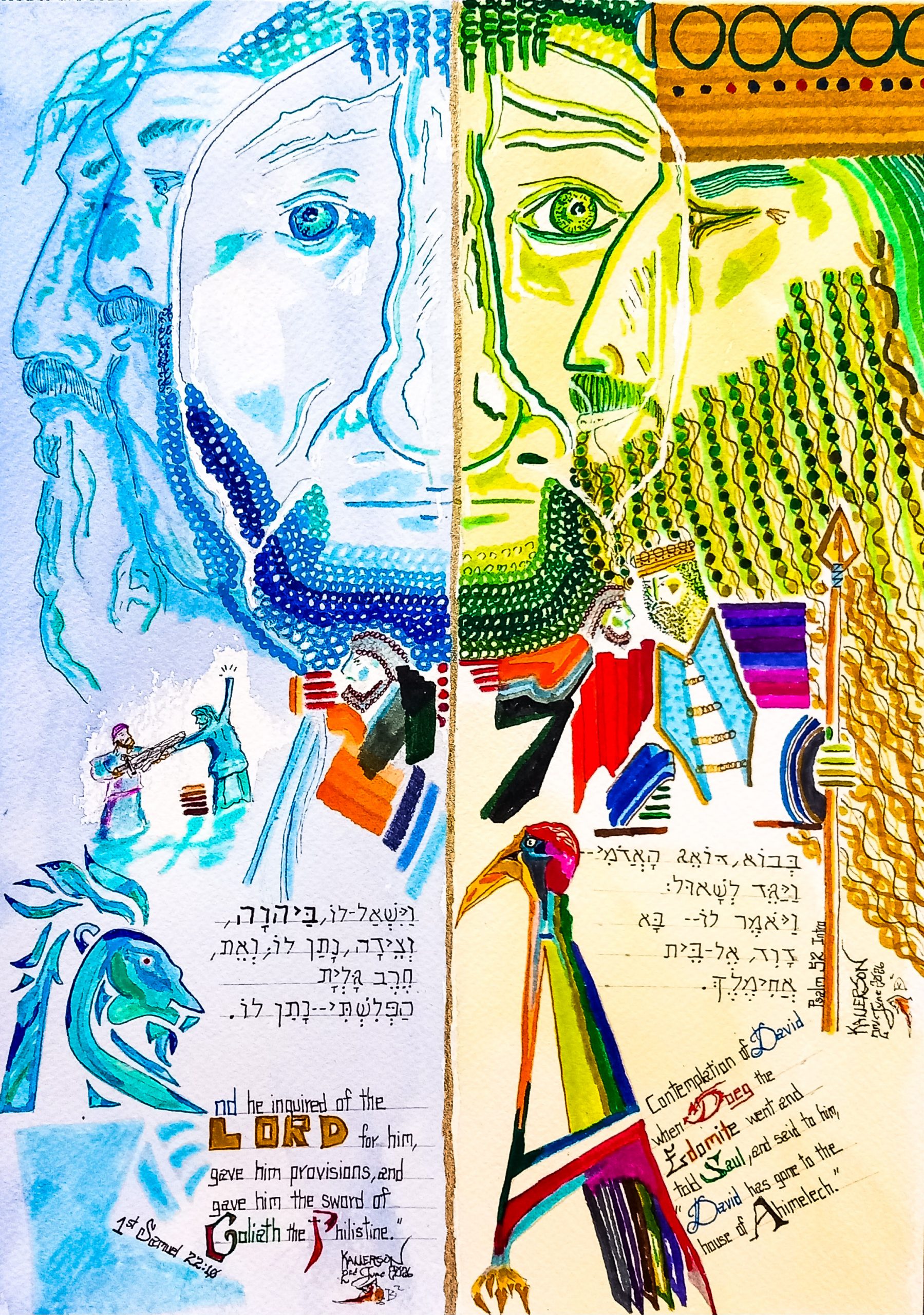
Artwork by Douglas Kallerson
1 Samuel 22:1-13
Doeg the Adomite, Part I
(Typed 26 January 2026) Gerry Rafferty was a Scottish musician born in 1947. He played with the Humblebums and Stealers Wheel before going solo. The song “Stuck in the Middle with You” was one of the more popular songs from Stealers Wheel. However, his real fame came when he released his solo album City to City.
Anyone who listened to the radio in the late seventies would have heard his songs playing. The song “Baker Street” continues to be played, and the video has tens of millions of views on YouTube.
Unfortunately, like Saul, he didn’t handle his exalted position very well. Although the Bible doesn’t give many specific details on Saul’s condition, one can imagine the parallels between the two. Rafferty descended into alcoholism, depression, and erratic, self-destructive behavior.
It is said he struggled with the pressures of fame and carried around personal demons. He would disappear from public view and hide in various locations. He drank himself to death in 2011. Studying the details of the life of Saul, one can see he, too, was filled with a host of mental problems, resulting in erratic behavior.
Text Verse: “To the ‘orchestrating.” Enlightening, to David, in going, Doeg the Adomite, and he caused to declare to Saul, and he said to him, ‘He went, David, unto ‘house, Ahimelech’.’” Introduction to Psalm 52 (CG)
Saul was already on edge before Doeg reported to Saul. His slide into mental instability made his attitude and actions afterward seem inevitable. Samuel warned the people about their desire for a king. Israel chose to have fallen men lead them rather than the Lord. Even after being presented with what they could expect from a king, they still shouted, “No! For lo! King, he will be upon us!” (1 Samuel 8:19) (CG).
From that time forward, kings came and went, but the majority of them were not great kings. And Saul was not the measure of what a great king would be. Rather, time and again in Kings and Chronicles, David is used as the standard for whether a king was a good one or not when their rule is described.
The kings were evaluated based on how they honored or failed to honor the Lord. Each of us will be evaluated in the same way. When we stand before Him, that one premise will be the deciding factor for every reward or loss we experience.
As we haven’t seen or personally interacted with the Lord, everything we are judged on will be based on our faith in Him. One doesn’t need faith when he has sight. But we are to live by faith that He is there, and He is a Rewarder of all who come to Him. Specifically, this means the things we do in this life, by faith.
This is a fixed and firm truth that is to be found in His superior word. And so, let us turn to that precious word once again, and… May God speak to us through His word today, and may His glorious name ever be praised.
I. In the Stronghold (verses 1-5)
David therefore departed from there
vayelekh David misham – “And he walked, David, from there.” Chapter 21 ended with the words of Achish, king of Gath, saying, “Behold! You will see man raving himself! To why you will cause to bring him unto me? Lacking being raved, I, that you caused to bring this to rave himself upon me? The this you will bring unto my house?”
These opening words of Chapter 22, unless they are not chronological but categorical, are referring to Gath. David means Beloved. David walked from there…
1 (con’t) and escaped to the cave of Adullam.
vayimalet el mearat adulam – “And he was eluded unto ‘Cave, Adullam’.” Adullam is in the Judean foothills, about 16-20 miles southwest of Jerusalem, near the Valley of Elah, where David slew Goliath. It is eastward and a bit south of Gath.
The meaning of Adullam is debated. Jones sees it as coming from the Arabic ‘dl, just and am, people. As such, he says, Justice of the People. The NOBSE and BDB identify is coming from the root ‘mum, a word leading to the thought of turning aside, and thus, Hiding or Seeking Refuge. Young’s says Resting Place.
However, Charlie takes another path. Adullam is mentioned in Micah 1, where the prophet uses puns to identify the names of many locations, such as –
“Therefore you shall give presents [shillukhim] to Moresheth [moresheth] Gath;
The houses of Achzib [akhziv] shall be a lie [akhsav] to the kings of Israel.
15 I will yet bring an heir [yarash] to you, O inhabitant of Mareshah [mareshah];
The glory of Israel shall come to [עַד] Adullam [עֲדֻלָּם].” Micah 1:14, 15
In these words, he says ad adulam, “unto Adullam.” If the name is a contraction of ad and olam (vanishment), a phrase common in Scripture, it would mean Unto Vanishment or Forever. That would fit with the idea of God’s glory noted in Micah. Sergio agreed with this assessment 🥳.
As for the mearah, cave, it is from ur to make naked. Thus, it signifies what is exposed or bare. In Joshua 10, it was used to signify the Torah, the five books of Moses.
1 (con’t) So when his brothers and all his father’s house heard it, they went down there to him.
vayishmeu ekhav vekhal beith aviv vayeredu elav shamah – “And they heard, his brothers and all ‘house, his father’, and they descended unto him there-ward.” If David’s family heard he was there, it means they were informed he was there.
In other words, David probably sent messengers to tell them that Saul was after him and, thus, would probably be coming after them. Along with them…
2 And everyone who was in distress, everyone who was in debt, and everyone who was discontented gathered to him.
vayithqabetsu elav kal ish matsoq vekhal ish asher lo noshe vekhal ish mar nephesh – “And they amassed themselves unto him, all ‘man, scrunch’, and all man who ‘to him, indebted’, and all ‘man, bitter soul’.” Along with his family, a hodge-podge collection of disaffected people joined up with David.
Maybe these people felt the brunt of Israel’s decision to call for a king. They realized that the little they had was being taken for Saul’s use, exactly as Samuel warned in Chapter 8 when the request was made.
A new word is used here, matsoq, a narrow place. It gives the sense of being pressed. A fun word to describe such a situation is the noun scrunch, the act or sound of scrunching. That is the result of being scrunched. Such people may have felt this way because of the laws set forth by the king.
Along with the scrunchies were the indebted, something that may have come about from tax systems set up by Saul, and those who were bitter in soul. Such people may have had family taken from them and put into servitude to the king, just as Samuel warned.
This is all speculation, but these people were not content with how things were going. They have put their lot in with David, a refugee from Saul. Therefore, it makes sense that Saul was the cause of their problems…
2 (con’t) So he became captain over them. And there were about four hundred men with him.
vayhi alehem lesar vayihyu imo kearba meoth ish – “And he was upon them to commander. And they were, with him, according to four hundreds man.” Despite being disaffected, David was able to bring them into a cohesive band of military men, signified by the word commander.
His bravery among Israel when he challenged the Philistine was remembered. His adeptness in leading his thousand men to battle would have been the subject of many talks. His natural ability to tactfully handle the aches and disaffected moans of others made him a reasonable man to be listened to and obeyed.
Four hundred is a derivative of four, the number of creation and the world (and city) number, and ten, which signifies “Completeness of order, marking the entire round of anything … It implies that nothing is wanting; that the number and order are perfect; that the whole cycle is complete” (Bullinger).
It is also a derivative of forty and ten. Forty is described by Bullinger –
“It is the product of 5 and 8, and points to the action of grace (5), leading to and ending in revival and renewal (8). This is certainly the case where forty relates to a period of evident probation. But where it relates to enlarged dominion, or to renewed or extended rule, then it does so in virtue of its factors 4 and 10, and in harmony with their signification.”
As for those who should not be conjoined with a band of armed men…
3 Then David went from there to Mizpah of Moab;
vayelekh David misham mitspeh moav – “And he walked, David, from there – ‘Mizpah, Moab’.” Mizpah Moab is found only here in Scripture. Its location is unknown. However, Mizpah means Watchtower. Therefore, it would have been a place in a prominent location.
This means that David is now dwelling in the land of Moab, at this particular location. Reading the whole verse at once, it makes it sound like he took his parents to the king who was residing at Mizpah Moab, but that is not the case. David is staying there instead of in Cave Adullam.
Moab means From Father.
3 (con’t) and he said to the king of Moab, “Please let my father and mother come here with you, till I know what God will do for me.”
vayomer el melekh moav yetse na avi veimi itekhem ad asher eda mah yaaseh li elohim – “And he said unto ‘king, Moab’, “You will bring out, pray, my father and my mother with you until which I will know what He will do to me – God.” This is a new sentence within the verse. David is in Mizpah Moab, which will be called “the stronghold” in the next verse. While there, he wants to disencumber himself of the added burden of tending to his parents.
Because of this, he contacted the king of Moab, asking him to take charge of his parents while he was in Mizpah Moab. The reason David could communicate so naturally with the king of Moab is two-fold.
First, he was descended from Ruth, the Moabitess. Jesse, his father, was her grandson. Second, it said in 1 Samuel 14:47 that Saul fought Moab as an enemy. The old adage “The enemy of my enemy is my friend” would have applied to David who was hated by Saul.
Therefore, David made this appeal for his parents, asking the king to keep them by his side when he went out in the land, meaning while David continued to learn what God had planned for him.
4 So he brought them before the king of Moab, and they dwelt with him
vayankhem eth pene melekh moav vayeshevu imo – “And he caused to guide them – faces ‘king, Moab’, and they sat with him.” The words tell us that the king of Moab agreed to David’s request. Therefore, he entrusted his parents to the care of the king of Moab while he remained in Mizpah Moab, as is seen in the next words…
4 (con’t) all the time that David was in the stronghold.
kal yeme heyoth David bametsudah – “all days was David in the stronghold.” As can be seen when the sentences and clauses are rightly divided, David’s location is in Mizpah Moab, a different place than where his parents are. This location is identified with a new word in Scripture, matsud, a stronghold.
It is cognate to matsod, a net, and thus by implication a bulwark or hold. Both are derived from the verb tsud, to lie alongside (as in waiting for prey). Therefore, it signifies to hunt.
5 Now the prophet Gad said to David,
vayomer gad ha’navi el David – “And he said, Gad the prophet, unto David.” Gad is introduced here. He is only seen once in 1 Samuel, but he will also be seen five times in 2 Samuel 24 as well as in the Chronicles. In 2 Samuel 24, he is noted as David’s khozeh, gazer.
Gad is derived from gadad, to cut, invade, or expose. It is generally believed to mean Fortune, Good Luck, or something similar, but Abarim rightly states it is “a fortune for which a troublesome, invasive effort is made.” Gad’s words to David are…
5 (con’t) “Do not stay in the stronghold; depart, and go to the land of Judah.”
lo theshev bametsudah lekh u-vatha lekha erets Yehudah – “Not you will sit in the stronghold. You must walk, and you went to you – land Judah.” This confirms that the stronghold is Mizpah Moab. David is dwelling outside of the land of Israel, as he did when he was in Gath of the Philistines. He wanted a national border to separate him from Saul.
However, he wanted to “know what He will do to me – God.” Gad, the prophet, provided him an answer, which is to set his feet in the direction of Judah.
Judah means Praise. Because of Gad’s instruction…
5 (con’t) So David departed and went into the forest of Hereth.
vayelekh David vayavo yaar khareth – “And he walked, David, and he went ‘Forest, Hareth’.” This location is found only here in the Bible. The name is derived from kharath, to engrave. That word was only seen once, as well –
“And the tablets, work God, they. And the writing, writing God, it. Engraved [khareth] upon the tablets.” Exodus 32:16 (CG)
As for the yaar, forest, Abarim notes the following –
“The verb יער (ya’ar) isn’t used in the Bible and it’s a complete mystery what it might have meant. Noun יער (ya’ar) is the common word for forest or thicket, and the identical noun יער (ya’ar) means honeycomb. It is, of course, perfectly possible that these two nouns are not two but one, describing something general like a thing that consists of many elements, which contain energetic nutrients (either fruits or honey) …” Abarim
Young, in agreement with Strong, identifies the name with the cognate word khoresh, forest or wooded. He says Thicket. Jones says A Cutting. Charlie says Engraved.
Eyes on the Lord, not on oneself
This is the way to keep things right
Let us take our self-worth and put it on a shelf
Let us keep Jesus in our sight
When we have troubles or trials
We should fix our eyes on Jesus
And when our life is filled with smiles
Let us remember what He has done for us
Being haughty and filled with pride in self
Our eyes are misdirected from what is right
Let us take this attitude and put it on a shelf
Jesus! Let us always keep Jesus in our sight
II. Behold Me, My Lord (verses 6-13)
6 When Saul heard that David and the men who were with him had been discovered—
vayishma shaul ki noda David vaanashim asher ito – “And he heard, Saul, for he was known, David, and mortals who ‘with him’.” One might wonder why the Lord told Gad that David should return to Judah if Saul was sure to find out his location.
The answer is that the Lord was directing David’s steps. In this, He will reveal details in typology of future events. At the same time, David’s life is being prepared for his reign as king through his interactions with Saul. God is directing both men to meet His purposes in the ongoing stream of redemptive history.
Saul means Asked, but the spelling is identical to Sheol. One can think of the pit asking for the souls of men.
6 (con’t) now Saul was staying in Gibeah under a tamarisk tree in Ramah,
veshaul yoshev bagivah takhath ha’eshel baramah – “And Saul, sitting in the Gibeah under the tamarisk in the height.” A large number of translations agree with the NKJV and say, “in Ramah.” However, Gibeah is about seven miles south of Ramah. Saul was a big guy, but he wasn’t that big.
Rather, the word ramah, height, is being used in a new way to indicate a high place. It will be used four more times this way in Ezekiel.
This is the second of three times eshel, tamarisk, will be seen. The first was in Genesis 21:33 when Abraham planted a tamarisk and called on the Lord, the Everlasting God. The last use of the word will be in chapter 31 when the bones of Saul and his sons will be buried under a tamarisk in Jabesh.
Because of Abraham’s actions in Genesis 21, we can infer that the significance of the tamarisk is permanence and reliability.
6 (con’t) with his spear in his hand, and all his servants standing about him—
vakhanito veyado vekhal avadav nitsavim alav – “And his spear, in his hand, and all his servants ‘being stationed upon him’.” The scene is that of the seat of power and authority, similar to Deborah sitting under the palm in the area between Bethel and Ramah. Saul has called a council because David has been located.
The spear is the symbol of Saul’s authority. However, the word khanith, spear, is identical to the feminine word meaning grace.
7 then Saul said to his servants who stood about him, “Hear now, you Benjamites!
Rather: vayomer shaul laavadav hanitsavim alav shimu na bene yemini – “And he said, Saul to his servants, the ‘being stationed upon him,’ ‘You must hear, pray, sons Right.” There is no justification for translating this as Benjamites. The plural marker is on “sons.” Also, as in verses 9:1 and 9:4, the word yemini, right, is a singular proper noun.
This may be a way of identifying all of Saul’s men, regardless of tribal affiliation, as being on the right, even when not Benjamites. Whatever his intent, saying Benjamites, as almost all translations do, damages the intent. To these “sons Right,” Saul asks…
7 (con’t) Will the son of Jesse give every one of you fields and vineyards,
gam lekhulekhem yiten ben Yishai sadoth ukheramim – “Also, to you all he will give, ‘son, Jesse’, fields and vineyards?” The word “also” is being used as the initiator of a question, as in “Will he,” rather than a statement of assurance, as in “He will also give…”
In other words, Saul has done exactly what Samuel warned about, taking the property of the people and passing it out to his chosen select attendees –
“And your fields, and your vineyards, and your olives – the good, he will take and he gave to his servants.” 1 Samuel 8:14
The Lord, through Samuel, told the people what to expect. They would get a leader who would be partial to some and unfavorable toward others. Saul has exactingly lived up to those words.
Jesse means Yehovah Exists.
The thought of Saul’s partiality continues…
7 (con’t) and make you all captains of thousands and captains of hundreds?
lekhulekhem yasim sare alaphim vesare meoth – “To you all he will put commanders thousands, and commanders hundreds?” Samuel likewise mentioned this in his address to the people –
“Your sons he will take, and … put to him commanders thousands and commanders fifties.” 1 Samuel 8:11, 12
This is great for those who are appointed to the position of commander, but the families from whom they are taken would have had no choice in the matter.
Saul was using his authority to sway those under his command to feel sorry for him. He wanted to dissuade them from any thought of forsaking him and taking a stand with David.
And more, he is actually concerned that they have formed a conspiracy against him. Thus, his delusions were not only focused on David, his main enemy, but anyone who was not actively rubbing Saul’s back and expending his energies for the sake of his king…
8 All of you have conspired against me,
ki qeshartem kulekhem alay – “For you tied, you all, upon me.” The word “tied” does not refer to them tying up (binding) Saul. Rather, it expresses uniting in a league, binding together in the form of a treasonous conspiracy.
Saul is certain that the people should have been able to weed David out and eliminate him since he is back in Judah. Therefore, because this wasn’t done, his own subjects must want it that way. This is evident to him because…
8 (con’t) and there is no one who reveals to me that my son has made a covenant with the son of Jesse;
vein goleh eth azeni bikhrath beni im ben Yishai – “And naught denuding my ear in cut, my son, with son Jesse.” There is no reason to assume that the covenant between Jonathan and David in Chapter 20 was known to anyone else, including Saul.
Rather, Saul assumes that because Jonathan stood up for David, they had cut a covenant. Because of this, he is certain those with him could not be so blind as to not know it as well. He is projecting his own cogitations on those under him.
8 (con’t) and there is not one of you who is sorry for me or reveals to me
veein kholeh mikem alay vegoleh eth azeni – “And naught ‘being rubbed’ from you upon me and denuding my ear.” The NKJV gives a suitable paraphrase of the intent. The word khalah, rubbed, signifies being worn out, sick, worried, etc. A more suitable paraphrase would be, “None of you are worried sick for me about this issue…”
Saul has gone from being a brave fighting man to a deluded, neurotic wimp who shudders over every little thing as if his life were the whole purpose for the existence of the universe.
He is certain that David and his son cut a covenant and that everyone else was aware of it but failed to tell him because…
8 (con’t) that my son has stirred up my servant against me, to lie in wait, as it is this day.”
ki heqim beni eth avdi alay leorev kayom hazeh – “For he caused to rise my son, my servant, upon me to lurk according to the day, the this.” This tells us that Saul is only speculating. Nothing like this was covenanted between Jonathan and David. And more, both Jonathan and David have been the epitome of faithful servants and soldiers to Saul.
He is delusional and expects those around him to coddle him with words of encouragement and fidelity. Instead, he will get words from a bootlicker that will lead to the catastrophic downfall of many men…
9 Then answered Doeg the Edomite, who was set over the servants of Saul,
vayaan doeg ha’adomi vehu nitsav al avde shaul – “And he answered, Doeg the Adomite, and he ‘being stationed’ upon ‘servants, Saul’.” The form of the verb natsav, to station, is used many times followed by the word al, upon. The meaning is quite often “with” or “next to,” although it can mean “on top of.”
There is no need to assume that he was over the servants of Saul. He was one of them, standing with them before Saul. He is just one of Saul’s lackeys, and he knows his words will end in disaster for others. David even confirms this in verse 22.
Doeg is from daag, to be or become anxious. Thus, his name means Anxious or Fearful. Adomi comes from adom, red or ruddy. Thus, he is the Red One.
9 (con’t) and said, “I saw the son of Jesse going to Nob, to Ahimelech the son of Ahitub.
vayomar raithi eth ben Yishai ba noveh el akhimelekh ben akhituv – “And he said, ‘I saw ‘son, Jesse’ going Nob-ward unto Ahimelech, ‘son, Ahitub’.’” It is a true statement. However, it is information that, when presented, will only stir Saul’s madness even more.
David understood this and wrote this about him in Psalm 52 –
“Why do you boast in evil, O mighty man?
The goodness of God endures continually.
2 Your tongue devises destruction,
Like a sharp razor, working deceitfully.
3 You love evil more than good,
Lying rather than speaking righteousness. Selah
4 You love all devouring words,
You deceitful tongue.” Psalm 52:1-4
Jesse means Yehovah Exists. But it also means My Husband. As such, the name Jesse contains the weighty notion that human marriage reflects divine revelation.
Strong’s says Nob means Fruit, coming from nob, to flourish. This can be real fruit or figurative, such as the fruit of the lips, meaning praise, etc. Abarim has the source as nabah, to be high or prominent. They define it as Height or High Place. Ahimelech means My Brother Is King, Brother of the King, or something similar. Ahitub means My Brother Is Goodness or Brother of Goodness.
Doeg, knowing that his words will lead to devouring others, continues…
10 And he inquired of the Lord for him,
vayishal lo Yehovah – “And he asked to him in Yehovah.” Nothing is recorded about this. When confronted with it, Ahimelech will not deny it. Rather, he will note that this was a common occurrence. Despite this, it is something that will immediately set Saul on a bad path.
If the high priest asked for guidance for David, Saul would assume he would also know that David was a renegade by whatever answer was given. This would be considered abetting a fugitive for not letting Saul know.
10 (con’t) gave him provisions,
vetsedah nathan lo – “And provision he gave to him.” Along with abetting David, Ahimelech also aided him in his flight by giving him food. One can see Saul clenching his fists, grinding his teeth, and making that angry mrrrrrrr sound that dogs do when they get miffed. And more…
10 (con’t and gave him the sword of Goliath the Philistine.”
veeth kherev galeyath ha’pelishti nathan lo – “and ‘sword, Goliath, the Philistine’, he gave to him.” This is true, and it would have set Saul off even more. Allowing David to have the sword that he used to cut off the Philistine’s head would make him seem invincible to those he encountered. It would be the highest status symbol for him as a warrior to possess.
The word sword, kherev, has the same spelling as Horeb, the mountain of God. It is used consistently to picture the law.
Goliath means Exposer with a secondary meaning of Exiler.
Philistine means Weakener. Goliath, being called “the Philistine,” means he is the main Weakener, typical of Satan who uses law to destroy humanity’s relationship with God.
11 So the king sent to call Ahimelech the priest, the son of Ahitub, and all his father’s house, the priests who were in Nob. And they all came to the king.
vayishlakh ha’melekh liqro eth akhimelekh ben akhituv ha’kohen veeth kal beith aviv ha’kohanim asher benov vayavou khulam el ha’melekh – “And he sent, the king, to call Ahimelech, ‘son, Ahitub’ the priest, and all ‘house, his father’, the priests who in Nob. And they came, they all, unto the king.” Instead of going to Nob, Saul called the priests to come to him. All of them.
That does not bode well. If he was concerned about fairness in his accusations, he would have called Ahimelech, the only person who was spoken of by Doeg.
It seems that Saul purposed to do what he would do from the moment he heard Doeg’s news. Calling the priests to him would leave them totally vulnerable to whatever Saul decided. They would be defenseless, surrounded by Saul’s men, with no place they could flee without being cut down.
Saul would have been stewing the entire time it took to send men to get the priests and bring them to him. By now, he would be completely unhinged. His attitude can easily be seen in the manner he addresses Ahimelech…
12 And Saul said, “Hear now, son of Ahitub!”
vayomer shaul shema na ben akhituv – “And he said, Saul, ‘You must hear, pray, son Ahitub.’” The imperative verb and the use of the name Ahitub, Ahimelech’s father, sets a sore and nasty tone when talking to the high priest. Saul is abrupt, discourteous, and demeaning right off the bat. On the contrary, Ahimelech’s response is just the opposite…
12 (con’t) He answered, “Here I am, my lord.”
vayomer hineni adoni – “And he said, ‘Behold me, my lord.’” Ahimelech doesn’t jump on Saul as he could have. Being the high priest, he had the same type of anointing as Saul did. He could have responded just as curtly, but he instead acknowledges Saul’s presence while calling him lord.
This doesn’t calm him down a bit. Saul begins raking Ahimelech over the coals instead of quietly and politely asking for his view of what took place…
13 Then Saul said to him, “Why have you conspired against me, you and the son of Jesse,
vayomer elo shaul lamah qeshartem alay atah u-ven Yishai – “And he said unto him [k.], Saul, ‘To why you tied upon me, you and ‘son, Jesse’.’” There is a difference in the written and oral Hebrew. The written says elo, while the oral says elav. The difference is the lack of a single letter, a yod. The meaning remains the same, however.
It could be a copyist’s error, or it may be that dropping the yod has significance. Whatever the intent, Saul uses the same charge towards his men that he now accuses Ahimelech of, conspiracy against his authority.
Calling David “the son of Jesse” accentuates this, just as in the previous verse when Saul called Ahimelech the son of Ahitub. With his rude accusation stated, he next provides the charges…
13 (con’t) in that you have given him bread and a sword, and have inquired of God for him,
betitekha lo lekhem vekherev veshaol lo belohim “in your giving to him bread, and sword, and asking to him in God.” The three things stated by Doeg are considered sufficient to accuse the priest of treason. Saul has accused Ahimelech without even obtaining a statement from him first.
The decision concerning the matter is already concluded in Saul’s mind. Ahimelech’s actions were treasonous, so…
*13 (fin) that he should rise against me, to lie in wait, as it is this day?”
laqum elay leorev kayom ha’zeh – “to rise unto me to lurk according to the day, the this?” The charge is not for helping David flee for his life, but for providing David with supplies and a weapon in order to enable him to come against Saul.
This dismisses the fact that Saul is surrounded by his men. In other words, he feels they are inept and unable to secure his life against a single enemy, and that Ahimelech has made this possible.
Like the radical left protestors in the US, fighting against the legally established government officials in the lawful execution of their duties by removing violent criminal aliens from the society, Saul has lost all sense of reason.
He has reduced himself to a state of animal instinct, biting at anything he sees as the slightest threat to himself. Such a state can happen to anyone when he exalts himself and his supposed importance above what is normal for humans. With such an attitude, a state of mental instability can creep in and bring real harm to us.
We will have to wait to find out what the result of Saul’s madness will mean for the priests. For now, we can consider that without the fear of the Lord and the restraint on our lives that comes from applying the Bible to our lives, we are all capable of going off the deep end.
Looking around at the ungodly cities and states of America, we can see an attitude similar to Saul. All restraint is cast off, there are unjust leaders and judges, and the people who are being obedient to the Lord are in their crosshairs.
Things didn’t start that way. But as the word of the Lord and biblical Christianity have been pushed out of our lives, such conduct is the inevitable result. Eventually, a catastrophe like 9/11 may happen, and the people will seek God as they always do.
But depending on when in the stream of time such an event occurs, it may be too late. There is a point where God’s tolerance of human wickedness will reach its end.
Until then, it is our job to hold fast to the word, keep telling others that there is a better way, and pray for direction and wisdom in ourselves and in those who so desperately need Jesus. May we be about His business while the day of God’s favor is here.
Closing Verse: “Here is the man who did not make God his strength,
But trusted in the abundance of his riches,
And strengthened himself in his wickedness.” Psalm 52:7
Next Week: 1 Samuel 22:14-23 The guy is a biblical blight, it’s true… (Doeg the Adomite, Part II) (48th 1 Samuel sermon)
The Lord has you exactly where He wants you. He has a good plan and purpose for you. He is the One who abases the haughty and exalts the humble. He regards the lowly, and the proud, He knows from afar. So yield yourself to Him, trust Him, and believe His word. In this, He will do great things for you and through you.
1 Samuel 22:1-13 (CG)
And he walked, David, from there. And he was eluded unto ‘Cave, Adullam’. And they heard, his brothers, and all ‘house, his father’, and they descended unto him there-ward. 2And they amassed themselves unto him, all ‘man, scrunch’*, and all man who ‘to him, indebted’, and all ‘man, bitter soul’. And he was upon them to commander. And they were, with him, according to four hundreds man.
3And he walked, David, from there – ‘Mizpah, Moab.’ And he said unto ‘king, Moab’, “You will bring out, pray, my father and my mother with you until which I will know what He will do to me – God?” 4And he caused to guide them – faces ‘king, Moab’, and they sat with him all days was David in the stronghold.
5And he said, Gad the prophet, unto David, “Not you will sit in the stronghold. You must walk, and you will go to you – land Judah.” And he walked, David, and he went – ‘Forest, Hareth’.
6And he heard, Saul, for he was known, David, and mortals who ‘with him’. And Saul, sitting in the Gibeah under the tamarisk in the height. And his spear, in his hand, and all his servants ‘being stationed upon him’. 7And he said, Saul to his servants, the ‘being stationed upon him’, “You must hear, pray, sons Right. Also, to you all he will give, ‘son, Jesse’, fields and vineyards? To you all he will put commanders thousands, and commanders hundreds? 8For you tied, you all, upon me. And naught denuding my ear in cut*, my son, with son Jesse. And naught ‘being rubbed’ from you upon me and denuding my ear. For he caused to rise my son, my servant, upon me to lurk according to the day, the this.”
9And he answered, Doeg the Adomite, and he ‘being stationed’ upon ‘servants, Saul’. And he said, “I saw ‘son, Jesse’ going Nob-ward unto Ahimelech, ‘son, Ahitub’. 10And he asked to him in Yehovah. And provision he gave to him, and ‘sword, Goliath, the Philistine’, he gave to him.”
11And he sent, the king, to call Ahimelech, ‘son, Ahitub’ the priest, and all ‘house, his father’, the priests who in Nob. And they came, they all, unto the king. 12And he said, Saul, “You must hear, pray, son Ahitub.”
And he said, “Behold me, my lord.”
13And he said unto him [k.], Saul, “To why you tied upon me, you and ‘son, Jesse’, in your giving to him bread, and sword, and asking to him in God, to rise unto me to lurk according to the day, the this?”
1 Samuel 22:1-13 (NKJV)
David therefore departed from there and escaped to the cave of Adullam. So when his brothers and all his father’s house heard it, they went down there to him. 2 And everyone who was in distress, everyone who was in debt, and everyone who was discontented gathered to him. So he became captain over them. And there were about four hundred men with him.
3 Then David went from there to Mizpah of Moab; and he said to the king of Moab, “Please let my father and mother come here with you, till I know what God will do for me.” 4 So he brought them before the king of Moab, and they dwelt with him all the time that David was in the stronghold.
5 Now the prophet Gad said to David, “Do not stay in the stronghold; depart, and go to the land of Judah.” So David departed and went into the forest of Hereth.
6 When Saul heard that David and the men who were with him had been discovered—now Saul was staying in Gibeah under a tamarisk tree in Ramah, with his spear in his hand, and all his servants standing about him— 7 then Saul said to his servants who stood about him, “Hear now, you Benjamites! Will the son of Jesse give every one of you fields and vineyards, and make you all captains of thousands and captains of hundreds? 8 All of you have conspired against me, and there is no one who reveals to me that my son has made a covenant with the son of Jesse; and there is not one of you who is sorry for me or reveals to me that my son has stirred up my servant against me, to lie in wait, as it is this day.”
9 Then answered Doeg the Edomite, who was set over the servants of Saul, and said, “I saw the son of Jesse going to Nob, to Ahimelech the son of Ahitub. 10 And he inquired of the Lord for him, gave him provisions, and gave him the sword of Goliath the Philistine.”
11 So the king sent to call Ahimelech the priest, the son of Ahitub, and all his father’s house, the priests who were in Nob. And they all came to the king. 12 And Saul said, “Hear now, son of Ahitub!”
He answered, “Here I am, my lord.”
13 Then Saul said to him, “To why have you conspired against me, you and the son of Jesse, in that you have given him bread and a sword, and have inquired of God for him, that he should rise against me, to lie in wait, as it is this day?”