
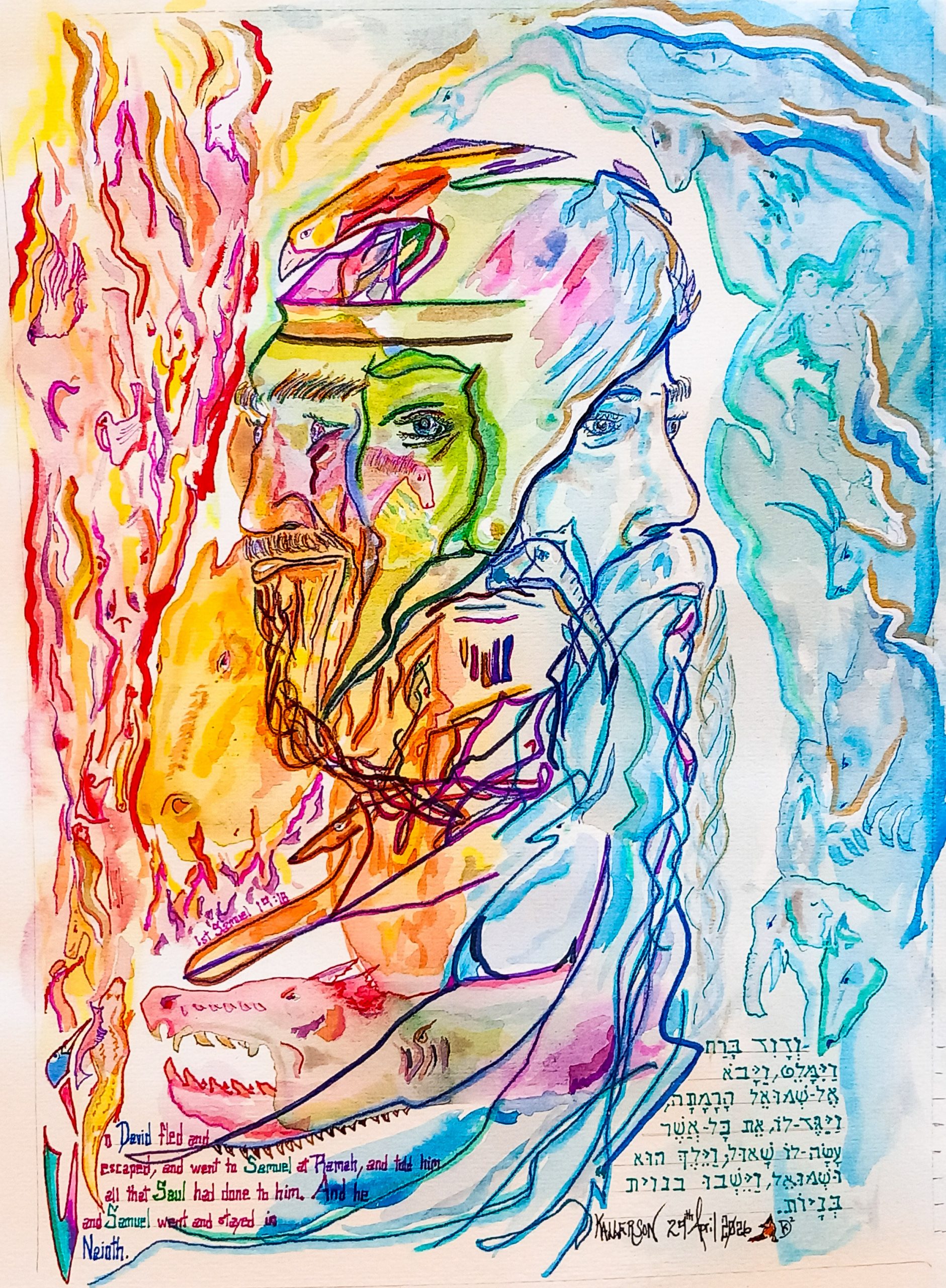
Artwork by Douglas Kallerson
1 Samuel 19:15-24
He Set His Soul in His Palm, Part II
(Typed 22 December 2025) In 1 Samuel, there have been six times that indicate a “spirit” came upon Saul to replace the Spirit of the Lord that once rested upon him. The word used to describe this spirit is ra’ah, evil.
Most translations go with that and say, “evil spirit.” Attempting to get around the obvious theological difficulty of God sending an evil spirit, some change the wording to “distressing spirit” or something similar.
That conveniently changes the intent, but it doesn’t resolve what the Hebrew says. A couple of times, it specifically says that this was an evil spirit “from God.” In 1 Samuel 19:9, it said –
“Now the distressing spirit from the Lord came upon Saul as he sat in his house with his spear in his hand. And David was playing music with his hand.” (NKJV)
Saying this was an evil (or distressing) spirit from the Lord is such a difficult thing to accept that Charles Ellicott said in his commentary for 1 Samuel 19:9 –
“The LXX. [the Greek translation of the Old Testament] was offended at the statement “evil spirit of (or from) Jehovah,” and cuts the knot by leaving out “Jehovah.” It is, no doubt, a hard saying, and no human expositor has ever yet been able fully to explain it.” Charles Ellicott
I don’t know if anyone else has evaluated this thought as I did, but I can find no translation that uses the word breath rather than spirit. Extensive explanation for this was given in the analysis of 1 Samuel 16, and it fully explains the matter.
Text Verse: “But you must continue in the things which you have learned and been assured of, knowing from whom you have learned them, 15 and that from childhood you have known the Holy Scriptures, which are able to make you wise for salvation through faith which is in Christ Jesus.” 2 Timothy 3:14, 15
There is so much going on in Scripture that none of us will ever be able to fully understand it all. Just when we think we have a passage figured out, someone comes along and adds in some little nugget we never even considered.
However, the more we are in the Bible, reading it, contemplating it, and meditating on it, the more we will be able to grasp the truths contained in it. I would caution you not to get stuck on a single translation.
So far in this chapter, we have already come across numerous errors in the NKJV that follow blunders in the KJV. When comparing the Hebrew with the English, more inconsistencies are seen.
It isn’t that there are just translational errors, but there are missing words necessary to understand typology, faulty structure in the English, which leads to misunderstanding the intent, and other errors to be found in translations.
By reading more than one translation and checking against the original, which is not difficult with modern technology, the word can be more readily evaluated and understood. The more time you put into the word, the greater the reward you will receive from it.
This grand truth is specifically taught in His superior word. And so, let us turn to that precious word once again, and… May God speak to us through His word today, and may His glorious name ever be praised.
I. He Was Eluded (verses 15-18)
15 Then Saul sent the messengers back to see David,
vayishlakh shaul eth ha’malakhim liroth eth David – “And he sent, Saul, the messengers to see David.” There is a literary gap between verses 14 and 15. Saul sent the messengers to take David. Michal said he was sick. Without any explanation of their return and report, Saul again sends them –
14And he sent, Saul, messengers to take David. And she said, “Rubbed he.”
15And he sent, Saul, the messengers to see David…
This abruptness of the narrative suggests that Saul didn’t trust his daughter’s testimony. He senses a conspiracy in relation to everything associated with David, whether it is him personally, Jonathan, his son, or Michal, his daughter. This extends to all who interact with David.
Saul means Asked. David means Beloved.
15 (con’t) saying, “Bring him up to me in the bed,
lemor haalu oto vamitah elay – “to say, ‘You must cause to ascend him in the bed unto me.’” Saul doesn’t care if Michal’s words are true. He intends to have David brought to him, even if he is on his sick bed. Being sick was the least of David’s worries at this point…
15 (con’t) that I may kill him.”
lahamitho – “to cause to kill him.” Saul intended to be rid of David that day. He had become completely possessed by this desire.
16 And when the messengers had come in, there was the image in the bed, with a cover of goats’ hair for his head.
vayavou ha’malakhim vehineh ha’teraphim el ha’mitah u-khevir ha’izim merashotav – “And they went, the messengers. And behold! The teraphim unto the bed, and ‘quilt, the goats’ – his headpieces.” The personal inspection of “David” reveals an embarrassing situation. Michal has been dishonest toward her own father for David’s sake. Her ruse delayed his capture, allowing David a lengthy head start in his escape.
17 Then Saul said to Michal, “Why have you deceived me like this, and sent my enemy away, so that he has escaped?”
vayomer shaul el mikhal lamah kakhah rimithini vateshalekhi eth oyevi vayimalet – “And he said, Saul, unto Michal, ‘To why just so you hurled me, and you sent my hating, and he was eluded?’” We can be sure that Michal had heard of Saul’s determination to kill Jonathan when he thought Jonathan’s tasting of the honey in the forest caused the Lord to turn away from responding to Saul’s petitions (1 Samuel 14:36-45).
If he was willing to allow Jonathan to be executed over such dubious circumstances, Michal would know her life was one misspoken word away from ending.
Genesis 2:24 explains that a man and a woman become one flesh. This is a bond above the allegiances a person has toward his parents, but this would not be acceptable in Saul’s mind.
Michal means Who Is Like God. Her fear was great enough to lie to her own father, therefore…
17 (con’t) And Michal answered Saul, “He said to me, ‘Let me go! Why should I kill you?’”
Her response is emphatic: vatomer mikhal el shaul hu amar elay shalekhini lamah amithekh – “And she said, Michal, unto Saul, ‘He, he said unto me, “You must send me! To why I will cause to kill you?”’” The emphasis, combined with the emphatic verb, “You must send me,” is a plea for leniency. “I know it was wrong, but my life was threatened. It’s all his fault. Daddy, he was going to kill me!”
Despite lying, anything less would have ended badly for her. In the meantime..
18 So David fled and escaped, and went to Samuel at Ramah,
Rather: vedavid barakh vayimalet vayavo el shemuel ha’ramathah – “And David, he bolted, and he was eluded, and he went unto Samuel the Ramah-ward.” Despite being a great warrior, David was probably unsure about what to do. He couldn’t take on the entire Israelite army, and he would never be able to defend himself from the personal attacks of Saul in the eyes of his comrades.
He went to Samuel, who hasn’t been mentioned since David’s anointing in verse 16:13. Samuel anointed David, and would have the word of the Lord available to guide David through the uncertain waters he was facing.
Samuel means Asked from God. Ramah is identical to ramah, height, high place, or exalted. It is from rum, to be high or to exalt. It means The Height, The Lofty, or The Exalted.
18 (con’t) and told him all that Saul had done to him.
vayaged lo eth kal asher asah lo shaul – “And he caused to declare to him all which he did to him, Saul.” David’s explanation would be readily accepted by Samuel, who already knew Saul’s many faults. He also knew that the Lord had chosen David to replace Saul, as well as the exploits of David. Therefore, there would be no reason for Samuel to question the integrity of David or his truthfulness.
As for the location, David went to Samuel “the Ramah-ward,” meaning toward the Ramah. However, the two of them went to a particular spot there…
18 (con’t) And he and Samuel went and stayed in Naioth.
vayelekh hu u-shemuel vayeshevu benoith – “And he walked, he and Samuel. And they sat in habitations [k.].” The written and the oral Hebrew are different. The written is debated. It says nevayoth, habitations, or Navith, Residence (Strong’s 5121). The same spelling can be considered either way. The oral changes the name to Naioth, which means Habitations. That change will occur six times in this chapter.
If it is a plural noun, then “And they sat in habitations” might mean that they dwelt in an area like a communal community, such as where prophets lived together. This seems likely based on what occurs in the coming verses.
Regardless, the roots are all ultimately derived from navah, to rest in the sense of keeping at home or preparing a habitation.
The first use of the word is found in Exodus 15:2, where it says –
“My strength and orchestra – Yah,
And he became to me to salvation,
This – my God, and I will cause to habitate Him [navah],
God, my father, and I will exalt Him.” Exodus 15:2
Whichever is correct, it was a place that others, including Saul, would know of…
When Adam fell, death spread to all men
And so all in Adam die
When our numbered days are finished, it is over… and then
Where do we go? Up to the sky?
We who have trusted in the Lord Jesus Christ
Are set to die unless the rapture happens first
But with His shed blood, our souls were priced
And so, death in us will surely be reversed
God promises that it is so
We have no need to doubt that it is true
Because of Jesus, we can fully know
That to us eternal life God will endue
II. Also, He (verses 19-24)
19 Now it was told Saul, saying, “Take note, David is at Naioth in Ramah!”
vayugad leshaul lemor hineh David benoith baramah – “And it was caused to declare to Saul, to say, ‘Behold! David in habitations [k.] in the Ramah.’” Again, the narrative gets straight to the point, omitting information along the way. There is no note of how Saul knew where David was. Saul proclaims it as a known fact. He takes action to resolve the matter…
20 Then Saul sent messengers to take David.
vayishlakh shaul malakhim laqakhath eth David – “And he sent, Saul, messengers to take David.” With David located, it was Saul’s intent to have him returned for execution. However, his attempts will be frustrated…
20 (con’t) And when they saw the group of prophets prophesying,
Rather: vayar eth lahaqath haneveim nibeim “And he saw ‘gathering, the prophets’ being prophesied.” First, it says, “he saw,” not “they saw.” The Pulpit Commentary says, “…as all the versions have the plural, it is probably a mere mistake.” That makes no sense. A version is rendered out of the Hebrew, not the other way around. Multiple Hebrew manuscripts say “he.”
The meaning is probably that David, the nearest antecedent, is being referred to. He saw what was going on as the messengers came to retrieve him. David had fled to Samuel. The Lord, through what is occurring, is assuring David that things will be ok.
And more, the verb is passive. The prophets were “being prophesied.” A unique word is seen in this clause, lahaqah, a gathering or assembly. It is believed to come from an unused root meaning to gather.
This group was gathered and being prophesied. This tells David that the Lord is present and actively involved in what is happening. Further…
20 (con’t) and Samuel standing as leader over them,
u-shemuel omed nitsav alehem – “and Samuel standing, being stationed upon them.” In other words, the prophets are ‘being prophesied’ and Samuel is as well. Saying he is “being stationed tells us that these things were happening by the influence of the Lord. This is seen in the next words…
20 (con’t) the Spirit of God came upon the messengers of Saul, and they also prophesied.
vatehi al malakhe shaul ruakh elohim vayithnabeu gam hemah – “And it was, upon the ‘messengers, Saul’, ‘Spirit, God’, and they prophesied themselves, also they.” This confirms that “he saw” in the previous clause was referring to David, not the messengers. Otherwise, there is no need to repeat “the messengers Saul.”
Rather, David is watching all these things going on around him, which includes those sent to retrieve him being overshadowed by God’s Spirit. Although they are not prophets, they too began to “prophesy themselves.”
The reflexive verb solidifies the notion that they were not merely excited and joined in, but this was from God and not themselves.
21 And when Saul was told, he sent other messengers, and they prophesied likewise.
vayagidu leshaul vayishlakh malakhim akherim vayithnabeu gam hemah – “And they caused to declare to Saul, and he sent messengers, others. And they prophesied themselves, also they.” The object of this is to eventually lead Saul to attend to the matter personally.
The first group of messengers was unable to withstand the influence of God upon them. It is likely that they returned and said that there was no way they could withstand the Spirit’s influence and no way they were going to try again.
Therefore, Saul sent others to attend to the matter. However, they were likewise overwhelmed and began to prophesy themselves also. Not cluing into things…
21 (con’t) Then Saul sent messengers again the third time, and they prophesied also.
vayoseph shaul vayishlakh malakhim shelishim vayitnabeu gam hemah – “And he caused to add, Saul, and he sent messengers – third. And they prophesied themselves, also they.” Like the first two attempts, Saul’s hopes of having David returned to him failed.
A similar account of messengers being sent by a king to a prophet is found in 2 Kings 1. Be sure to read that Chapter today to see the similarities and the differences. The repeated inability of Saul’s men to tackle the job finally leads him to take action himself.
This shows the hardness of his heart. Three times, he has failed to secure the capture of David via his messengers. Instead of looking at this as the will of the Lord, which it clearly is because the men came under the power of the Spirit of God, he defiantly proceeds with his murderous intentions…
22 Then he also went to Ramah,
vayelekh gam hu haramathah – “And he walked, also he, the Ramah-ward.” Saul, probably seeing that he has been personally drawn by the Lord to attend to this matter because the others failed, finally relents and heads toward Ramah. On his way, it says…
22 (con’t) and came to the great well that is at Sechu.
vayavo ad bor ha’gadol asher basekhu – “And he came until ‘cistern, the great’, which in the Sechu.” The name Sechu is found only here in Scripture. Its location is unknown. So obscure is the name that the Greek translation changes the wording to say, “and he comes as far as the well of the threshing floor that is in Sephi.”
Changes like this are not uncommon in the Greek text. As for Sechu, Strong’s says it is “From an unused root apparently meaning to surmount.” Therefore, he calls it Observatory. Young’s and Jones’ agree and call it Watch Place.
While at Sechu, it appears Saul forgot where he was heading. He knew where David was, sent three companies of messengers there, but now he has to ask…
22 (con’t) So he asked, and said, “Where are Samuel and David?”
And someone said, “Indeed they are at Naioth in Ramah.”
vayishal vayomer ephoh shemuel vedavid vayomer hineh benoith baramah – “And he asked, and he said, ‘What place Samuel and David?’ And he said, ‘Behold in habitations [k.] in the Ramah.’” Again, information is left out that is often supplied, such as “And he asked a man.”
Therefore, it is unknown who Saul asked. It could have been the Lord in a petition, one of his men, a guy sitting at the well, or a group playing Parcheesi, one of whom responds. The vagueness of the account intentionally leaves us considering the unstated bits and pieces.
Whoever the respondent is, he knew the answer to the question that Saul somehow had forgotten. Although we have no idea who it is, it seems to me that because Saul forgot where he was going, he may have asked the Lord. The reason for that is found in the next verse…
23 So he went there to Naioth in Ramah.
vayelekh sham el noith baramah – “And he walked, there, unto habitations [k.] in the Ramah.” He was reminded of where he was heading, so Saul began this final leg of the trek to his destination. On that trek…
23 (con’t) Then the Spirit of God was upon him also,
The word “then” is a time marker not implied in the Hebrew: vatehi alav gam hu ruakh elohim vayelekh halokh – “And it was upon him, also him, ‘Spirit, God’, and he walked, walking.” These words are an explanation of his trip to the habitations (and), not an explanation of what happened (then) when he got there.
As soon as he learned (well, relearned) where Samuel and David were, the Spirit of God was upon him. This is why, even though the text doesn’t say it, I can’t help but think Saul just said, “Lord, where are Samuel and David?” Unfortunately, it is just speculation. There are no hints to clarify the matter. As for the Spirit of God on him…
23 (con’t) and he went on and prophesied until he came to Naioth in Ramah.
vayithnabe ad bo’o benoith baramah – “And he prophesied himself until he came – habitations [k.] in the Ramah.” From Sechu, wherever that is located, until he got to the habitations where Samuel and David were, he prophesied himself. Once he got there…
24 And he also stripped off his clothes
vayiphshat gam hu begadav – “And he stripped, also he, his garments.” Notice the difference between this account and that of 1 Samuel 10 –
1 Samuel 10
10And they came there, the hill-ward, and behold, company prophets to meet him. And it surged upon him, Spirit God. And he prophesied himself in their midst.
1 Samuel 19
24And he stripped, also he, his garments, and he prophesied himself, also he, to faces Samuel.
It begs the question, “Why did he strip his garments?” The answer is found in what that signifies. A couple of other examples using the same word, pashat, will clarify the matter –
“So it came to pass, when Joseph had come to his brothers, that they stripped [pashat] Joseph of his tunic, the tunic of many colors that was on him.” Genesis 37:23
“Then he [the priest] shall take off [pashat] his garments, put on other garments, and carry the ashes outside the camp to a clean place.” Leviticus 6:11
“So Moses did just as the Lord commanded, and they went up to Mount Hor in the sight of all the congregation. 28 Moses stripped [pashat] Aaron of his garments and put them on Eleazar his son; and Aaron died there on the top of the mountain. Then Moses and Eleazar came down from the mountain.” Numbers 20:27, 28
Saul wore the garments of a king. But under the influence of the Spirit of God, he was reduced to the state of a mere man, like any other…
24 (con’t) and prophesied before Samuel in like manner,
vayithnabe gam hu liphne shemuel – “And he prophesied himself, also he, to faces Samuel.” There in the presence of Samuel, he was overcome by the illapse of the Spirit of God, reduced to an even lesser state than the men he must have thought he was better than in his brash attempt to seize David, despite what the Spirit of God had done to them. And more…
24 (con’t) and lay down naked all that day and all that night.
vayipol arom kal ha’yom ha’hu vekhal ha’layelah – “And he fell naked all the day, the it, and all the night.” Saul is being reminded of the state of man before God, naked and exposed. He had been selected to be king over Israel. This should have reminded him that there was One who did the selection.
And when the selection was made, the signs confirming His selection, including being overcome by the Spirit of God, should have been to Saul a constant reminder of his obligations before Him. He was a man with a short memory and a shorter fuse, the latter seemingly capable of erasing the former with ease.
Despite Saul’s constantly backslidden nature, God was reminding him of Who is in control. Along with that, a previously used saying became fashionable once again…
*24 (fin) Therefore they say, “Is Saul also among the prophets?”
al ken yomeru hagam shaul baneviim – “Upon thus, they will say, ‘Also!? Saul in the prophets?’” In 1 Samuel 10:11, it said, “Upon thus, it became to proverb, ‘Also Saul in the prophets?’”
That saying had probably died away after a while. The king was the king, and people considered him in that light because of it. However, the saying was reenergized into common use because of these events.
The question, however, took on a greater significance. Without it being said, the idea had become, “Is Saul, Israel’s king, also in the prophets?”
With the evaluation of the chapter complete, it is time to consider why this story has been included in the ongoing biblical narrative.
What is the sting of death? Nothing I say!
When one knows the Lord Jesus Christ
It is a temporary parting, until that Day
Because with His shed blood, your soul was priced
The power of Sheol is destroyed
Hades is powerless because of Jesus
Its claim is rendered null and void
See what great thing God has done for us!
Death has lost its hold, and we have been set free
Because of Jesus, we have a new and enduring hope
God has given to us His personal guarantee
It will never fail, no way! I mean it’s a big NOPE!
III. Sheol, the Powerless Pit
The chapter is dealing with two separate thoughts. The first is in verses 1-7. The second is from verse 8 until the end. Despite this, they fit together in the sense that a vow was made by Saul, but was almost immediately voided by his actions.
Saul is emblematic of being destined for the pit. This includes believers and unbelievers. All are going to Sheol/Hades until the rapture. Jonathan, Yah Has Given, is emblematic of those willing to pursue the gifts God has given them. In verse 1, Saul spoke to Jonathan and his servants about wanting to kill David.
David is typical of the state of accepting the doctrines of Christ. Despite Saul’s intentions, it said that Jonathan inclined toward David. Therefore, it said in verse 2 that Jehonathan told David. At that time, the name changed, adding the letter hey (our h).
This represents the mark of grace and the presence of the Spirit. It identifies the saved believer, granted salvation by grace through faith, and sealed with the Spirit. Jonathan is using his gift of faith toward accepting the doctrines of Christ, which Saul wanted killed. One can think of Saul, Sheol, calling out for the souls of men.
With David’s life on the line, Jehonathan instructs him to be on guard in the morning. The morning generally signifies the time when a change takes place. A change in Saul’s relationship with David is expected to occur.
In hopes of avoiding that, Jonathan tells David, the state of accepting the doctrines of grace, to sit in the hideaway. The Hideaway is the Lord. Jonathan then said in verse 3 that he would go out and stand in the field where David was with his father and talk to him about David, promising to tell David what he learns.
The field represents the world. Those who hold to the doctrines of grace are safe in the Lord anywhere in the world. In verse 4, Jonathan spoke well concerning David to Saul. Remember that David and Jonathan covenanted with one another.
There is complete agreement between the saved believer, granted salvation by grace through faith and sealed with the Spirit, and the doctrines of the state of grace. The two are, essentially, inseparable. As such, Jonathan’s appeal for David is an appeal for himself.
It is for this reason that he spoke well of David to Saul. Essentially, he reasons, “He isn’t doing you any harm.” Until the rapture, all people are going to Sheol. Nothing is lost by David living. It would be wrong for Sheol to attempt to usurp God’s plans by coming against the very thing that saves people.
Sheol is a temporary aspect of God’s eternal plan, just as Saul was to be a temporary king until the Messianic line of David assumed the throne. Jonathan even reminds Saul in verse 5 that David, the state of accepting the doctrines of Christ, set his soul in his palm and struck the Philistine. This means he was willing to give himself up entirely for the sake of sound doctrine.
Sheol will get its people either way. What David did was for the sake of God’s plan. All are destined for the pit. That remains unchanged, whatever they believe. However, what David did was on Yehovah’s behalf, who made “salvation whopping to all Israel.”
At that time, Jonathan reminded Saul that he saw and he brightened. What had changed that would cause Saul to sin by killing David for nothing? The answer is obvious. Nothing would be gained by it. Next, in verse 6, Saul heard Jonathan’s word and agreed, sevening himself as an assurance that David would not be killed.
Verse 7 noted that Jonathan called David and explained what occurred, then he took David to be with Saul as before. The state of the doctrines of grace will continue as the means of salvation, even though all, both believers and unbelievers, are destined for Sheol during the dispensation of grace.
Verse 8 brought in the next theme, noting that David struck the Philistines, the Weakeners, meaning those who attempt to weaken the faith of others through law observance. He struck them with a whopping blow, and they fled before him.
Because of this, in verse 9, the evil breath of Yehovah was again upon Saul. Typologically, it is as if there is a constant fear of Sheol that David will prevail so greatly that he will overthrow death itself before the fullness of time passes, something Paul refers to in Romans 11.
David is attempting to restore Saul, symbolized by the thrumming. At the same time, Saul sat with his spear in his hand. In non-pointed Hebrew, the word spear is identical to the feminine form of the word grace.
Verse 10 noted that Saul sought to strike David in the spear and in the wall. It is an attempt to reject the doctrine of grace through faith as a means of salvation. In this act, he has revealed his character, symbolized by the wall.
Despite Saul’s attempt, it said that David cleaved, patar, from Saul’s presence. The use of the word in Scripture signifies the protection of the messianic line, and thus the plan of redemption. Instead of hitting David, the spear went into the wall. Saul’s character is revealed in the act.
Sheol not only wants the souls of men, but he also wants them permanently. Stopping for a moment, we have to look at what is going on.
The Bible is revealing truths about the state of believers. Will they be freed from Sheol, or is there a chance that Sheol will prevail and hold the dead, even the dead in Christ?
This is what is being addressed. With this understanding, in verse 11, Saul sent messengers to David’s house to watch him and have him killed “in the morning,” at the time when a change will take place. Michal, Who Is Like God, signifying true believers in the church, told David that he needed to “elude your soul” that night or he would be killed in the morning.
Therefore, she let him down through the window. The window describes an anticipation of a result. True believers must protect the doctrines of grace at all costs because nothing else can save. Because of her actions, David was saved, eluding Saul’s attempts on his life.
In place of David, in verse 13, Michal set a teraphim in the bed, with a quilt of the goats for the headpieces, and she plumped it up “in the garment.”
The meaning is that she made a knock-off copy of David, including a body shape (teraphim), a quilt of goats for his headpieces (a symbol of authority and signifying atonement), and plumped it as an act of protecting David as he fled.
Although this seems like an outlandish thing, Christians have employed such methods throughout the church age, even since its inception, such as the ICTHYS fish that was used as a means of hiding while protecting their faith.
Michal continued the ruse in verse 14, and in verse 15, Saul sent messengers back to see David, telling the messengers to bring him back, even on his bed, to have him killed. Instead, they found the fake David. In verse 17, Saul questioned Michal about her deception.
Her answer was untrue, just as Rahab’s was hundreds of years earlier. Michal worked under the law of faith, holding to a higher moral standard. As such, neither her lie nor any lie intended to protect the doctrines of grace can be considered sin.
Next, it said David bolted to Samuel, the Ramah-ward. Samuel means Asked from God. He signifies the seed of grace (Christ and those in Him). The Ramah signifies The Lofty, the place where the redeemed will someday arrive.
In that area, it said in verse 18 that David, the state of accepting the doctrines of grace, and Samuel, Christ, and those in Him, stayed in the habitations. Saul has been eluded, and these things are secure. Sheol has no authority over them.
However, what transpires next? In verse 19, Saul states that David is in “habitations in the Ramah”. It is an acknowledgement that believers are secure through their faith. Despite this, Saul again attempts to undo this.
In verse 20, he sends messengers to take David, but when they see the prophets prophesying, they are overcome by the Spirit of God. This is just what Paul writes about in 1 Corinthians 14 –
“But if all prophesy, and an unbeliever or an uninformed person comes in, he is convinced by all, he is convicted by all. 25 And thus the secrets of his heart are revealed; and so, falling down on his face, he will worship God and report that God is truly among you.” 1 Corinthians 14:24, 25
Saul repeats this process two more times. Finally, he went Ramah-ward in verse 22. At the great cistern at Sechu, Watch Place, he had to ask where Samuel and David were.
The bor, cistern, is a word that is found scattered throughout the Old Testament, bearing various significations. However, it is used synonymously for Sheol several times, such as –
“Yehovah, You caused to ascend from Sheol my soul,
You revived me from descending – Cistern.” Psalm 30:3 (CG)
The meaning is that those destined for Sheol, which is asking even those on their way to the heaven (Lofty) to come, will not thwart the will of God.
Saul forgot where he was going, but he was reminded when he asked about Samuel and David. But when he asked, figuring he had them in his hand as he headed toward habitations, he, too, had the Spirit of God come upon him. Each step of the way (he walked, walking), the Lord was in control of the process.
This state continued until he reached habitations. When he did, it said, “And he stripped, also he, his garments, and he prophesied himself, also he, to faces Samuel. And he fell naked all the day, the it, and all the night.”
Even the king of death, Sheol, who holds the souls of men, lies bare and exposed before God –
“Naked, Sheol, afront Him.
And naught covering to the Abaddon.” Job 26:6 (CG)
Sheol lies naked before the Lord, and Abaddon, the Cistern, has no covering before God. This is true by day and by night. Nothing can thwart the will of God.
The lesson of this chapter is not merely about the immediate effectiveness of the doctrines of grace, meaning salvation by grace through faith and all that it entails for God’s people. It is about the absolute surety of it and is thus inclusive of the often-maligned doctrine of eternal salvation.
God is telling us in this Old Testament story that Sheol has no authority over God’s redeemed. It is a temporary place for all who go the way of Adam. Paul resoundingly proclaims this in 1 Corinthians 15 –
“So when this corruptible has put on incorruption, and this mortal has put on immortality, then shall be brought to pass the saying that is written: “Death is swallowed up in victory.”
55 ‘O Death, where is your sting?
O Hades, where is your victory?’
56 The sting of death is sin, and the strength of sin is the law. 57 But thanks be to God, who gives us the victory through our Lord Jesus Christ.” 1 Corinthians 15:54-57
Hades is the New Testament name of Sheol. We are being instructed on proper doctrine and our hope-filled expectations because of promises from God based on the full, final, finished, and forever work of God in Christ.
Each story is given to instruct us more fully on what God is doing and how it affects us. And Jesus is the key to it all. He did the work, and the doctrines of grace that stem from His labors are what set us on the proper path to glory.A temporary nap in the repository of the dead, Sheol/Hades, has no bearing on our ultimate end. But everything must happen in its proper sequence. These stories are providing important lessons for our understanding of proper doctrine. Thank God for His tender mercies toward us in Christ. Hallelujah and amen.
Closing Verse: “Then Jonah prayed to the Lord his God from the fish’s belly. 2 And he said:
‘I cried out to the Lord because of my affliction,
And He answered me.
“Out of the belly of Sheol I cried,
And You heard my voice.’” Jonah 2:1, 2
Next Week: 1 Samuel 20:1-16 Not finishing the chapter, the outcome will remain unknown, but you will still be smarture, so have fun… (The Stone, the Departure, Part I) (43rd 1 Samuel Sermon)
The Lord has you exactly where He wants you. He has a good plan and purpose for you. He is the One who abases the haughty and exalts the humble. He regards the lowly, and the proud, He knows from afar. So yield yourself to Him, trust Him, and believe His word. In this, He will do great things for you and through you.
1 Samuel 19:15-24 (CG)
15And he sent, Saul, the messengers to see David, to say, “You must cause to ascend him in the bed unto me to ‘cause to kill him’.” 16And they went, the messengers. And behold! The teraphim unto the bed, and ‘quilt, the goats’ – his headpieces. 17And he said, Saul, unto Michal, “To why just so you hurled* me, and you sent my hating, and he was eluded?”
And she said, Michal, unto Saul, “He, he said unto me, ‘You must send me! To why I will cause to kill you?’”
18And David, he bolted, and he was eluded, and he went unto Samuel the Ramah-ward. And he caused to declare to him all which he did to him, Saul. And he walked, he and Samuel. And they sat in habitations [k.]. 19And it caused to declare, to Saul, to say, “Behold! David in habitations [k.] in the Ramah.” 20And he sent, Saul, messengers to take David. And he saw ‘gathering, the prophets’ being prophesied and Samuel standing, being stationed upon them. And it was, upon the ‘messengers, Saul’, ‘Spirit, God’, and they prophesied themselves, also they. 21And they caused to declare to Saul, and he sent messengers, others. And they prophesied themselves, also they. And he caused to add, Saul, and he sent messengers – third. And they prophesied themselves, also they. 22And he walked, also he, the Ramah-ward. And he came until ‘cistern, the great’, which in the Sechu. And he asked, and he said, “What place Samuel and David?”
And he said, “Behold in habitations [k.] in the Ramah.” 23And he walked there, unto habitations [k.] in the Ramah. And it was upon him, also him, ‘Spirit, God’, and he walked, walking. And he prophesied himself until he came – habitations [k.] in the Ramah. 24And he stripped, also he, his garments, and he prophesied himself, also he, to faces Samuel. And he fell naked all the day, the it, and all the night. Upon thus, they will say, “Also!?, Saul in the prophets?”
1 Samuel 19:15-24 (NKJV)
15 Then Saul sent the messengers back to see David, saying, “Bring him up to me in the bed, that I may kill him.” 16 And when the messengers had come in, there was the image in the bed, with a cover of goats’ hair for his head. 17 Then Saul said to Michal, “Why have you deceived me like this, and sent my enemy away, so that he has escaped?”
And Michal answered Saul, “He said to me, ‘Let me go! Why should I kill you?’”
18 So David fled and escaped, and went to Samuel at Ramah, and told him all that Saul had done to him. And he and Samuel went and stayed in Naioth. 19 Now it was told Saul, saying, “Take note, David is at Naioth in Ramah!” 20 Then Saul sent messengers to take David. And when they saw the group of prophets prophesying, and Samuel standing as leader over them, the Spirit of God came upon the messengers of Saul, and they also prophesied. 21 And when Saul was told, he sent other messengers, and they prophesied likewise. Then Saul sent messengers again the third time, and they prophesied also. 22 Then he also went to Ramah, and came to the great well that is at Sechu. So he asked, and said, “Where are Samuel and David?”
And someone said, “Indeed they are at Naioth in Ramah.” 23 So he went there to Naioth in Ramah. Then the Spirit of God was upon him also, and he went on and prophesied until he came to Naioth in Ramah. 24 And he also stripped off his clothes and prophesied before Samuel in like manner, and lay down naked all that day and all that night. Therefore they say, “Is Saul also among the prophets?”