
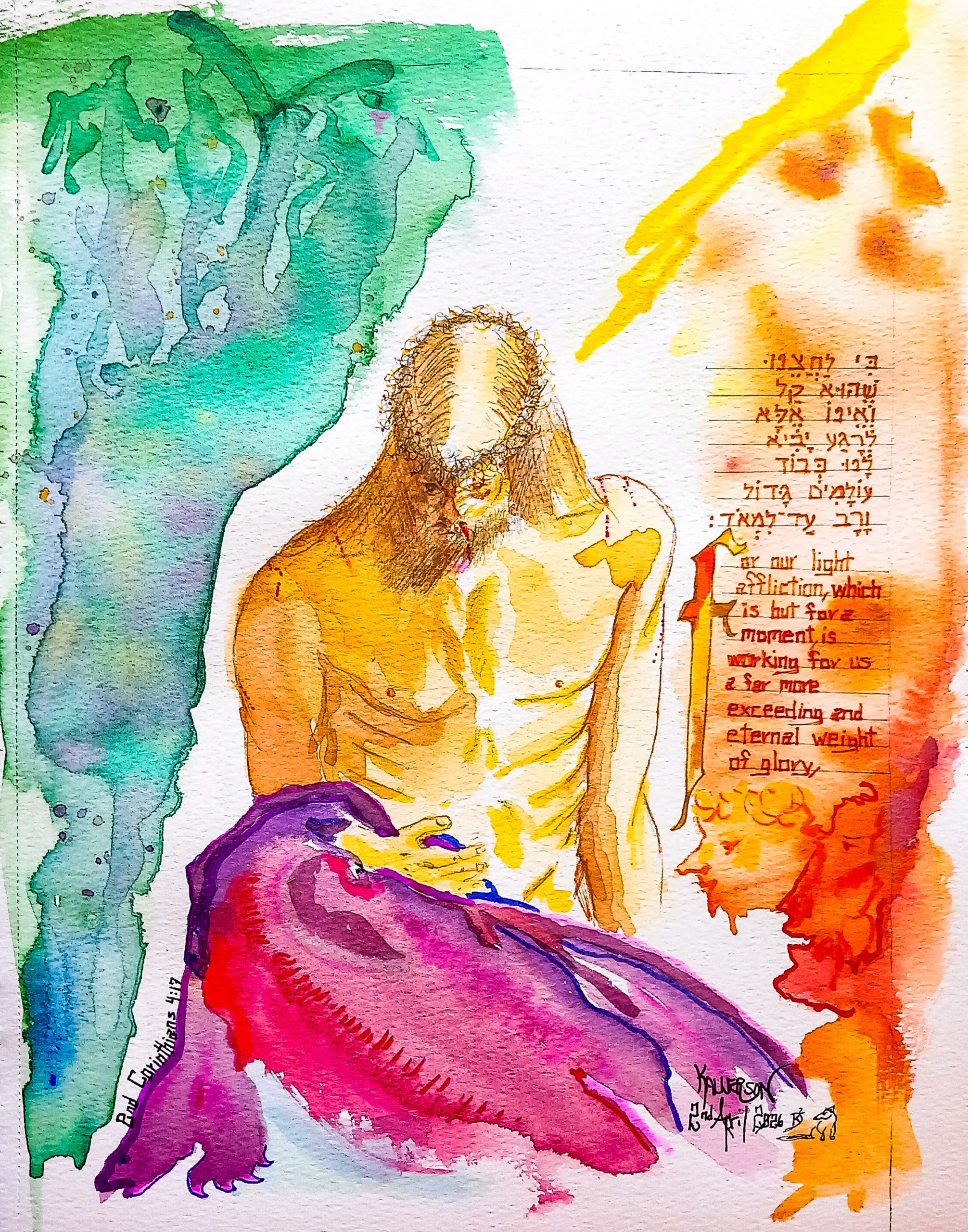
Artwork by Douglas Kallerson.
Jonah 1
The Good News of Jesus Christ
1 And it was, word Yehovah unto Jonah, son Amitai, to say, 2“You must arise! You must walk unto Nineveh, the city, the whopping, and you must call upon her. For it ascended, their evil, to My faces.” 3And he arose, Jonah, to bolt Tarshish-ward from ‘to faces’ Yehovah. And he descended – Joppa, and he found – ship, going – Tarshish. And he gave her fare. And he descended in her to go with them Tarshish-ward from ‘to faces’ Yehovah.
4And Yehovah, he caused to hurl – wind, whopping, unto the sea. And it was, tempest, great, in the sea. And the ship, it interpenetrated to be broken.
5And they feared, the mariners, and they shrieked – man unto his gods. And they caused to hurl the vessels which in the ship unto the sea to ‘cause to lighten’ from upon them. And Jonah, he descended unto flanks the vessel. And he laid, and he was stupefied.
6And he approached unto him, great, the rope-man, and he said to him, “What to you, being stupefied? You must arise! You must call unto your God. If not, He will shine Himself, the God, to us, and not we will perish.” 7And they said, man unto his associate, “We must walk! And let us cause to fall lots. And let us know in whosoever the evilness, the this, to us.” And they caused to fall lots. And it fell, the lot, upon Jonah. 8And they said unto him, “You must (surely) cause to declare, we pray, to us, in what to whom the evilness, the this, to us? What your deputyship, and from whence you will come? What your land, and where from this people, you?” 9And he said unto them, “Hebrew, I. And Yehovah – God the heavens, I fearful, who, He made, the sea and the dry.”
10And they feared, the mortals, fear whopping. And they said unto him, “What you did?” For they knew, the mortals, for from ‘to faces’ Yehovah he bolting, for he caused to declare to them. 11And they said unto him, “What we will do to you, and it will subside, the sea, from upon us?” For the sea walking and assaulting.
12And he said unto them, “You must lift me, and you must cause to hurl me unto the sea. And it will subside, the sea, from upon you. For knowing, I, for in which to me the tempest, the great, the this, upon you.”
13And they dug*, the mortals, to cause to return unto the dry. And not they could. For the sea walking and assaulting upon them. 14And they called unto Yehovah, and they said, “Ah now, Yehovah, not, we pray, let us perish in soul, the man, the this. And not you will give upon us blood innocent. For You, Yehovah, according to which You inclined, You did.” 15And they lifted, Jonah, and they caused to hurl him unto the sea. And it stood, the sea, from its boil. 16And they feared, the mortals, fear whopping – Yehovah. And they sacrificed sacrifice to Yehovah. And they vowed vows.
17And He allotted, Yehovah, fish, great, to swallow Jonah. And he was, Jonah, in bowels the fish three days and three nights. … (Jonah 2:10) And he said, Yehovah, to the fish, and it caused to vomit Jonah unto the dry.
On Resurrection Day, Christians around the world gather to contemplate the most important moment in all of human history. It isn’t a single moment that came and went in a flash. Rather, it is a series of events: death (including internment), and the culmination of it in a single moment when the bonds of death were destroyed – the resurrection of Jesus Christ.
This series of events is placed by Paul as a single event for theological purposes –
“Now it was not written for his sake alone that it was imputed to him, 24 but also for us. It shall be imputed to us who believe in Him who raised up Jesus our Lord from the dead, 25 who was delivered up because of our offenses, and was raised because of our justification.” Romans 4:23-25
Paul looks at Christ being delivered up for crucifixion and being raised from the dead as a united event. Consider believers’ baptism. During a baptism, a person is submerged and then brought out of the water.
Being submerged symbolizes dying with Christ. The time under water (hopefully not too long!) equates to Christ’s internment. And being raised from the water symbolizes resurrection to newness of life in Christ. Together, they form a single event we speak of afterwards, “Oh, I was baptized in the Jordan River in 2003. Let me show you the photo!”
As for the span of time covering Jesus’ death and resurrection becoming one united act, it is typologically alluded to in Jonah 1:17 –
“Now the Lord had prepared a great fish to swallow Jonah. And Jonah was in the belly of the fish three days and three nights.”
This event in Jonah’s life was used as a metaphor for a similar event that would occur in the life of Jesus –
“For as Jonah was three days and three nights in the belly of the great fish, so will the Son of Man be three days and three nights in the heart of the earth.” Matthew 12:40
A couple of points to understand what Jesus was speaking of should be considered. The first is the time frame. He says, “three days and three nights.” It is a phrase that, unfortunately, leads to all kinds of misinterpretations and misanalyses of what Jesus went through.
The timeline of Jesus’ passion, crucifixion, and resurrection is clear when properly laid out. Jesus was crucified on a Friday, He was in the tomb throughout Saturday, and He arose on Sunday.
A complete analysis of this timeline will be attached to the end of the written sermon online for anyone who needs clarification of everything that occurred in the week of Jesus’ Passion, leading to His cross and resurrection.
In short, however, because Jesus said three days and three nights, some will dogmatically claim that Jesus had to be in the grave a full three days and three nights. Some go so far as to demand exactly seventy-two hours.
Such demands upon the text lead to unscripturally backing up the crucifixion to Thursday or even Wednesday. But this leads to other unjustifiable claims. Despite being unscriptural, they are conjured up to justify the unjustifiable.
The term “three days and three nights” speaks of any part of a day and a night. This is seen, for example, in 1 Samuel 30:12. However, it is explicitly noted with the same terminology in Esther 4:16, where it says, “neither eat nor drink for three days, night and day.”
In Esther 5:1, it reads, “Now it happened on the third day…” Thus, the time frame in Esther, which Jesus uses in Matthew, means three days, up to the third day.
The second point to understand from Jesus’ words is the term “heart of the earth.” Various explanations of this have been suggested, but there is only one proper meaning based on Scripture.
Jesus uses the story of Jonah as His reference. Because this is so, one must go to the Book of Jonah to understand His meaning. When Jonah was cast into the sea, a picture of Christ’s death, he was swallowed by the dag, fish. That corresponds to the kétos, fish in the Greek Septuagint. It says in Jonah 1:17 –
“And He allotted, Yehovah, fish [Hebrew: dag, Greek: kétos], great, to swallow Jonah. And he was, Jonah, in bowels [Hebrew: meeh, Greek: koilia] the fish three days and three nights.” Jonah 1:17
Then in Jonah 2:3, it says –
“From womb Sheol [Greek: Hades], I cried,
You heard my voice,
And you caused to cast me – depth,
In heart [Hebrew: levav, Greek: kardias] seas.” Jonah 2:3 (CG)
In other words, Jesus speaks in parallelism, a literary device found throughout the Bible. He refers to Sheol (Greek: Hades) and equates it directly to the belly of the fish. That is set in parallelism to the heart. Jesus does this while citing the essential contents of Jonah 1:17 and 2:3 –
“For just as Jonah, he was in the lunker’s belly [koilia] three days and three nights, thus He will be, the Son of Man, in the earth’s heart [kardias] three days and three nights.” Matthew 12:40
Jesus takes the story of Jonah, equates the heart of the seas to His own coming death, and replaces “heart of the seas” (something the Jews were perfectly familiar with from the story of Jonah) with His coming descent into Hades as the “heart of the earth.”
The structure of these verses is purposeful. Jesus masterfully explains what would happen and for how long it would be. But these points of doctrine don’t explain to us why Jesus would die and descend.
As He alludes to the story of Jonah, it begs us to return to Jonah to see why he was in the heart of the sea at all. Jonah was a prophet called to cry out against the wickedness of Nineveh, Offspring’s Habitation.
Nineveh represents the world at large, filled with wickedness. Jonah, depending on the surrounding events, takes on different types. At first, he represents Israel, called to be a light to the nations. However, they rebelled against their calling, just as Jonah tried to evade his calling to Nineveh.
Consider it. Israel was redeemed from Egypt, another picture of the world of sin. They were given the law and were expected to live it out in order to possess life, which was explicitly promised to the man who would do the works of the law.
However, as soon as they were called, they violated the law. This pattern never failed throughout their history. There were times when the nation would turn and do what was right, but their disobedient heart was always there, ready to turn to the wrong path.
That attitude was, in a nutshell, represented by Jonah getting into a boat and fleeing from the presence of the Lord. Not only would Israel not fulfill their call to be a light to the nations, but they turned from the Lord in added disobedience.
And so, the entire world churned and whirled in the tempestuous state of sin. This is reflected in the three sons of Noah, all of whom were represented in the first verses of the book of Jonah. Jonah, picturing Israel, was from Shem.
Nineveh, picturing the wicked world whose cry reached as high as heaven, was from the line of Ham. Tarshish, where Jonah was traveling to in order to escape from the Lord, was from the line of Japheth. They were named in the same order as the sons of Noah were listed in Scripture – Shem, Ham, and Japheth.
In one way or another, each group of people was in disobedience and separated from the Lord. This is why Jesus came. The raging sea of turmoil only increased as Israel continued to run from their appointed commission.
There is a moral lesson in this. Jonah was directed to go to Nineveh, a location north and east of Israel. It is where the lands of his past were located, where his forefathers had departed in order to go to Canaan. Rather than go there, he went in the opposite direction, heading north and west of Israel.
With sin and rebellion, there is no middle ground. A person disobedient to the Lord is as far removed from Him as he would have been near Him in obedience. One is either in His favor and near to His throne, or he is out of His favor, nearer to hell.
Like the rich man who went sorrowfully away from the Lord, and like the disciples who turned and no longer walked with Him, Jonah also turned from Him in rebellion.
Israel’s rebellion, like Jonah in the ship on the sea, saw the winds and tempestuous commotion of a world in sin increase. The text said of Jonah’s ship, “And the ship, it interpenetrated to be broken.”
The word khashav was used. It means to plait or interpenetrate, as one would weave together fabric. Anthropomorphism was being used to make the point. It was as if the ship itself thought it would be broken up.
Think of the world in chaos without Christ. Until He came, the world entirely rejected God. Israel was in a state of disobedience, no other group of people had any knowledge of the true God, and sin could not continue this way any longer lest the world break apart as at the time of Noah.
But God promised this would never happen again. To avoid such a calamitous event, the mariners on the ship with Jonah cried out to their gods. They did everything they could to save themselves as well, such as throwing their cargo over the side to lighten the ship.
Think of the sight from heaven’s perspective. The world is roaring and raging in sin. All of the baggage means wars, murder, terror, adultery, hatred, and death.
The world that doesn’t know the true God will call out to whatever spirit or “god” they have in their cultural tradition. They attempt to save themselves by the works of their own hands, looking for any means to rectify their pitiful situation.
At the same time, Israel was doing nothing to help the matter. Jonah was in the recesses of the ship, slumbering. A unique word was used to describe the ship, sephinah. It comes from the word saphan, covered or paneled.
The idea is that Jonah was in the spot where he felt he could be completely hidden from the Lord. Likewise, Israel was smugly sleeping away their responsibilities before the Lord. They were not looking for a cure to sin in their rebellious state.
They felt they were completely hidden from the consequences of their sin because of the law, the same law that they had continuously failed to uphold since their inception as the people of the Lord. Why should they worry about the Gentiles and the world of chaos and sin around them?
They were secure, the Lord “loved” them, and the rest of the world’s population be damned (which, by the way, is the attitude of innumerable Christians today). But something needed to be done lest the world come apart from man’s wickedness.
At this point in Jonah’s story, the great rope-man, the lead pilot of the ship, went down and asked Jonah to get up and call on his God. He said to Jonah, “You must arise! You must call unto your God. If not, He will shine Himself, the God, to us, and not we will perish.”
All people have a fundamental understanding that there is one supreme God. They have called on their lesser “gods,” and there has been no response. Jonah is now being asked to call on his God, in hopes that “the God” will respond to his call.
This is the intent of this great rope-man, as can be discerned from his use of the term ha’elohim, “the God.” Whether or not Jonah’s God was “the God,” maybe “the God” would listen to Him and respond.
Those who read Jonah with the understanding that He is the true God don’t think of things this way. But imagine the state of the world without knowledge of Him. They have no idea who “He” is, so they are trying any way to reach out to Him.
The next thing the great rope-man said begins to make sense. He used the word ashath, a verb which means “to shine.” Some versions say “think.” Other versions, trying to make sense of the word, say “notice us,” “pay attention to us,” “be concerned about us,” “have compassion on us,” etc.
This word ashath comes from a primitive root which means “to be sleek” and thus glossy. Through the idea of polishing, it means to shine. It is used only one other time in the Bible, in Jeremiah 5:28, where it is translated as either sleek or shine.
The captain says, “Perhaps the God will shine on us.” When God shines on someone, it means that He illuminates their thinking, shows them favor, and restores them to a pleasant and propitious place of peace, along with harmony between Himself and that person.
Everything is made manifest by the light. Despite being in a real storm in the sea of chaos, and fear of physical harm, there is a spiritual connotation that is being drawn out for us to consider so that we can see what God is doing in the world.
There was disharmony between the people and God that needed to be rectified. At the same time, the men on the ship decided to cast lots to determine who was responsible for their problem.
With the lot cast, the finger pointed at Jonah. As this is recorded in Scripture, and because of what it says elsewhere, we know that the finger of time and ever-increasing calamity in the world before the coming of Christ was pointing at Israel –
“The lot is cast into the lap,
But its every decision is from the Lord.” Proverbs 16:33
In other words, the Lord is saying that Israel was failing to do the job they were called to do. In what is an ironic twist, Jonah was willing to cut himself off from the Lord in order not to allow someone else to participate in the Lord’s favor.
This is exactly how history repeated itself in the Jews of Jesus’ time. They were so unwilling to accept that Gentiles could share in the Lord’s grace that they willingly cut themselves off from His favor.
That thought must be understood from the fact that the world needed to be redeemed. Once the sailors found out that Jonah was the cause of their calamity, they asked about his identity. His response to them was, “Hebrew, I.”
Jonah identified himself as a Hebrew, one who crossed over. They were the people who crossed over the spiritual void of understanding who God is and what He expects. Jonah also noted that Yehovah is the One true God, the Creator.
This was understood by Israel, even if they didn’t always accept and believe it or honor Him as such. The same remains true to this day. Any competent Jew will acknowledge that the God of Israel is the true God. They may not accept it by personally believing, but they still have the knowledge that this is the claim.
And apart from those who have come to Christ, not one of them honors Him appropriately. It is the same defect that has existed in them since their calling –
“‘Did you offer Me sacrifices and offerings
In the wilderness forty years, O house of Israel?
26 You also carried Sikkuth your king
And Chiun, your idols,
The star of your gods,
Which you made for yourselves.
27 Therefore I will send you into captivity beyond Damascus,’
Says the Lord, whose name is the God of hosts.” Hosea 5:25-27
This was later cited by Stephen in Acts 7 with a few changeup switcheroos to make a new point –
“Did you offer Me slaughtered animals and sacrifices during forty years in the wilderness,
O house of Israel?
43 You also took up the tabernacle of Moloch,
And the star of your god Remphan,
Images which you made to worship;
And I will carry you away beyond Babylon.” Acts 7:42, 43
The forty years of wilderness wandering picture Israel’s time after rejecting Christ until the day they will receive Him as their Messiah. In other words, Israel was in a state of disobedience, they remained in disobedience at Jesus’ time, and that state continues even till today.
In the case of Jonah, he had forsaken the spiritual aspect of the term Hebrew. He was holding onto the physical aspect only. If he thought that he could remain a Hebrew while running from the Lord and passing over a great body of water, he was mistaken.
In the New Testament, Paul said that being a Hebrew was a point on which he could boast if by the standards of the world –
“If anyone else thinks he may have confidence in the flesh, I more so: circumcised the eighth day, of the stock of Israel, of the tribe of Benjamin, a Hebrew of the Hebrews; concerning the law, a Pharisee; concerning zeal, persecuting the church; concerning the righteousness which is in the law, blameless.” Philippians 3:4-6
However, Paul goes on in the same passage to say that in the end, genealogy, clan, position, and obedience to the law fall short of the greatness of Jesus Christ. What matters isn’t culture, race, creed, status, or wealth.
Rather, what matters is knowledge of the Lord and being in a right relationship with Him. Jonah wanted the title, but not the relationship. His next words to the sailors formed an oxymoron. He said, “And Yehovah – God the heavens, I fearful, who, He made, the sea and the dry.”
How can Jonah be fearful of the Creator of all things and yet not honor Him in the manner He directed? The Jamieson-Faucett-Brown Commentary says of Jonah, “His practice belied his profession: his profession aggravated his guilt.”
Again, think of Israel. They claimed their God created the heavens and the earth, and that it was He whom they feared. But the record of their history shows this to be a falsehood.
They isolated themselves from their responsibility, claimed their own personal righteousness, and refused to honor the Lord. One read through their own Scriptures will testify to this.
And an acknowledgment that those writings preanticipated their exile for the past two thousand years will tell anyone that they have not been, and to this day, are not right with Him.
Upon hearing who Jonah (think of Israel) was in relation to the Creator God, it said that the sailors where whoppingly fearful. This was the state of some Gentiles at the time of Jesus as well. The gospels testify to the faith of the centurion, the Canaanite woman of Tyre, and others.
Acts testifies to the faith of Cornelius. Those who heard that Israel’s God was the true God feared the Lord more than those who claimed to fear the God whose name they bore. They wanted the sea of chaos in their lives to be calm, and they asked how it could happen.
This was poignantly highlighted by Jonah 1:11, “For the sea walking and assaulting.” The world was in chaos. It could not bear up under the strain of sin any longer.
The sailors’ fear of the Lord was going in two directions at once. First, it was fear of what He was doing, and second, it was fear of what He may do if what they did was wrong. They needed an answer, and so they awaited the words of the prophet himself.
At this point in the narrative, Jonah goes from representing Israel to representing the true Israel, Jesus. Jonah said to them, “You must lift me, and you must cause to hurl me unto the sea. And it will subside, the sea, from upon you. For knowing, I, for in which to me the tempest, the great, the this, upon you” Jonah 1:12 (CG).
In other words, Israel, through Jesus, finally acknowledges that it was their fault the world was in the catastrophically dangerous place it was in. Nobody had done the things of the law, except Jesus. It is why He came.
Therefore, His death would allay the wrath of the Lord working itself out in the created order. The Lord promised Noah –
“And I caused to rise, My covenant, with you. And not it will be cut, all flesh, again from waters the deluge, and not it will be again, deluge, to ruin the earth.” Genesis 9:11 (CG)
What can be inferred from Genesis and from Jonah is that the flood was a direct result of man’s sin. If man continued down the same path as before, the world would go into upheaval again. To avoid that occurrence, God sent Jesus into the world.
Sin would be dealt with, and the inevitable cataclysm would be averted. God promised a Messiah, and He covenanted to never again destroy the world by flood. Therefore, God gave Israel the law as an instructional tool to lead them to Jesus. Then, as Paul says –
“But when the fullness of the time had come, God sent forth His Son, born of a woman, born under the law, 5 to redeem those who were under the law, that we might receive the adoption as sons.” Romans 4:4, 5
Sin is the problem. Without it being dealt with, the world cannot bear up under the weight of wickedness that results from man’s sin. Jonah acknowledged that the sea would become calm for them in his death.
God was showing in typology that through the death of Christ, this raging, cataclysmic turmoil would cease. After Jonah gave his instructions, the next verse said –
“And they dug, the mortals, to cause to return unto the dry. And not they could. For the sea walking and assaulting upon them.” Jonah 1:13 (CG)
After being told what would save them from the raging tempest, these pagan Gentiles were adamant that they needed to save their passenger, even though they might lose their own lives.
A contrast is set forth between Jonah, who fled from the Lord so he didn’t have to take a saving message to the entire city of Nineveh, and these pagans who risked their own lives for the sake of a single, guilty man. The contrast is stark and striking.
Israel was unwilling to share their heritage with the world to restore it to God, but these men didn’t want a single Hebrew to be lost. Despite their efforts, the sea only grew worse. Therefore, the narrative continued –
“And they called unto Yehovah, and they said, ‘Ah now, Yehovah, not, we pray, let us perish in soul, the man, the this. And not you will give upon us blood innocent. For You, Yehovah, according to which You inclined, You did.’” Jonah 1:14 (CG)
Yehovah sent the storm. As He is the God of heaven who made the sea and the dry land, it was His will. Their understanding means that they no longer cry out, every man to his own god, as in verse 5. Rather, they collectively cry out to the true God.
They acknowledged that the Lord willed for Jonah to perish in the sea as he prophesied. The raging winds and the billowing waves were caused by Him. Therefore, Jonah’s other words must also be true.
For the raging storm to end, he must be cast over the side of the ship. Because the lot decided for them to do this, their prayer was that Yehovah would not impute it to them as taking innocent blood.
The typology has to be remembered. Though Christ Jesus never sinned, it was reckoned to Him as if He did. To these men, they saw Jonah as innocent towards them, even if counted guilty before God.
In imputing our guilt to Christ, and His righteousness being imputed to us, we see how the innocent Christ corresponds directly to the guilty Jonah. This is how the Lord saw it in both instances, and therefore, His will must be yielded to.
The final clause says, ki atah Yehovah kaasher khaphatsta asita – “For You, Yehovah, according to which You inclined, You did.” The words are robust and impressive. They acknowledge that everything to this point has been according to the will of the Lord
The storm arising, the casting of lots, the words of Jonah concerning what had to happen to him, all of it has been directed by the Lord.
The word khaphets, to incline, is the same as that found in Isaiah 53:10 – “It pleased [khaphets] the Lord to bruise Him.” The book of Jonah reveals the work of Christ in type and picture. The sailors, understanding the situation, act according to the Lord’s will –
“And they lifted, Jonah, and they caused to hurl him unto the sea. And it stood, the sea, from its boil.” Jonah 1:15
Interestingly, in verse 12, Jonah specifically told the sailors to lift him up and cast him into the sea. Why didn’t he just say, “Hurl me into the sea”? In verse 5, it didn’t say they lifted up the cargo and hurled it into the sea. It just says they hurled it into the sea.
The reason for the difference is that another picture is made for us. In fulfillment of Jonah 1:12, Jesus said the following in John 12, as translated by the Sar Shalom Hebrew New Testament –
“And I, if I be lifted up [nasah] from the earth, will draw all men unto myself.” John 12:32
Likewise, we read this in Isaiah 52, using the same word, nasah, also found here in Jonah –
“See, my Servant will act wisely; he will be raised and lifted up [nasah] and highly exalted.” Isaiah 52:13
God’s wrath at the sin of man was taken out on Christ Jesus, symbolized by Jonah being hurled into the sea. All the tempestuous turmoil of human wickedness was potentially subsumed by Him in this act.
It was sufficient to allay God’s wrath, withhold destruction on the earth, and allow the dispensation of Grace to come into the ongoing redemptive narrative of mankind’s time walking in the presence of God.
For those who believe, the time of wrath is past. That is seen in the words –
“And they feared, the mortals, fear whopping – Yehovah. And they sacrificed sacrifice to Yehovah. And they vowed vows.” Jonah 1:16 (CG)
This shows the name of the Lord being accepted and honored by the Gentile world. From this point and through to the end of Jonah 2, the story deals in poetic form with the time of Christ’s death, His descent into Sheol, and what occurs on the third day. That is seen at the end of Jonah 2 –
“And he said, Yehovah, to the fish, and it caused to vomit Jonah unto the dry.” Jonah 2:10 (CG)
The book of Jonah is to be taken literally. The Lord gave the command, and the fish followed through with the orders as given. It spewed Jonah out of its belly and onto the dry land.
The symbolism is what is important. First, there was a command from the Lord. This was followed by an action. The fish symbolizes the means of delivery, not the state of death. Jonah died in the waters and was caught up into the belly of the fish, where he prayed.
Christ was cast among the great sea of sinful people, symbolized by the chaos of the ocean. There he died for the sins of the world. However, His delivery was already prepared based on His sinless life, pictured by the fish.
His sinless state is what delivered Him from the ordeal. It is what rescued Him from inevitable corruption. Peter mentioned this in Acts 2 –
“I foresaw the Lord always before my face,
For He is at my right hand, that I may not be shaken.
26 Therefore my heart rejoiced, and my tongue was glad;
Moreover my flesh also will rest in hope.
27 For You will not leave my soul in Hades,
Nor will You allow Your Holy One to see corruption.
28 You have made known to me the ways of life;
You will make me full of joy in Your presence.” Acts 2:25-28
As the fish was the means of Jonah’s delivery, and as Christ is the means of salvation, a picture is formed from the clause “it vomited Jonah on to the dry.” Jesus was vomited out of Sheol (Hades). Sheol simply could not stomach Him.
Sheol devoured that which is unclean from sin. Jonah was spewed out of the fish, but the fish lives in the sea. Therefore, he was spewed out of the sea, which represents the place of sin, chaos, and death. The fish for Jonah, and God in Christ for the sinless Man, Jesus. Both were what provided safety.
The words of Jonah anticipate the symbol of Christianity, ICTHYS, “The Sign of the Fish.” It is an acrostic – ISEOUS CHRISTOS THEO YIOS SOTER – JESUS CHRIST SON OF GOD, SAVIOR. His sinless perfection is what is seen in the fish.
The vomiting of Jonah onto the dry land pictures His triumph over the sea of chaos. Again, it is explained by Peter in Acts 2 –
“…whom God raised up, having loosed the pains of death, because it was not possible that He should be held by it.” Acts 2:24
From the place of chaos and death, Jesus was restored to a place of stability, harmony, and assurance, pictured by the dry land. On the first page of the Bible, a distinction was made between the waters and the dry land. When God made the yabashah, dry land, by separating it from the waters, it was proclaimed good.
In the New Testament, the disciples were told that they would be fishers of men. Christ was the first to be delivered from the chaos of the seas to the dry land, meaning the place of safety. Now, those who follow Him are fished out of the chaotic sea and brought to that same place of safety.
The entire episode was orchestrated by God, based on Jonah’s rebellion, to show us a picture of the world of fallen man being rescued by the perfect Man, Christ Jesus.
The difference between Jonah and Christ is that Jonah died on account of his own sin, something common to all men. He was delivered from that death by the Lord.
On the other hand, Christ died for the sins of His people, which He willingly took upon Himself. But He died as a member of His people, the nation of Israel, and under the law which was given to them.
Jesus died for sin, and He was delivered by God in order to save people from all nations. Jonah, and indeed all of Scripture, is more than a fish tale. It is a grand, epic story about the workings of God in Christ.
Understanding this, think of the men on the boat. Though they didn’t know of the gospel, they knew that there was a need for the gospel. The light of the gospel message is the only way to make things which are indecent appear as they really are.
That is why it said in verse 6, “If not He will shine Himself, the God, to us, and not we will perish.” Once the truth of the gospel shines on the deeds of wickedness, they are exposed and can be compared to what is right, holy, and proper.
That knowledge allows people to do what is needed with that light in order to come to a right relationship with God. Paul says this in the book of Ephesians. It very well could be that he was pondering the book of Jonah at some point and came to this conclusion –
“And have no fellowship with the unfruitful works of darkness, but rather expose them. 12 For it is shameful even to speak of those things which are done by them in secret. 13 But all things that are exposed are made manifest by the light, for whatever makes manifest is light. 14 Therefore He says:
“Awake, you who sleep,
Arise from the dead,
And Christ will give you light.” Ephesians 5:11-14
The gospel awakens the internal call of the lost human soul for the knowledge of God and a right relationship with Him. The good news of Jesus Christ is available to all people.
There is a time when the Lord will come for His church. After that, the wickedness of the world will have to be dealt with. Christ’s potential for taking on the sin of the world is unlimited, but it will only be actuated in people who believe the good news.
Once the church is gone, God’s wrath will be poured out on the world. This time, however, the world will not be destroyed by flood, but by fire. If the resurrection of Jesus Christ is true, it proves that the message of the Bible is true.
Today is Resurrection Day. It is hoped that you will hear the message, respond to the call, and be saved by the precious blood of Jesus Christ. His proposition to you is that if you believe what He did as outlined in the gospels, you will be saved. Choose wisely. Choose Jesus.
Closing Verse: Let this mind be in you which was also in Christ Jesus, 6 who, being in the form of God, did not consider it robbery to be equal with God, 7 but made Himself of no reputation, taking the form of a bondservant, and coming in the likeness of men. 8 And being found in appearance as a man, He humbled Himself and became obedient to the point of death, even the death of the cross. 9 Therefore God also has highly exalted Him and given Him the name which is above every name, 10 that at the name of Jesus every knee should bow, of those in heaven, and of those on earth, and of those under the earth, 11 and that every tongue should confess that Jesus Christ is Lord, to the glory of God the Father.” Philippins 2:5-11
Next Week: 1 Samuel 18:17-30 Thinking of it and my head spins… (Two Hundred Philistine Foreskins) (40th 1 Samuel sermon)
The Lord has you exactly where He wants you. He has a good plan and purpose for you. It is He who has defeated the enemy and who now offers His people rest. So, follow Him and trust Him, and He will do marvelous things for you and through you.
A Celebration of the Resurrection of Jesus Christ
This is the gospel which was preached to you
It is also the one you received and on which you stand
It is the gospel of salvation, providing life that’s new
And which will carry you to the promised Holy Land
What is delivered to you is what was before received
That Christ died for our sins according to God’s word
He was buried and He rose, and so we have believed
And many witnesses testify to this message you have heard
Now, if Christ is preached that He is risen from the dead
How can some among you say the resurrection isn’t true?
If there is no resurrection after Christ was crucified and bled
Then our faith as well as yours is certainly askew
And if so, we are found false witnesses of God
Because we have wrongly testified of this mighty deed
And our faith is futile, no heavenly streets we’ll trod
And we are still dead in our sins; fallen Adam’s seed
Even more, those who have fallen asleep in the Lord are gone
And we are the most pitiable creatures the world could ever look upon
But indeed, Christ is risen from the dead
He is the Firstfruits of those who have fallen asleep
And as death came through one man, Adam, our federal head
So Christ will make all alive; our souls He will keep
There is an order to the Resurrection call
Christ was first, the pattern for the rest when He comes
When He does, He will make a shout out to us all
And we will rise as if to the sound of heavenly battle drums
Then comes the time, when He delivers the kingdom to the Father
When all rule, authority, and power have come to an end
The last enemy to be destroyed is death, never more to bother
Then the Son will to the Father eternal rule extend
But you ask, “What will we be like after our time of sleep?
After we have been buried in corruption’s pit so deep?”
Our body is sown in dishonor, but it will be raised in glory
It is sown in weakness, but raised in power – the resurrection story
The first man Adam became a living being, it is true
The last Adam became a life-giving Spirit, life to me and you
And as was the man of dust, created so long ago
So are those likened unto him, also made of dust
And as is the Man, the Lord from heaven, you know
That we shall bear His image for eternity just as we’ve discussed
Flesh and blood cannot inherit the kingdom of God
Nor can corruption inherit that which is incorrupt
Be we shall all be changed, and so, heavenly streets we’ll trod
In the twinkling of an eye, the change will be abrupt
When the last trumpet sounds, we will be taken to glory
We shall all be changed, completion of the gospel story
Where O Death, O where is your sting?
When Christ our Savior, us to Himself does He bring
Where O Hades, O where is your victory?
When Christ translates His children to eternal glory
The sting of death is sin, and the strength of sin the law
But thanks be to God who gives us victory through our Lord
My beloved brethren be steadfast in all you’ve heard and saw
And cling confidently to God’s eternal word
Know for certain that your labor is not in vain
Be of good cheer, Christ is coming again
Hallelujah and Amen…
————————————
TIMELINE OF JESUS’ WEEK OF PASSION
Misconceptions –
1) Sign of Jonah / Three days and three nights. Matthew 12:40 –
a: The sign of Jonah is not the Lord’s time in the belly of the great fish. It is the message He preached and which will be rejected. Jonah cried out, “Yet forty days and Nineveh will be destroyed.” As is consistent in the Bible, it was a warning, a day for a year. Israel would be destroyed in 40 years.
With a cursory look at Jesus’ words in Matthew, the sign seems to be His death and resurrection. But Luke leaves out both the time frame and the entire account of the fish. When he does this, he clears up the context – that the sign of Jonah is his preaching, and what that preaching stated… that destruction was decreed in 40 days. The preaching to the Ninevites was the sign.
When Israel disobeyed in the wilderness, they were given a day for a year punishment for every day that the spies were gone. It was 40 days, and thus 40 years of punishment. In Ezekiel chapter 4, he was told to lie on his right side for 40 days, signifying a day for a year of punishment for Judah. He was told to do the same for his left side, but for 390 days. It was a day for a year for the house of Israel. Together, they form the prophetic basis for the return of Israel in 1948.
Forty years after Jesus’ words, for a day, Israel was destroyed and carried away into exile. The Romans came in and did what Nineveh was spared of. God’s judgment fell heavily upon them for failing to repent, receive their long-awaited Messiah, and conform to the will of God, which is found in the finished work of Jesus Christ.
b: “For as Jonah was three days and three nights in the belly of the great fish, so will the Son of Man be three days and three nights in the heart of the earth.” Matthew 12:40
This is an idiomatic expression. It does not mean literally three days and three nights. This is a misunderstanding of the phrase as it relates to Biblical time. It’s important to note that this verse is from Matthew and is directed to the Jewish people, Jesus as King.
Hebrew idioms would have been understood and not needed any clarification or verbal amending. To the audience, Matthew was writing that any part of a day is considered to be inclusive of the whole day. It’s no different from the terminology we use today. If I arrive in Florida on a plane at 11:30 pm on 11 April, during a later conversation, I would still say I was in Florida on that day.
The biblical pattern of “evening and morning” being a day goes back to the first chapter of the Bible and includes an entire day, regardless of what part of a day one is referring to. If you want to understand the term day and night as an idiomatic expression, simply type “day and night” into your Bible search engine and see how many times, throughout the Bible, the term is used in this way. It goes on and on. Jeremiah does a great job of using it in this way. Study!
The same verse, as recorded in Luke, says, “And while the crowds were thickly gathered together, He began to say,
“This is an evil generation. It seeks a sign, and no sign will be given to it except the sign of Jonah the prophet. 30 For as Jonah became a sign to the Ninevites, so also the Son of Man will be to this generation. 31 The queen of the South will rise up in the judgment with the men of this generation and condemn them, for she came from the ends of the earth to hear the wisdom of Solomon; and indeed a greater than Solomon is here. 32 The men of Nineveh will rise up in the judgment with this generation and condemn it, for they repented at the preaching of Jonah; and indeed a greater than Jonah is here.” Luke 11:29-32
As you can see, Jesus explicitly states that the sign is the preaching of Jonah. In this instance, Luke was not writing only to Jewish people, but predominantly to non-Jewish people – Jesus as the Son of Man. Therefore, the terminology is amended to avoid confusion. This occurs many times in the gospels, and therefore, the addressees (or the background of the writers themselves) need to be identified to understand proper terminology.
The same phrase is given in Esther 4:16 –
“Go, gather all the Jews who are present in Shushan, and fast for me; neither eat nor drink for three days, night or day. My maids and I will fast likewise. And so I will go to the king, which is against the law; and if I perish, I perish!”
This is then explained in Esther 5:1 –
“Now it happened on the third day (b’yom ha’shelishi) that Esther put on her royal robes and stood in the inner court of the king’s palace, across from the king’s house, while the king sat on his royal throne in the royal house, facing the entrance of the house.”
As you can see, what she said in verse 4:16 is explained as an idiomatic expression in verse 5:1. This same phrase is exactly repeated in the NT 13 times – “On the third day,” not “After the third day.”
2) High Sabbath. John 19:31 –
“Therefore, because it was the Preparation Day, that the bodies should not remain on the cross on the Sabbath (for that Sabbath was a high day), the Jews asked Pilate that their legs might be broken, and that they might be taken away.”
The second issue to be resolved is that some scholars claim that John “appears” to place the crucifixion on a different date than the other writers. Because of this, an attempt was made to insert a second type of Passover meal, or a second Sabbath, into the Bible. This supposedly helps the Bible out of an apparent problem.
However, no such meal, or Sabbath, is identified in the Bible at any time. Nor is it necessary to make something erroneous like this up. The Bible identifies the timing of the entire Passion Week, dispelling the problem. The terminology for “Preparation Day” used in all four gospel accounts absolutely clears this up and will be noted as we go on.
The terminology “high Sabbath” is pointing to the fact that the Sabbath (there is only one Sabbath, Saturday) coincided with the beginning of the Feast of Unleavened Bread, a “holy convocation” according to Exodus 12:16 and Leviticus 23:7. There are only six times in the Bible that something is called a Shabbath Shabaton, or “Sabbath of complete rest.” Four of them speak of the Seventh Day Sabbath, one concerns the Day of Atonement, and the last speaks of the seventh-year Sabbath rest for the land.
Thus, there is no second Sabbath. A holy convocation is not a Sabbath. On a Sabbath, meals could not be prepared. However, Exodus 12:16 says –
“On the first day there shall be a holy convocation, and on the seventh day there shall be a holy convocation for you. No manner of work shall be done on them; but that which everyone must eat—that only may be prepared by you.”
3) Four days. Exodus 12:3 –
“Speak to all the congregation of Israel, saying: ‘On the tenth of this month every man shall take for himself a lamb, according to the house of his father, a lamb for a household.’”
This requirement has nothing to do with the Passover at Jesus’ time. Nothing in Scripture can be used to justify what is commonly taught, saying that the Passover lamb was selected each year to test it for defects. The opposite is true. The lamb was selected because it had no defects. Thus, this has nothing to do with Palm Sunday and the subsequent days leading up to Passover. Rather, this animal was selected early to ensure that every household had a lamb before the plague of darkness that fell on Egypt. It is never mandated again. People bought their lambs in Jerusalem from keepers of the flock who had already inspected them. Further, they did it within a day of the Passover.
There are four things that occurred at the first Passover that are not required in the annual celebration found in Leviticus 23 –
- The eating of the lamb in their houses was dispersed through Goshen.
- Taking the lamb on the tenth day.
- The striking of its blood on the doorposts and lintels of their houses. And,
- Eating it in haste.
The four-day requirement never occurred again. There is no biblical support for it. People have picked and chosen selected verses, without following through on the study, to come to an incorrect conclusion on this.
Chronology of the Events –
1) The easiest way to identify the day of Passover from the gospels is by reviewing the term “Preparation Day.” It is in all four gospels, and it exactingly identifies the day of the Passover –
Matthew 27:62 – “The next day, the one after the Preparation Day, the chief priests and the Pharisees went to Pilate.” This was the day after the crucifixion. Matthew says it is the day “after Preparation Day.” After this is recorded the day after the Sabbath (Matt 28:1, the first day of the week).
Mark 15:42 – “It was Preparation Day (that is, the day before the Sabbath). So as evening approached…” This is the day of the crucifixion. Mark says, “It was Preparation Day.” Mark 14 ends on the night of Christ’s time in the Garden of Gethsemane. Mark 15:1 then identifies that it is “immediately, in the morning,” meaning Preparation Day.
Luke 23:54 – “It was Preparation Day, and the Sabbath was about to begin.” This is the day of the crucifixion. Luke says, “It was Preparation Day.” Luke 23:56 then says that they rested on the Sabbath, and then He was raised on the day after the Sabbath, Sunday, the Lord’s Day, the first day of the week (Luke 24:1).
John 19:14 – “Now it was Preparation Day of the Passover.” This is the day of the crucifixion. John says, “It was Preparation Day.”
This definitively, and without any chance of coming to any other conclusion, identifies the day as Friday, followed by the Saturday Sabbath. As sad as it is that this is denied by many, it is what the Bible actually teaches.. The four gospels are harmonious in this, and it is… irrefutable. However, the rest of the Passion week identifies this as well.
And so, let’s break all this down. Here’s what you need to know:
Paul plainly states that the Feast of Firstfruits is a picture of the resurrection:
“But Christ has indeed been raised from the dead, the firstfruits of those who have fallen asleep.” 1 Corinthians 15:20
The feast of Firstfruits was a Sunday according to Leviticus 23:15 – “From the day after the Sabbath, the day you brought the sheaf of the wave offering, count off seven full weeks.” Note: the Sabbath referred to here is a Saturday. We don’t need to go any further there to know this is correct and that Christ rose on a Sunday.
Here is the math from the gospel accounts. It’s all there in black and white and very easy to look up –
**“Six days before the Passover, Jesus arrived at Bethany, where Lazarus lived, whom Jesus had raised from the dead.” John 12:1 This would have been a Sabbath day (Saturday).
**“The next day, the great crowd that had come for the Feast heard that Jesus was on His way to Jerusalem.” John 12:12 This would have been 5 days before the Passover, meaning Sunday (Palm Sunday), as the Passover would have started Thursday night at sundown and run until Friday night at sundown (remember biblical days start at sundown).
The account couldn’t be clearer that the next day after the Passover was a Sabbath. This is indicated several times. As I said, some people have attempted to use the terminology in John (it was a “high day” or a “special Sabbath”) to indicate that it could have been a day other than a Saturday. All special Sabbaths are specified in Leviticus and don’t necessarily fall on Saturdays. However, the term “Sabbath” as used in the other gospel accounts indicates a Saturday. There is nothing to support, anywhere in Scripture, that there were two Sabbaths in a row on this particular week. Further, the special Sabbaths in Leviticus do not apply here. As I said, one is the Day of Atonement, which occurs in the seventh month. The other is a Sabbath for the land every seventh year. Neither applies.
In fact, such an analysis does an injustice to the reading of the text. Therefore, the special Sabbath occurred on a regular Sabbath day (Saturday). As I said earlier, it was a great (high) Sabbath because it coincided with the holy convocation, which is the first day of Unleavened Bread.
From this, we can give the entire week’s schedule (refer to the cited verses in your own Bible to familiarize yourself with what’s being said) –
Sabbath 6 before // John 12:1 – …six days before the Passover. Bethany/Lazarus.
Sunday 5 before // John 12:12 & Mark 11:10 – The next day… Palm Sunday/Riding the donkey.
Monday 4 before // Mark 11:12 Now on the next day… Jesus cursed the fig tree.
Tuesday 3 before // Mark 11:20 Now in the morning… The withered fig is identified.
Wednesday 2 before // The gospels are silent on what occurred on this day.
Thursday 1 before – Passover starts at Sundown //Mark 14:1 After two days it was the Passover… (this is the first timing mentioned since Mark 11:20, which was Tuesday).
Note: Pay special attention to the fact that in the following accounts, Mark is using Jewish time (sunset to sunset and John is using Roman time – from midnight) –
Mark 14:12 – “Now on the first day of Unleavened Bread when they killed the Passover Lamb.” Here, Mark, like Luke, unites the Passover with the Feast of Unleavened Bread.
John 13:1 – “Now before the Feast of the Passover…”
Both Mark and John are speaking of the same day – The meal, washing of feet, Gethsemane, etc.
***Christ was crucified during this same 24-hour period, but it was obviously after the final night at Gethsemane and then the illegal trial. Mark is speaking of this event from sundown, John is speaking of it in Roman time (this is obvious because they use different terminology for the same meal where Judas left to betray the Lord… can’t miss this point and get it right).
6 days before – Saturday
5 days before – Sunday
4 days before – Monday
3 days before – Tuesday
2 days before – Wednesday
1 day before – Thursday
The Day – Friday
The problem with people believing that John was speaking of a different day (as mentioned above) is that they miss the fact that the terminology for the day is different based on the author. To clear up any misunderstanding here, one needs only to compare the uses of the term “Preparation Day.” Once one does this, there are no discrepancies in the accounts. Go back and review what I said about that earlier. The timeline is set, it is irrefutable, and it is the only biblical option. Anything else inserts unbiblical information into the record.
Based on the biblical evidence,
1) There is no discrepancy between any of the accounts.
2) Jesus was crucified on a Friday.
3) Jesus rose on a Sunday.
Again, the Bible says 13 times that He was raised “on” the third day. This is mentioned by Jesus Himself as well as the apostles. Therefore, it must have been Friday that Christ was crucified.
——————————————————————–
Finally, please don’t believe (as some have claimed) that Christ rode the donkey into Jerusalem on a Saturday instead of a Sunday. This would have been the Sabbath. If He did, He would have violated the law –
“Observe the Sabbath day, to keep it holy, as the LORD your God commanded you. Six days you shall labor and do all your work, but the seventh day is the Sabbath of the LORD your God. In it you shall do no work: you, nor your son, nor your daughter, nor your male servant, nor your female servant, nor your ox, nor your donkey, nor any of your cattle, nor your stranger who is within your gates, that your male servant and your female servant may rest as well as you.” Deuteronomy 5:12-14
There is no need to make the assertion that it was a Saturday unless you simply wanted to finagle the dating. There is also no biblical provision for an exemption to the commandment prohibiting working a donkey.