
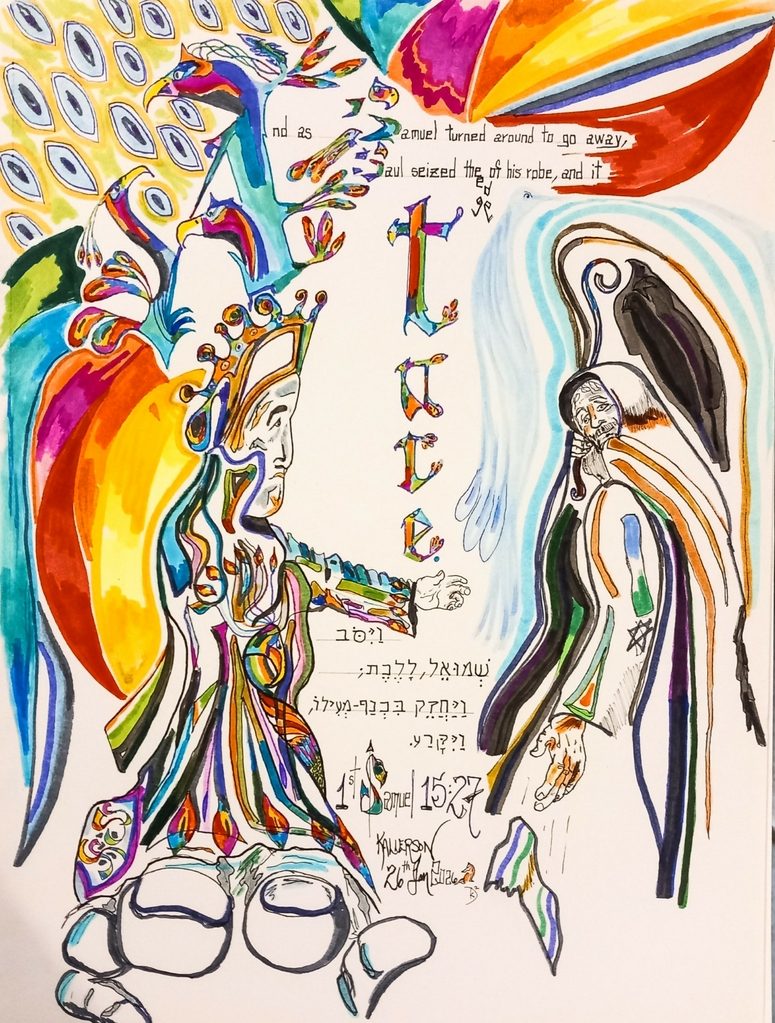
1 Samuel 15:27-35
Anathematize the Sinners – Amalek, Part III
In 1 Samuel, the Hebrew word nakham, to sigh, is found four times. All four of those uses are in Chapter 15. The first was in verse 11 where I argued against the standard translation of most versions, which use the verbs relent, repent, regret, etc.
Those give a bit of the sense, but the meaning is fuller than that. In fact, other uses of the word convey a completely different meaning, such as comfort, appease, consolation, etc. Those are so disparate that it is hard to see any connection.
However, if every instance of the 108 uses of nakham in Scripture is translated as sigh, the underlying meaning will be more understandable in each case.
As noted in the comments on 1 Samuel 15:11, the Lord doesn’t actually regret His decisions. They are made in accordance with His foreknowledge and predetermined plan. However, the verses in the passage today give us seemingly contradictory thoughts –
v.29 – And also Refulgency Israel, not He will cheat, and not He will be sighed. For not man, He, to be sighed.
v.35 – And Yehovah, He was sighed for He caused to reign, Saul, upon Israel.
What do we do when such thoughts appear contradictory? Why would the Bible say one thing about the Lord and then just a few verses later say exactly the opposite? It would be foolish to think that the Bible would have a contradiction within just six verses. So, how would you handle what is presented?
Text Verse: “And He sent, the God, Messenger to Jerusalem to cause to ruin her, and according to causing to ruin, He looked, Yehovah, and he was sighed [nakham] upon the evil. And He said to the Messenger, the ‘causing to ruin,’ ‘Abundant! Now, you must cause to slacken your hand. And Messenger Yehovah standing with threshing floor Ornan the Jebusite.” 1 Chronicles 21:15
So how can it be that the Lord will “not be sighed” and yet the Lord is sighed? The answer lies in our relationship with Him. When Samuel said the Lord will not be sighed, he was stating a truth which in ancient Greek was known as theopropeō, meaning in a manner befitting God. We would say theomorphically.
When we read that God sighed, that is known as anthrōpopathōs, after the manner of human passion. The word we commonly use today is “anthropomorphic.” The Bible assigns to God human attributes. God does not change. He is. However, we change in relation to Him.
When we see a change in the events occurring in the redemptive narrative, such as Saul losing the kingship, it is because God knew Saul would change in relation to Him. In order to explain the change in events so that we can readily understand what has happened, the change is ascribed to God.
If you keep this in mind as you read Scripture, you will have a better sense of what God’s word is conveying to you. There are no contradictions. Rather, the word contains verbal accommodations to help us process what is going on.
Great things such as anthropomorphism are to be found in His superior word. And so, let us turn to that precious word once again, and… May God speak to us through His word today, and may His glorious name ever be praised.
I. Now You Must Enweigh Me (verses 27-35)
The final verses of the previous passage said –
“And he said, Saul unto Samuel, ‘I sinned. For I traversed mouth Yehovah and your words. For I feared the people, and I heard in their voice. 25 And now, you must lift, I pray, my sin. And you must return with me. And I prostrated myself to Yehovah.’
26 And he said, Samuel unto Saul, ‘Not I will return with you. For you spurned word Yehovah, and He spurned you, Yehovah, from being king upon Israel.’” 1 Samuel 15:24-26
Having completed his words to Saul…
27 And as Samuel turned around to go away, Saul seized the edge of his robe, and it tore.
Rather: vayisov shemuel lalekheth vayakhazeq bikhnaph meilo vayiqara – “And he turned, Samuel, to walk, and he caused to seize in extremity his robe, and it was rent.” Inserting the name Saul does an injustice to the account. It is a quick and convenient addition, but it misses the point.
Who is the nearest antecedent? Samuel. He finished speaking to Saul, turned, and as he was turning, Samuel seized the extremity of Saul’s robe. The causative verb indicates that the action is not accidental but purposeful. He is giving Saul an object lesson to remember.
This would likely have been the tzitzith mandated in Numbers 15:38. In Deuteronomy 22, speaking of these tassels, Moses uses the term gedilim. Both indicate what is carefully described in Numbers 15 –
“Again the Lord spoke to Moses, saying, 38 ‘Speak to the children of Israel: Tell them to make tassels on the corners of their garments throughout their generations, and to put a blue thread in the tassels of the corners. 39 And you shall have the tassel, that you may look upon it and remember all the commandments of the Lord and do them, and that you may not follow the harlotry to which your own heart and your own eyes are inclined, 40 and that you may remember and do all My commandments, and be holy for your God. 41 I am the Lord your God, who brought you out of the land of Egypt, to be your God: I am the Lord your God.’” Numbers 15:37-41
Samuel is conveying that Saul’s actions failed to honor the Lord. Instead, he did what his own heart and eyes were inclined to do. Tearing Saul’s robe is a symbolic act that would leave him no doubt that Samuel, and by extension, the Lord, was through with him.
Something similar occurs in 1 Kings 11 –
“Now it happened at that time, when Jeroboam went out of Jerusalem, that the prophet Ahijah the Shilonite met him on the way; and he had clothed himself with a new garment, and the two were alone in the field. 30 Then Ahijah took hold of the new garment that was on him, and tore it into twelve pieces. 31 And he said to Jeroboam, ‘Take for yourself ten pieces, for thus says the Lord, the God of Israel: ‘Behold, I will tear the kingdom out of the hand of Solomon and will give ten tribes to you…” 1 Kings 11:29-31
It is the prophet in both cases who performs the symbolic action that points to a truth already decided in God’s plans. But just in case Saul has become too dull to understand…
28 So Samuel said to him, “The Lord has torn the kingdom of Israel from you today,
vayomer elav shemuel qara Yehovah eth mamlekhuth Yisrael mealekha ha’yom – “And he said unto him, Samuel, ‘He rent, Yehovah, kingdom Israel from upon you the day.’” The action of Samuel tearing Saul’s rob adds poignancy and potency to the words. It is an intentional, not accidental, act. The Lord has decided and this is what will come to pass. And more…
28 (con’t) and has given it to a neighbor of yours, who is better than you.
u-nethanah lereakha ha’tov mimekha – “And he gave her to your associate – the good from you.” Like a city, a kingdom is a feminine entity. Saying “it” is fine, but using the feminine conveys the sense more appropriately. It is the people who form a kingdom under a king. Saul has lost his right to rule God’s people.
Therefore, someone else will be selected to whom the kingdom will be given. As noted in a previous sermon, this was not by chance or something unexpected that had to be reworked into God’s plans now that Saul had failed.
Instead, it was already known that the rule would go to Judah. Because in Genesis 49, it was to Judah that the promise of Shiloh’s coming was made. Along with that explicit note, innumerable typological hints of this have been provided.
God knew in advance that Saul’s kingdom would not continue. However, it was a necessary step in the process of His redemptive plans. The decision for his rule to end and another to assume the kingdom has now been openly displayed to Saul in the tearing of his robe. As a confirmation of this, Samuel continues…
29 And also the Strength of Israel
vegam netsakh Yisrael – “And also Refulgency Israel.” A new noun, ascribed as a name of the Lord, is used, netsakh, a goal. Strong’s describes it as “The bright object at a distance travelled towards.” This is the only time it is directly applied to the Lord in this manner. However, the word is used elsewhere to describe what belongs to Him –
“Yours, O Lord, is the greatness,
The power and the glory,
The victory and the majesty [netsakh];
For all that is in heaven and in earth is Yours;
Yours is the kingdom, O Lord,
And You are exalted as head over all.” 1 Chronicles 29:11
The word “strength” doesn’t convey this idea at all. Some translations say “glory,” but there is a word for that. Other translations include Refuge, Preeminence, Triumpher, Eternal One, Glorious One, Excellency, Hope, Majestic God, etc.
The word netsakh is often translated as “forever,” but to say “goal” more correctly satisfies the intent. A goal can include the sense of forever, but that is the state in which the goal may exist, such as when pursuing God. In the case of the deity of God in Christ, Paul says –
“…who alone has immortality, dwelling in unapproachable light, whom no man has seen or can see, to whom be honor and everlasting power. Amen.” 1 Timothy 6:16
Therefore, to maintain the idea of the goal, which is described by the unapproachable light, I selected the word refulgency, the quality of being bright and sending out rays. Next, Samuel says that He…
29 (con’t) will not lie nor relent.
lo yeshaqer velo yinakhem – “not He will cheat, and not He will be sighed.” The word shaqar includes lying, but it contains a fuller sense. It can indicate dealing falsely in action as well as word. The Lord will do neither. His words will always be truthful, and His actions will be in line with His words.
Also, He will never sigh, meaning breathe strongly over a matter, be it from frustration, sorrow, consternation, etc. Such an expression can be applied to Him so we understand such a situation, but it does not actually apply to Him…
29 (con’t) For He is not a man, that He should relent.”
ki lo adam hu lehinakhem – “For not man, He, to be sighed.” Various words are translated as man in the Hebrew canon. In this case, Samuel uses the word adam, coming from adom, to be red. The use of adam speaks of humanity having been created by God. Unlike man, God is uncreated.
Therefore, His being is perfect and unchanging. In contrast, humanity is temporal and has potential to change. Where man waffles in his convictions, God remains steadfast. Therefore, His will in a matter will not change, even if He allows man to change in relation to Him, thereby seemingly to indicate a change in Him.
Saul finally gets it and concedes the point. Despite that, he continues to only think of himself…
30 Then he said, “I have sinned;
vayomer khatathi – “And he said, ‘I sinned.’” It is a single Hebrew word. Thus, we can take the expression as an admission in state only, but not in remorse. In other words, “Yeah, yeah, so I sinned…” Saul is simply not getting the scope of his transgression or the weight of the matter that has been presented to him. Therefore, he continues seeking self-aggrandizement…
30 (con’t) yet honor me now, please, before the elders of my people and before Israel,
atah kabedeni na neged ziqne ami veneged Yisrael – “Now you must enweigh me, I pray, afront elders my people, and afront Israel.” Losing the kingdom doesn’t necessarily mean losing the kingship. His kingdom will not continue after him, but he remains the anointed king during his life.
As such, to maintain that state, he seeks to be honored by Samuel in the presence of the people. Otherwise, they may sense the rift between them and bring his kingship to an end. How much more if they saw that the tzitzith of Saul’s garment had been torn off.
Saul’s use of an imperative verb appears to be based on fear of the outcome if Samuel doesn’t come with him. The use of imperative continues, saying…
30 (con’t) and return with me, that I may worship the Lord your God.”
veshuv imi vehishtakhavethi leYehovah elohekha – “And you must return with me, and I prostrated myself to Yehovah your God.” Saul has done a changeup switcheroo in his terminology from verse 25 –
v.25 – “And now, you must lift, I pray, my sin. And you must return with me. And I prostrated myself to Yehovah.”
v.30 – “And you must return with me, and I prostrated myself to Yehovah your God.”
He no longer asks for his sin to be lifted, and instead of saying Yehovah, he says, “Yehovah your God.” He understands that the Lord’s decision is final, but he can still appeal to the humanity in Samuel. His appeal is understood and acknowledged…
31 So Samuel turned back after Saul, and Saul worshiped the Lord.
vayashav shemuel akhare shaul vayishtakhu shaul leYehovah – “And he returned, Samuel after Saul. And he prostrated himself, Saul, to Yehovah.” Despite Saul’s petition being selfish, it is one that Samuel could hardly neglect. He had anointed Saul. To reject Saul at this time would indicate a rejection of the anointing that still rested on him.
That may seem trivial, but what would his anointing of the next king matter in the eyes of the people if Samuel could walk away from his anointed king at this time? The validity of the Lord’s anointed king would be called into question.
Thus, the people could brazenly appoint their own king and assume their chosen potentate was as worthy as whoever Samuel had anointed. They had already rejected the Lord as a king to rule them. The next step of rejecting the Lord’s anointed would be simple after that.
Despite this, there was also a failure of Saul to attend to in order for the kherem that was demanded by the Lord to be fulfilled. The people failed in regard to the animals, but Samuel will not tolerate it in regard to Amalek personally…
32 Then Samuel said, “Bring Agag king of the Amalekites here to me.”
vayomer shemuel hagishu elay eth agag melekh amaleq – “And he said, Samuel, ‘You must cause to near unto me Agag, king Amalek.’” It’s hard to know what was on Agag’s mind when the summons was made. He was spared by Saul, and now he is told that the Lord’s prophet wanted to see him.
It is unlikely he was worried about death. One would think that was a matter for Saul. Therefore, the request may have even emboldened Agag to think he had some value to Samuel since he was kept alive. Therefore…
32 (con’t) So Agag came to him cautiously.
Rather: vayelekh elav agag maadanoth – “And he walked unto him, Agag, delightedly.” The word maadanoth, a delight or delicacy, is rare in the Bible, this being the second of only four uses. It is derived from adan, to be soft or pleasant. The only use of that word is in Nehemiah 9:25, where it is used reflexively to indicate delighting oneself.
This, rather than cautiously, is the intent. The word is used adverbially to indicate that Agag is delightedly going to see the prophet. This meaning is seen in Proverbs –
“You must chastise your son,
And he will cause to rest you,
And he will give delights to your soul.” Proverbs 29:17 (CG)
Agag’s soul is delighted, and so he walks to Samuel delightedly. The reason for this is…
32 (con’t) And Agag said, “Surely the bitterness of death is past.”
vayomer agag akhen sar mar ha’maveth – “And he said, Agag, ‘Surely, it veered, bitter – the death.’” The NKJV gives a good sense, but the Hebrew is stronger, “the death.” Thus it personifies death. It is as if Agag was walking along the road heading to death (because of the battle), but then the bitterness of death took a turn off that path, leading to delight in its place.
However, in his arrogant stride, he failed to realize he never left the original path he was on…
33 But Samuel said, “As your sword has made women childless, so shall your mother be childless among women.”
Rather: vayomer shemuel kaasher shikelah nashim kharbekha ken tishkal minashim imekha – “And he said, Samuel, ‘According to which it miscarried women, your sword, thus it will miscarry, from women, your mother.’” The certain meaning, lost in all translations, is as I have rendered it. Only a few ancient Jewish commentaries got the intent.
The verb form is known as a qal. Its aspect is imperfect. There are two possible paradigms in this aspect –
It will miscarry…
She will be miscarried…
Notice the difference –
According to which it miscarried women, your sword, thus it will miscarry, from women, your mother.
According to which it miscarried women, your sword, thus she will be miscarried, from women, your mother.
The word sword is feminine. So the subject of the second clause could refer either to the sword or to the mother. There are two reasons why it is sword. The first is that it is the main subject and also the appropriate antecedent. The word from is being used as a comparative between the miscarrying of women and the mother.
Agag’s mother is being caused to metaphorically miscarry because of Agag’s pending death. The second option allows this, but then it loses the parallelism to the first clause.
The second reason is because of what is about to happen to Agag…
33 (con’t) And Samuel hacked Agag in pieces before the Lord in Gilgal.
vayshaseph shemuel eth agag lipne Yehovah bagilgal – “And he hewed, Samuel, Agag to faces Yehovah in the Gilgal.” A unique word, one that would have been loved by Gomer Pyle, is found here: shasaph. It signifies to hew to pieces. The implication is that Saul used Agag’s own sword to hew him.
Because of the use of this word, it seems that Samuel not only struck and killed him, but sacrificially parted him in some undescribed manner. And thus ended the life of Agag…
34 Then Samuel went to Ramah, and Saul went up to his house at Gibeah of Saul.
vayelekh shemuel ha’ramatah veshaul alah el beitho givath shaul – “And he walked, Samuel, the Ramah-ward. And Saul, he ascended unto his house – Gibeah Saul.” Once the meeting was complete, the two parted ways, each heading homeward. Ramah signifies Lofty Place. Gibeah means Hill.
35 And Samuel went no more to see Saul until the day of his death.
velo yasaph shemuel liroth eth shaul ad yom motho – “And not he added, Samuel, to see Saul until day his death.” There was a complete parting of the two. In 1 Samuel 19, Saul will go to where Samuel is in Naioth. However, there is no indication they met, and there was no conversing between them.
Saul went there to kill David. However, the Spirit of God came upon him in the presence of Samuel, causing him to strip and lie before Samuel, prophesying. No actual meeting between the two took place.
35 (con’t) Nevertheless Samuel mourned for Saul,
ki hithabel shemuel el shaul – “For he bewailed himself, Samuel, unto Saul.” Samuel had developed a close bond with Saul. The affection he felt for him is reflected in these few words. Despite this, because of the Lord’s decision and because of his obedience to the will of the Lord, the separation between the two was permanently maintained by Samuel.
*35 (fin) and the Lord regretted that He had made Saul king over Israel.
veYehovah nikham ki himlikh eth shaul al Yisrael – “And Yehovah, He was sighed for He caused to reign, Saul, upon Israel.” As noted in the introduction, these words are anthropomorphically ascribed to the Lord for us to understand and empathize with the events that have taken place.
The Lord tolerated the selection of Saul as an object lesson to Israel that the tallest and seemingly most prime of the people was not the only consideration in selecting a king. Rather, a deep love for the Lord and a desire, even if failingly, to follow His ways is what is of prime consideration to Him.
You saved me, and yet I sin
It’s troubling that it is this way
I keep failing… think I’m done in
The Lord will drop me for sure… maybe today
Sometimes I even do wrong intentionally
It’s like the Imp of the Perverse deep down inside
There he is, poking and prodding at me
For sure, I’m a goner, the Lord can’t abide
*
Yes, you have a streak that is wrong
Just like My people, Israel
But I have kept them all along
And because of Jesus, you are safe from hell
II. The Lord’s Patience and Eternal Salvation
Chapter 15 is given to reveal the difference between merely seeking the Lord and obeying Him. As noted in verse 1, “There is no hint of time, as the word ‘also’ [NKJV] implies.” It is a narrative that is selected from the lives of Samuel and Saul as they interact with one another before the Lord.
Saul, Asked, pictures those seeking the truth, even to the point of being saved. Saul’s typological salvation has already been seen previously.
But is that enough to be pleasing to the Lord from that point on? Or does the Lord suffer us in our salvation when we are disobedient? Seeing the nation of Israel for its 3500-year history should answer the question. But it still needs to be addressed for those who are in Christ.
In verse 1, Samuel, Asked from God, picturing the seed of Grace (Jesus and those in Him), says to Saul that the Lord sent him to anoint him as king over His people. Having reminded him of that, the imperative words that he must hear Yehovah’s voice, meaning being obedient to them, are required.
Verse 2 lets Saul know that the Lord considered the ways of Amalek (those who are disconnected from the body and strive to disconnect people from the body) when they attacked Israel as they ascended from Egypt. Egypt signifies Double Trouble. That is indicative of life bound by sin and without God. Man is born in sin, and he cannot redeem himself. Thus, he is in double trouble.
Saul’s job is to eliminate this foe, Amalek, totally anathematizing them and all they had. Samuel’s listed items left no room for anything but total anathematization. A comparable note from Paul is given concerning those – any and all – who deviate from the gospel –
“I marvel that you are turning away so soon from Him who called you in the grace of Christ, to a different gospel, 7 which is not another; but there are some who trouble you and want to pervert the gospel of Christ. 8 But even if we, or an angel from heaven, preach any other gospel to you than what we have preached to you, let him be accursed. 9 As we have said before, so now I say again, if anyone preaches any other gospel to you than what you have received, let him be accursed.” Galatians 1:6-9
Verse 4 noted the men were numbered in the Telaim, the spotted lambs. The word is ultimately derived from tala, to cover with pieces, as in patching. In Genesis, it was used to picture the acceptance of the doctrine of the grace of Christ outlined in Paul’s epistles.
The number of those selected was two hundred thousand and ten thousand from Judah. These reflect those who have entered the New Covenant from Israel and Judah, as noted in Jeremiah 31:31. The numbers, however, are the main issue. Two is the number of division or difference (Israel and Judah), twenty is expectancy, two hundred is insufficiency.
Bullinger notes that ten, a multiple of both numbers given, signifies completeness of order where nothing is wanting, the number and order are perfect, and the whole cycle is complete. Being “footed” signifies their guidance and moral walk (Topical Lexicon).
Summed up, their guidance and moral walk, though adhering initially to the doctrines of grace in Christ, were insufficient throughout this entire cycle of redemption. That is what is explained in the chapter concerning their actions.
When they came to Amalek City (verse 5), it said that “he caused to grapple, riv, in the valley, nakhal, valley.” The word valley is derived from the verb nakhal, which means to inherit. This means that they contended with the word of the Lord in their inheritance, their state of salvation. This begins the explanation of what occurred.
Verse 6 noted the Kenite, Acquire. It speaks of those who have Acquired (Kenite) salvation through Christ’s fulfillment of the Law of Moses. They are united to Him by affinity through His imputed righteousness. These are to be spared.
The destruction is to be on the Amalekites. They are The People Who Wring Off. They are those who are disconnected from the body and strive to disconnect the body. The Lord wants them excised from among the people.
The clause that says they were struck by Saul from Havilah to Shur which is facing Egypt escapes me. My best guess is that it speaks of completely destroying the Amalekites, meaning those they picture, in their doctrine with evidence presented to them from throughout Scripture (Havilah to Shur). That, however, is total speculation, even if it matches the typological purpose of the battle.
I conclude this from the likely meaning of Havilah and Shur, and the known meaning of Egypt: Circle, Wall, and Double Trouble. There is Scripture, there is the end of the argument, and that faces the place where man is in sin, without God.
Despite Israel’s success in battle, they sadly took Agag, Rooftop, alive. Abarim notes, “since a society was a ‘house,’ its ‘rooftop’ referred to that society’s governing council.”
As such, Agag pictures the apex of those who come against God’s people, attempting to sever them from the body. In other words, he symbolizes the prime false doctrine of what Amalek, those who wring off the head, signifies.
He was taken alive while the rest were anathematized with the mouth of the sword. In other words, the law, which they supposedly held to, was found to condemn them because it is what points to Christ. It is not an end in itself.
Along with Agag, the people also kept the best of the animals, but the author used different words to describe them than those initially used.
It is a note of disobedience in adhering to the word. It is what people do all the time when they misuse Scripture for their own purposes, pulling verses out of context in order to form a pretext. It said that Saul was unwilling to anathematize them.
It is exactly what Paul rebuked Peter for in Galatians. Paul said that those who present a false gospel were to be anathema. An example of this disobedience is given concerning what Peter did in Galatians 2:11-21.
Because of this, the Lord said in verse 11, “I was sighed, for I caused to reign, Saul, to king.” It is not those who are merely saved that are pleasing to God, but those who are obedient in their salvation.
God covenanted with all who are saved, and they will remain saved. However, He finds no pleasure in those who fail to live in faithful obedience. That is the continued warning and admonition to the seven churches in Revelation 2 and 3.
For this reason, it said, “And it burned to Samuel, and he shrieked unto Yehovah all the night.” How many of you have been so upset about the state of believers’ lives that you shout out to the Lord about it? Hopefully, all of us would have such an attitude.
Verse 12 noted that Saul went Carmel-ward and erected a monument to himself. Carmel, Vineyard of God, is explained by Paul, saying, “you are God’s field” (1 Corinthians 3:9). It doesn’t say he went to Carmel, just toward it.
The meaning appears to be that those who are like Saul want to erect a name for themselves among God’s people, but they are unwilling to go all the way in obedience.
After Saul built his monument, he revolved, traversed, and went to the Gilgal, the Liberty. This means that he went there to honor himself as king, despite being disobedient to the word. It is something people like this are famous for.
In verse 13, Saul proclaimed to Samuel that he had done what the Lord commanded. Samuel, however, noted to Saul the voice of the flock, tson, to migrate, and cattle, baqar, to seek. The doctrines of Amalek, migrating through the word and searching it out in an inappropriate way, were not eliminated.
Rather, they were assimilated as if they were acceptable offerings to the Lord. In verse 16, Samuel told Saul that he was to slacken up and let him speak. Saul answered with a plural response, we, for him to speak. The people wanted to hear what the issue was. However, Samuel redirected his words solely towards Saul.
The Lord’s words through Samuel reminded Saul that even when he was little in his own eyes, he was appointed the head of Israel’s tribes. In other words, those seeking the truth, meaning those of faith, are set in the preeminent position in Israel.
They were given the word and expected to obey it, destroying all that Amalek stands for. Instead, they failed. Think of Peter in Galatians 2. This is the theme being presented. There is one gospel, one truth, and the focus is to be on that. There can be no accommodation of another gospel. All false doctrines must be eliminated.
Samuel continued speaking to Saul, asking why he didn’t obey the word of the Lord. Instead, he swooped down on the booty of the enemy. If this doesn’t sound like much of the church in the world, it would be hard to say what did.
False doctrines are mixed in, accommodations are made, and leaders, even if saved, swoop down on these things in order to ingratiate themselves. Despite this, Saul protested, “Which I heard in voice Yehovah!”
He couldn’t even state a complete thought to defend himself. It is like multitudes of people who have no idea what the word of the Lord says, or they misrepresent the word of the Lord, attempting to defend themselves based on… the word of the Lord!
Saul even boasted of his disobedience while trying to defend himself, saying that he brought Agag when he anathematized Amalek. If Agag is an Amalekite, then he didn’t anathematize Amalek.
It is like the Catholic Church. They subdue their enemies and then incorporate the main doctrine of those same enemies into their doctrines. Think of it as, “I conquered the Lord’s enemies by assimilating what made them enemies into our doctrine!” The thinking is erratic, confused, and unholy.
The greatest example of this is found in those who came to Christ, who triumphed over the law, but who then place that same enemy, meaning the law, as the pinnacle of their doctrine. This is exactly what Saul is doing by sparing Agag and the best of the animals.
In verse 22, Samuel rebuked him for his supposed great acts –
- Behold! *Hearing – from +sacrifice, good!
- To @‘causing to hearken’ – from #fat rams!
- For +sin divination – *bitterness.
- And #nothingness and teraphim – @causing to peck.
Saul’s actions are completely unacceptable. As noted at that time, “Israel failed to hear the word of faith. They were cut off and exiled. Those in the church who fail to heed the word of faith will likewise be cut off (if not saved) or lose all rewards (if they were saved and then turned to false doctrines).”
Verse 23 conveyed the words that Saul was spurned from being king. Because of that (verse 24), Saul admitted his transgression, blaming his attitude on the people, exactly like Peter when he feared “those who were of the circumcision.”
In verse 26, Samuel refused to budge and noted a second time that Saul had been spurned from being king. Verse 27 said that Samuel turned to walk, and when he did, he seized the extremity of Saul’s robe, rending it.
Those who are the seed of grace will not be led by the weak and peevish who cannot properly uphold the doctrines of the Lord. Rather, as verse 28 points out, those who will lead the people are those who are better than that.
What is being seen here is a contrast between Saul and the one who will replace him. These are types, not concrete ones, but examples. This is why verse 1 was given without regard to time. There has to be a time when David will take the lead role in the redemptive narrative.
When he does, he will be used as an example of the kind of believer the Lord favors. This chapter anticipates the coming switch from Saul to David. This is why verse 29 noted that the Lord will not cheat or be sighed. It is because he is not a man that such could happen.
The Lord determined from the beginning that Saul would be the first king, and that he would then be followed by David. In using the lives of these two men, He is showing us what pleases Him, even when both categories may be saved.
Saul, after hearing the words of finality concerning his kingship, still asked selfishly for Samuel to honor him. Samuel did so. However, he also directed that Agag be brought to him.
The idea here is still honoring those who are saved, but it ensures that their wrong beliefs are eradicated. This is a recurring theme in Paul’s letters.
Next, Agag came to Samuel in a delighted fashion. Think of a saved, right-thinking believer going to a church that has incorporated false doctrine, like law observance, and destroying that doctrine. This is the intent. It is what Paul did in Antioch when Peter was there playing the hypocrite, and it is what we are called to do.
At that time, Samuel said to Agag, “According to which it miscarried women your sword, thus it will miscarry from women, your mother.” In other words, Samuel is using the law (kherev, sword, which is identical to Horeb, the mountain of the law), to destroy the very doctrine of the offender, symbolized by Agag.
It is what we do every week at the Superior Word. We analyze the law, from Moses through Malachi, to defeat the false doctrines of those who refuse to come to Christ alone for salvation. The typology, if nothing else, confirms the translation in contrast to all others, which makes the miscarried woman the subject instead of the sword.
It is the sword itself, the law, which is used to destroy the enemies of God’s people who are supposedly trusting in the law. The picture has been seen many times, and it will continue to be seen repeatedly.
Therefore, it said, “And he hewed, Samuel, Agag to faces Yehovah in the Gilgal.” Agag, Rooftop, the prime false doctrine of what Amalek signifies, is hewn before the Lord in “the Liberty.” The doctrine of law observance cannot live in the presence of the gospel of grace.
In verse 34, it noted that Samuel went Ramah-ward. He is heading to the Lofty Place where those who hold to grace alone, even after salvation, will be exalted. They are anticipating what they possess, but what they have not yet actually attained.
Saul went to his house in Gibeah of Saul. Gibeah is etymologically connected to Gabbatha. This is a note of Saul’s salvation, despite his disobedience.
To understand that, take time to read 1 Corinthians 3:9-15 and 2 Corinthians 5:9-11. Verse 35 completed the chapter by saying that Saul and Samuel were separated henceforth, but that Samuel mourned for Saul. Along with that, the Lord sighed that He caused to reign, Saul, upon Israel.
It is a note that those who are saved and hold to proper doctrine are not to fellowship with those who hold to improper doctrine. It is a stern but sad admonition. We may mourn over their decision to cling to false doctrine and try to correct them, but there can be no harmony between the two.
Further, the Lord has saved and will continue to save them, but they are a disappointment to Him as they reject the grace they once so gladly received.
The chapter is clear and obvious in what it proclaims. It has continuously been the main focus of 1 Samuel. What is it that pleases God? It is not adherence to the law that Jesus fulfilled. That is a disgrace and a disappointment to the Lord for those who have at one time believed the gospel.
For those who never believed, the implication is obvious. There is no room in God’s economy for them. They will be anathematized and destroyed. Just think of the hacking Agag got! What a sad, mournful thought. Jesus is right there in Scripture, waiting for people to simply trust Him, and then to continue to trust Him apart from their own merits.
Let us learn that lesson and hold fast to it. Is it worth tolerating that which God will not tolerate and fellowshipping with those whose lives and actions are abhorrent to Him? Do we desire to give up on all of heaven’s riches to accommodate that which God finds deplorable?
Look at how Paul addressed Peter, calling him back to sound and reasonable doctrine after his gross violation of the grace he had been bestowed. Think on these things, apply the lesson to your lives, and honor God through holding fast to the doctrine of grace found when He gave Christ for our restoration. Amen.
Closing Verse: “And I testify again to every man who becomes circumcised that he is a debtor to keep the whole law. 4 You have become estranged from Christ, you who attempt to be justified by law; you have fallen from grace. 5 For we through the Spirit eagerly wait for the hope of righteousness by faith.” Galatians 5:3-
Next Week: 1 Samuel 16:1-13 The choice is wise, not just a whim – that’s how it’s done… (Arise! Anoint Him! Part I) (33rd 1 Samuel Sermon)
The Lord has you exactly where He wants you. He has a good plan and purpose for you. He is the One who abases the haughty and exalts the humble. He regards the lowly, and the proud, He knows from afar. So yield yourself to Him, trust Him, and believe His word. In this, He will do great things for you and through you.
1 Samuel 15:27-35 (CG)
27 And he turned, Samuel, to walk, and he caused to seize in extremity his robe, and it was rent. 28 And he said unto him, Samuel, “He rent, Yehovah, kingdom Israel from upon you the day. And he gave her to your associate – the good from you. 29 And also Refulgency Israel, not He will cheat, and not He will be sighed. For not man, He, to be sighed.”
30 And he said, “I sinned. Now you must enweigh me, I pray, afront elders my people, and afront Israel. And you must return with me, and I prostrated myself to Yehovah your God.” 31 And he returned, Samuel after Saul. And he prostrated himself, Saul, to Yehovah.
32 And he said, Samuel, “You must cause to near unto me Agag, king Amalek.” And he walked unto him, Agag, delightedly.
And he said, Agag, “Surely, it veered, bitter – the death.”
33 And he said, Samuel, “According to which it miscarried women, your sword, thus it will miscarry, from women, your mother.” And he hewed, Samuel, Agag to faces Yehovah in the Gilgal.
34 And he walked, Samuel, the Ramah-ward. And Saul, he ascended unto his house – Gibeah Saul. 35 And not he added, Samuel, to see Saul until day his death. For he bewailed himself, Samuel, unto Saul. And Yehovah, He was sighed for He caused to reign, Saul, upon Israel.
1 Samuel 15:27-35 (NKJV)
27 And as Samuel turned around to go away, Saul seized the edge of his robe, and it tore. 28 So Samuel said to him, “The Lord has torn the kingdom of Israel from you today, and has given it to a neighbor of yours, who is better than you. 29 And also the Strength of Israel will not lie nor relent. For He is not a man, that He should relent.”
30 Then he said, “I have sinned; yet honor me now, please, before the elders of my people and before Israel, and return with me, that I may worship the Lord your God.” 31 So Samuel turned back after Saul, and Saul worshiped the Lord.
32 Then Samuel said, “Bring Agag king of the Amalekites here to me.” So Agag came to him cautiously.
And Agag said, “Surely the bitterness of death is past.”
33 But Samuel said, “As your sword has made women childless, so shall your mother be childless among women.” And Samuel hacked Agag in pieces before the Lord in Gilgal.
34 Then Samuel went to Ramah, and Saul went up to his house at Gibeah of Saul. 35 And Samuel went no more to see Saul until the day of his death. Nevertheless Samuel mourned for Saul, and the Lord regretted that He had made Saul king over Israel.