
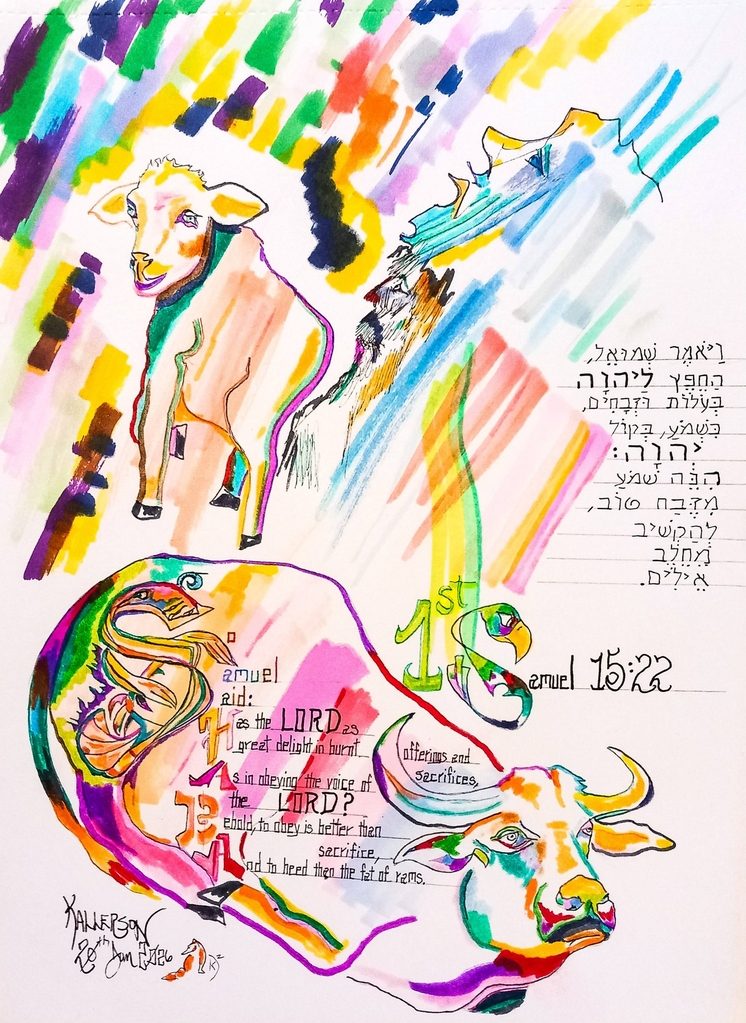
Artwork by Douglas Kallerson.
1 Samuel 15:13-26
Anathematize the Sinners – Amalek, Part II
(Typed 20 October 2025) Most of us know the old idiom, “You got caught with your hand in the cookie jar.” It became popular around WWII when it became common for people to keep their money in a cookie jar.
If someone took some of the money without the owner’s approval, he might get caught. Hence, the “getting caught” part. Today, the idiom extends to children who literally get caught with their hands in the jar, or to people who get caught taking anything they have no right to.
With the advent of cheap home security, office, warehouse, etc., cameras, there is a lot more getting caught going on in the world today. Despite getting caught, some people, even with chocolate chip goo all over their faces, will still deny what they did.
And even with the evidence presented directly to them, such as a video, some will continue to work around the situation, denying what they did was as it seems. In 1 Samuel 15, Saul will get caught with his hand in the cookie jar. He will deny any wrongdoing. And when presented with the evidence of his misdeeds, he will attempt to justify his actions.
Imagine having your face all smeared in cookie goo and then having it recorded in God’s word for everyone to read. Would we act differently if we thought our own misdeeds were going to be exposed to the whole world?
Text Verse: “Against You, You only, have I sinned,
And done this evil in Your sight—
That You may be found just when You speak,
And blameless when You judge.” Psalm 51:4
When David became king, he got caught with his hand in the proverbial cookie jar as well. When confronted with what he did, he didn’t try to hide it. Rather, he immediately said, “I have sinned against the Lord.” Along with that, he took the time to confess his wrongdoing to the Lord in a psalm.
His error and how he handled it is on prominent display in the same book that Saul’s is. The world has access to both stories because what they did is recorded. But what a difference in how the two men handled their sin, and how they are perceived by God’s people to this day.
Not only did David not hide what he did, but there is no hint of him justifying his wrongdoing, either to Nathan the prophet or to the Lord in the psalm. If we are honest with ourselves and others, we will admit that each of us is prone to wrongdoing. The effects of sin run deeply in even the greatest saint.
How we respond to our wrongdoings is important. This is a lesson that is on prominent display in His superior word. And so, let us turn to that precious word once again, and… May God speak to us through His word today, and may His glorious name ever be praised.
I. You Swooped Unto the Booty (verses 13-19)
13 Then Samuel went to Saul,
vayavo shemuel el shaul – “And he went, Samuel, unto Saul.” Samuel was probably in his hometown of Ramah. When he arose in the morning, he was told that Saul had first gone to Carmel and then to Gilgal. As Gilgal is close to the Jordan, it would be about fifteen miles from Ramah to Gilgal. This would be about a five-hour walk.
Samuel means Asked from God. Saul means Asked. However, Saul is identical in spelling to Sheol, the pit. It is a point to remember. As he approaches, meeting Saul…
13 (con’t) and Saul said to him, “Blessed are you of the Lord! I have performed the commandment of the Lord.”
vayomer lo shaul barukh atah leYehovah haqimothi eth devar Yehovah – “and he said to him, Saul, ‘Blessed you to Yehovah. I caused to arise word Yehovah.’” The proclamation itself shouts out that his words are a lie. It is a guilty person who greets another and immediately proclaims his innocence.
Saul doesn’t ask why Samuel has come, although it could be assumed that Samuel would come according to the instruction given in 1 Samuel 10:8. Saul had gathered at Gilgal according to the words of that verse. However, the last time they gathered the people in this manner, it said –
“And it was according to his finish to cause to ascend the burnt offering, and behold, Samuel, coming, and he went, Saul, to meet him to bless him.
11 And he said, Samuel, ‘What you done?’ And he said, Saul, ‘For I saw for dispersed, the people, from upon me, and you, not you came to appointment the days, and Philistines being gathered Michmash.’ 12 And I said, ‘Now they will descend, Philistines, upon me the Gilgal, and faces Yehovah not I rubbed, and I contained myself, and I caused to ascend the burnt offering.’
13 And he said, Samuel, unto Saul, ‘You were silly. Not you guarded command Yehovah your God which He enjoined you. For now – He caused to establish, Yehovah, your kingdom upon Israel until vanishment. 14 And now – your kingdom, not it will rise. He searched, Yehovah, to Him man according to His heart, and He enjoined him, Yehovah, to commander upon His people, for not you guarded which He enjoined you, Yehovah.’” 1 Samuel 13:10-14
Saul had not carefully guarded the Lord’s command. Samuel immediately called him out for it. This time, Saul preempted Samuel, calling out a blessing, as if that would stop any negative comments in their tracks.
Without being prompted, Saul then claimed that he had “cause to arise word Yehovah.” In other words, establish the word as if it stood firm. Unfortunately, little voices were calling out, highlighting Saul’s deceit…
14 But Samuel said, “What then is this bleating of the sheep in my ears, and the lowing of the oxen which I hear?”
vayomer shemuel u-meh qol ha’tson ha’zeh beazenay veqol ha’baqar asher anokhi shomea – “And he said, Samuel, ‘And what voice the flock, the this, in my ears, and voice the cattle which I hearing?’” Samuel’s words highlight Saul’s disobedience. The word of the Lord was to anathematize all living things. Nothing was to be excepted.
The animals of Amalek, bleating and lowing, proclaimed the ironic truth. They could not have highlighted the truth of Saul’s misdeeds more poignantly than the donkey of Balaam when it rebuked him for beating her.
The two types of animals mentioned here are the tson, flock, a word coming from a root meaning to migrate, and the baqar, cattle, which comes from the verb baqar, to seek or search out. Despite their barnyard rebukes to his transgressions, Saul gets his shovel and digs himself a bit deeper in the manure pile…
15 And Saul said, “They have brought them from the Amalekites; for the people spared the best of the sheep and the oxen,
vayomer shaul meamaleqi hevium asher khamal ha’am al metav ha’tson veha’baqar – “And he said, Saul, ‘From Amalekite they caused to bring them which he commiserated, the people, upon best the flock and the cattle.’” It is the same word Samuel spoke to Saul, khamal, to commiserate –
“And not you will commiserate upon him. And you will cause to die from man until woman, from suckling and until being suckled, from ox and until sheep, from camel and until donkey.” 1 Samuel 15:3
The rest of the words explained what “commiserate upon him” meant. Exactly what Saul was told not to do, he did. However, instead of acknowledging that as the leader, he was responsible for the actions of his people, he punted the blame to them, saying “he commiserated, the people.”
These are not the words of a strong leader but of a peevish simp, unwilling to lead and direct those under him in accord with the word of the Lord.
As for the name Amalek, it is derived from the word am, people, and malaq, to nip or wring off the head of a bird with or without severing it from the body. They are The People Who Wring Off. They are those who are disconnected from the body and who strive to disconnect the body.
Saul blamed his own people for what happened between them and Amalek. And worse, he next attempts to take their evil actions, of which he implicitly approved by allowing them to be done, and says it was intended for a holy purpose…
15 (con’t) to sacrifice to the Lord your God;
lemaan zevoakh leYehovah elohekha – “to end purpose sacrifice to Yehovah your God.” The ludicrous nature of Saul’s words is evident in what happened to peace (thank) offerings. When they were presented to the Lord, it says, “The flesh of the sacrifice of his peace offering for thanksgiving shall be eaten the same day it is offered” (Leviticus 7:15).
In other words, there are parts of the animal that were reserved for holy purposes. The rest of the animal was returned to the offeror for him to eat. The people had taken the best of the flock and herd to have a giant party, roasting and dining on the plundered animals of Amalek, exactly what the Lord had forbidden. Saul pretends this is ok, though, saying…
15 (con’t) and the rest we have utterly destroyed.”
veeth hayother hekheramnu – “and the remaining, we caused to anathematize.” In other words, “We kept all the good stuff to sacrifice to Yehovah (well, and to party with), and everything else (the not so good stuff), we dedicated to the Lord by anathematizing it.”
The entire thought is revolting and unholy. The false-hearted actions of Ananias and Sapphira could not excel Saul’s deceitfulness and disdain for the word of the Lord. But like Peter, who called them out for what they did, Samuel has words for Saul…
16 Then Samuel said to Saul, “Be quiet! And I will tell you what the Lord said to me last night.”
vayomer shemuel el shaul khereph veagidah lekha eth asher diber Yehovah elay ha’layelah – “And he said, Samuel unto Saul, ‘You must cause to slacken, and let me cause to declare to you what He spoke, Yehovah, unto me the night.’” The word khereph, to slacken, gives the sense of idleness, desisting, fainting, etc.
Saul is excitedly defending the indefensible. Samuel tells him to let it go, slacken his stand and pay heed to his words, words which are, in turn, the word of the Lord…
16 (con’t) And he said to him, “Speak on.”
The written and the oral Hebrew are not the same: vayomeru lo daber – “And they said [k.] to him, ‘You must speak.’” The written is plural, “And they said.” The oral is singular, “And he said.” Of this discord, Keil, et. al., say, the written “is evidently a copyist’s error.” It takes more to assume that than it takes to assume the text is correct.
A first read through such an error would be caught by the copyist. Rather, the oral fails to understand the context. Saul is standing there with his troops, not alone. In verse 15, Saul said, “And the remaining, we caused to anathematize.”
Samuel addresses Saul, the one speaking for the whole. However, they all want to know what is being conveyed. It is a common reaction when a group is presented with a matter relevant to all. Even though Samuel is addressing Saul, the issue pertains to those with him…
17 So Samuel said, “When you were little in your own eyes, were you not head of the tribes of Israel?
The words are highly emphatic: vayomer shemuel halo im qaton atah beenekha rosh shivte Yisrael atah – “And he said, Samuel, ‘Not if, diminutive, you, in your eyes – head scepters Israel, you?’” The emphasis tells us that, despite more than just Saul asking him to speak on, Samuel redirects the conversation back to Saul alone.
We don’t know the tone of Samuel’s voice, but he is repeating the word of the Lord. For all we know, the Lord could be excoriating him with sarcasm –
“Well, well, well! Wasn’t it… surely it was! You were so small in your own eyes. You didn’t see yourself as worthy to lead Israel’s leaders – yes you!”
It is a reminder of the day of his calling –
“And he answered, Saul, and he said, ‘Not son right, I? From least scepters Israel? And my family the little from all families, scepters Benjamin? And why you spoke according to word, the this?’” 1 Samuel 9:21
The thought, based on the Lord’s words, would then be, “And you were right! You proved yourself this day to be as unworthy as you thought you were! You are a “son right” and what you have done is completely wrong!”
17 (con’t) And did not the Lord anoint you king over Israel?
This is not a question but a firm proclamation: vayimshakhakha Yehovah lemelekh al Yisrael – “And He anointed you, Yehovah, to king upon Israel!” Despite Saul’s feeling of unworthiness, the Lord gave him the chance to excel and become more than he thought of himself. The opportunity and the offering were his.
What he did with it was also his to decide. And what Saul did proved that he was not a suitable king to rule the Lord’s people. To validate that, the evidence is laid before him…
18 Now the Lord sent you on a mission, and said, ‘Go, and utterly destroy the sinners, the Amalekites,
vayishlakhakha Yehovah bedarekh vayomer lekh vehakharamtah eth ha’khataim eth amaleq – “And He sent you, Yehovah, in road, and He said, ‘You must walk, and you caused to anathematize the sinners – Amalek.” The word kherem, anathematize, can mean only one thing. Saul failed to follow through with the Lord’s intent. He was to engage Amalek and destroy them.
The specific reason for this is that they are “the sinners.” Saying it this way is rather rare. It is a way of saying their sin is preeminent in the eyes of the Lord –
“And men Sodom wicked, and sinners to Yehovah, vehemently.” Genesis 13:13 (CG)
The terminology used was intended to highlight the necessity for following through with the command…
18 (con’t) and fight against them until they are consumed.’
venilkhamta vo ad kalotham otham – “And you were fought in them until they finish them.” Saul wasn’t just to fight Amalek and destroy their ability to wage war again. Nor was he to merely fight them and chase them out of Israel. Rather, he was to destroy them until there was not an Amalekite left breathing. But this didn’t take place…
19 Why then did you not obey the voice of the Lord?
velamah lo shamata beqol Yehovah – “And to why not you heard in voice Yehovah?” The NKJV is correct. To hear means more than to simply listen. It means to hearken by acting upon what was heard. Saul failed to do this. And more, the lack of acting was an intentional act of disobedience…
19 (con’t) Why did you swoop down on the spoil, and do evil in the sight of the Lord?”
vatat el hashalal vataas ha’ra beene Yehovah – “And you swooped unto the booty, and you did the evil in eyes Yehovah.” A new and rare word is seen, iyt, to swoop down on as a raptor might do to a mouse. It will only be seen here and in 1 Samuel 25:14.
Saul is being equated to a bird of prey, an unclean bird, that swoops down on its spoil. Such a bird fixes its eyes on the goal before it to the exclusion of all else. This is how Saul conducted himself, taking his eyes off the Lord, closing his ears to the word of the Lord, and fixating on nothing but the prey he intended to tear apart and devour.
Despite that, Saul shovels out more of what he is standing in, proving himself even more foolish…
What is it about that five-letter word?
What is so difficult that we can’t get it right?
Do we not trust the word we have heard?
Anything but GRACE… and so we put up a fight
We fight against God, not trusting His offer
We ignore what is so clearly stated in His word
Our own deeds are what we try to proffer
Ignoring the message of GRACE that we heard
Somehow, we have to insert ourselves into it
That place where we do not belong
We fight against the cross, failing to commit
By GRACE through faith alone… No!
Works shall be our song
I. He Spurned You (verses 20-26)
20 And Saul said to Samuel, “But I have obeyed the voice of the Lord,
The response is unusual. Saul uses a relative pronoun to begin his defense: vayomer shaul el shemuel asher shamati beqol Yehovah – “And he said, Saul unto Samuel, ‘Which I heard in voice Yehovah!’” It seems that his words form an ellipsis, such as, “I have done that ‘which I heard in voice Yehovah!’”
Without knowing the intonation, facial expression, and so forth, it is hard to tell if he is being coy, confused, shocked, smarmy, angry, or something else. As such, we can’t dogmatically read into the narrative anything about what is being conveyed. Whatever his intent, he continues with his protestation…
20 (con’t) and gone on the mission on which the Lord sent me, and brought back Agag king of Amalek; I have utterly destroyed the Amalekites.
veelekh baderekh asher shelakhani Yehovah vaavi eth agag melekh amaleq veeth amaleq hekheramti – “And I walked in the road which He sent me, Yehovah. And I caused to bring Agag, king Amalek, and Amalek I caused to anathematize.” An obvious point that either eludes Saul or that he is purposefully ignoring, is that Agag, king of Amalek is also an Amalekite.
If he were to anathematize Amalek, as he himself admits, then he could not have done so by leaving Agag alive.
Agag is from either agag, a verb meaning to violently blaze, or it is connected to gag, a rooftop. Various suggestions are Flaming, High, Very Sublime, Rooftop, or Apex.
Saul next continues with his illogical or obdurate words. Based on verse 24, I would go with the latter…
21 But the people took of the plunder, sheep and oxen, the best of the things which should have been utterly destroyed, to sacrifice to the Lord your God in Gilgal.”
vayiqakh ha’am mehashalel tson u-baqar reshith ha’kherem lizboakh leYehovah elohekha bagilgal – “And he took, the people, from the booty: flock and cattle, first, the devoted to sacrifice to Yehovah your God in the Gilgal.” Saul goes from the first person to the third, pinning the responsibility for what happened on the people. Notice how the pronouns cunningly change –
“Which I heard in voice Yehovah. And I walked in the road which He sent me, Yehovah. And I caused to bring Agag, king Amalek, and Amalek I caused to anathematize. 21 And he took, the people, from the booty: flock and cattle, first, the devoted to sacrifice to Yehovah your God in the Gilgal.”
The problem is that Agag should have been killed, so blaming the people for keeping the flocks makes little difference. And that, despite the fact that he is their king. Blaming them for taking from the booty doesn’t absolve him of wrongdoing.
Further, saying “the Lord your God,” to Samuel seems to imply that Saul is supposedly trying to rectify his past wrong, “I have done this so that you can offer the sacrifices to the Lord which I incorrectly did in the past. You are the Lord’s representative, and these sacrifices are for you to offer to Him accordingly.”
If this is his intent, it is a pathetic one by feigning obedience to the command he once violated (1 Samuel 13), as if it justifies his actions in this engagement against Amalek. But two rongs don’t make a rite. The animals were kherem, anathematized. As such, they belonged to the Lord through kherem. They could not be offered because they did not belong to the people.
The Gilgal signifies The Rolling, but the intended meaning is derived from the account of Joshua 5:9, where the Lord “rolled away the reproach of Egypt.” Thus, it means The Liberty.
So far, Saul’s words demonstrate weakness mixed with futile deflection. Samuel understands this and redirects the conversation back to the main point…
22 So Samuel said:
“Has the Lord as great delight in burnt offerings and sacrifices,
As in obeying the voice of the Lord?
vayomer shemuel ha’khephets leYehovah beoloth uzevakhim kishmoa beqol Yehovah – “And he said, Samuel, ‘The pleasure, to Yehovah, in burnt offerings and sacrifices according to hearing in voice Yehovah?’” It is a rhetorical question. Whether or not Saul is sincere in his words, he has failed to consider what most pleases the Lord. The nature of the question is to alert him to what is misdirected in his actions.
The answer to the question should be evaluated by each of us. What is it that pleases the Lord and which, when accomplished, places a person in right standing with Him?
The question’s importance is based on the same deficiency in thinking that Paul spends an inordinate amount of time in his epistles attempting to correct.
Burnt offerings and sacrifices were mandates of the law. Does the Lord find more pleasure in people who do deeds of the law, or in those who hear and obey his voice? The thought will be considered after hearing Samuel’s response to his own question…
22 (con’t) Behold, to obey is better than sacrifice,
And to heed than the fat of rams.
hineh shemoa mizevakh tov lehaqshiv mekhelev elim – “Behold! Hearing – from sacrifice, good! To ‘causing to hearken’ – from fat rams!” The word from is being used as a comparative, indicating a superlative followed by a diminutive.
Hearing (meaning obeying) is more important than sacrifice and, actively “causing to hearken,” meaning hearing and acting, is above the fat of rams, meaning the sacrificial part of the ram offered to the Lord as indicated in the law –
“Then he shall offer from the sacrifice of the peace offering an offering made by fire to the Lord. The fat that covers the entrails and all the fat that is on the entrails, 4 the two kidneys and the fat that is on them by the flanks, and the fatty lobe attached to the liver above the kidneys, he shall remove; 5 and Aaron’s sons shall burn it on the altar upon the burnt sacrifice, which is on the wood that is on the fire, as an offering made by fire, a sweet aroma to the Lord.” Leviticus 3:3-5
Saul could argue all day long that he acted in accord with the law, but the divine response would come back every time that his sacrifices and offerings were contemptible because they weren’t made in accordance with obeying through hearing and acting.
The word in both clauses is shama, to hear, but indicating obedience. This was seen, for example, in Numbers 14, the account which caused Israel to remain in the wilderness for forty years, and which typologically anticipated their second (the Roman) exile –
“Then the Lord said: ‘I have pardoned, according to your word; 21 but truly, as I live, all the earth shall be filled with the glory of the Lord— 22 because all these men who have seen My glory and the signs which I did in Egypt and in the wilderness, and have put Me to the test now these ten times, and have not heeded [shama] My voice, 23 they certainly shall not see the land of which I swore to their fathers, nor shall any of those who rejected Me see it.’” Numbers 14:20-23
That failure to obey (the act of hearing) is from the exact same account that the author of Hebrews uses to correct the thinking of the Hebrew people today –
“For who, having heard, rebelled? Indeed, was it not all who came out of Egypt, led by Moses? 17 Now with whom was He angry forty years? Was it not with those who sinned, whose corpses fell in the wilderness? 18 And to whom did He swear that they would not enter His rest, but to those who did not obey? 19 So we see that they could not enter in because of unbelief.” Hebrews 3:16-19
The author of Hebrews does exactly what the Lord did in Numbers. He equates hearing with obedience and not hearing with unbelief. It is the sin that Saul has committed, and it is the sin that those in the church commit every time they reinsert the law into their New Covenant theology.
Israel failed to hear the word of faith. They were cut off and exiled. Today, those in the church who fail to heed the word of faith will likewise be cut off (if not saved) or lose all rewards (if they are saved but turn to false doctrines). This is the lesson being taught in this passage about Saul and his faithless reaction to the word of the Lord. This is because…
23 For rebellion is as the sin of witchcraft,
And stubbornness is as iniquity and idolatry.
ki khatath qesem meri veaven u-teraphim haphtsar – “For sin divination – bitterness. And nothingness and teraphim – causing to peck.” Samuel’s use of ki, for, signifies parallelism, but his words are actually inverse parallelism –
“Behold! Hearing – from sacrifice, good! To ‘causing to hearken’ – from fat rams!”
- Behold! *Hearing – from +sacrifice, good!
- To @‘causing to hearken’ – from #fat rams!
- For +sin divination – *bitterness.
- And #nothingness and teraphim – @causing to peck.
The word meri, means bitterness. Figuratively, it signifies rebellion, but translating as bitterness is more precise. It is as if one takes the word of the Lord and, instead of assimilating it and acting on it, he finds it bitter. As such, it is something to be spit out. Because of this, the sacrifice is equated to the sin of divination.
In the second clause, causing to hearken is contrasted to causing to peck (urging until annoyance), while the fat of rams is equated to nothingness and teraphim. The words are brilliantly structured to get the point across that what Saul has done is completely unacceptable. Therefore…
23 (con’t) Because you have rejected the word of the Lord,
He also has rejected you from being king.”
yaan maasta eth devar Yehovah vayimasekha mimelekh – “Because you spurned word Yehovah, and He spurned you from king.” The word yaan signifies to heed, but it is used adverbially to indicate a reason or cause for something.
Spurning Yehovah’s words is the reason why He spurns Saul in his kingship. As such, the word maas, spurn, is set in contrast to shama, hear –
*Behold! Hearing – from sacrifice! And to ‘causing to hearken’ – from fat rams! [shama]
*Because you spurned word Yehovah, and He spurned you from king. [maas]
Everything about the word of the Lord through Samuel is precisely stated, getting to the very heart of what the Lord expects from His people and what the result of rejecting that expectation means.
24 Then Saul said to Samuel, “I have sinned, for I have transgressed the commandment of the Lord and your words,
vayomer shaul el shemuel khatathi ki avarti eth pi Yehovah veeth devarekha – “And he said, Saul unto Samuel, ‘I sinned. For I traversed mouth Yehovah and your words.’” To traverse means to go to the other side. When one hears the word of the Lord, he acts upon it, remaining in accord with the will of the Lord. When he traverses the word, he positionally moves out of the will of the Lord.
Saul acknowledges this is what he has done. After finally coming to this point of resigned acceptance, he explains why he did what he did, thus acknowledging that he knew all along that it was wrong. The problem was that his lack of faith in the word of the Lord was less than his desire to please men…
24 (con’t) because I feared the people and obeyed their voice.
ki yarethi eth ha’am vaeshma beqolam – “For I feared the people, and I heard in their voice.” Saul was afraid of those he was supposed to lead. Instead of having faith in the word of the Lord, he acted in order to please them over Him. This is exactly what Paul refers to when writing the Galatians –
“I marvel that you are turning away so soon from Him who called you in the grace of Christ, to a different gospel, 7 which is not another; but there are some who trouble you and want to pervert the gospel of Christ. 8 But even if we, or an angel from heaven, preach any other gospel to you than what we have preached to you, let him be accursed. 9 As we have said before, so now I say again, if anyone preaches any other gospel to you than what you have received, let him be accursed.
10 For do I now persuade men, or God? Or do I seek to please men? For if I still pleased men, I would not be a bondservant of Christ.” Galatians 1:6-10
To show that this is exactly what Paul refers to, he then speaks in Galatians 2 of Peter doing exactly what Saul did –
“Now when Peter had come to Antioch, I withstood him to his face, because he was to be blamed; 12 for before certain men came from James, he would eat with the Gentiles; but when they came, he withdrew and separated himself, fearing those who were of the circumcision. 13 And the rest of the Jews also played the hypocrite with him, so that even Barnabas was carried away with their hypocrisy.” Galatians 2:11-13
Both men, Saul and Peter, traversed the word of the Lord and had to be called out for their lack of faith. As for Saul…
25 Now therefore, please pardon my sin,
Rather: veatah sa na eth khatathi – “And now, you must lift, I pray, my sin.” Samuel cannot pardon [shalakh: to send] sin. Saul is asking him to lift it, meaning the consequences of it, from him. In other words, “I know that I have sinned and that you are miffed with me. You probably want nothing to do with me, but don’t have that attitude. Instead…”
25 (con’t) and return with me, that I may worship the Lord.”
veshuv imi veeshatkhaveh Yehovah – “And you must return with me. And let me prostrate myself to Yehovah.” Saul is looking for Samuel to overlook his sin so that he can prostrate himself before the Lord. Samuel would thus be the intercessor on Saul’s behalf. But even this request has an ulterior motive, which will be revealed in verse 30. Samuel, however, is determined to ignore the plea…
26 But Samuel said to Saul, “I will not return with you, for you have rejected the word of the Lord,
vayomer shemuel el shaul lo ashuv imakh ki maastah eth devar Yehovah – “And he said, Samuel unto Saul, ‘Not I will return with you. For you spurned word Yehovah.’” The words are similar to verse 23, but there is a subtle difference –
Because (yaan) you spurned word Yehovah
For (ki) you spurned word Yehovah
The first one speaks of consequences of an action: “Because you did this, He will do that.” The second one refers to principles for an action: “I will not go for this reason.”
Samuel will not agree to Saul’s request because Saul treated the word of the Lord with contempt. It would be inappropriate for him to accompany Saul. His presence would be an implicit sign to the people that what Saul did was acceptable. To continue the ethical reason for not going, he says…
*26 (fin) and the Lord has rejected you from being king over Israel.”
vayimasekha Yehovah mihyoth melekh al Yisrael – “and He spurned you, Yehovah, from being king upon Israel.” Continuing his thought from the first clause, Samuel is not referring to consequences, but principles –
…and He spurned you from king
…and He spurned you, Yehovah, from being king upon Israel.
If you are aware of the account of David’s transgression, you might question why there are differences in the outcome of each of them. Albert Barnes rightly explains the matter –
“How was it that these repeated confessions were unavailing to obtain forgiveness, when David’s was? Because Saul only shrank from the punishment of his sin. David shrank in abhorrence from the sin itself Psalm 51:4.” Albert Barnes
Barnes is right. It explains why the Lord continued to love David, despite the horrifying things he did. God understands our weaknesses. It is how we respond to them when they overtake us that explains who we really are.
Peter denied the Lord three times, but he was restored. He then implicitly did it again in Antioch when Paul had to call him out for his actions as recorded in Galatians. But we know that the Lord understood the deep-seated remorse Peter surely felt for his conduct because he continued to minister as an apostle.
The word repent is used to describe what we are supposed to do when we do wrong. Unfortunately, the modern sense of the word has been so manipulated over the years that it does not have the same meaning it once did.
When someone says, “You need to repent of your sins” in order to be saved, people think they have to completely stop sinning before they are saved. This, unfortunately, is the intent of most people who say it, and it is certainly implied by those who hear it.
But such a thought makes our salvation up to us. This is not the gospel. Thus, it is why I never hand out a tract that has the word repent in it. It is not because the word in its original meaning is wrong. Rather, it is how the word is perceived in modern thought.
The Greek word metanoeó signifies to think differently or afterwards. In other words, to reconsider. It is not the act that is changing but the mind. David’s mind was harmed by the knowledge of what he did. He reconsidered what he had done, acknowledging his transgression.
Saul has not reconsidered his wrongdoing. Instead, he regretted the fact that he got caught and that there were consequences for what he did. As an example, a person might get caught stealing jewels. His reaction might be to get upset that he must now go to jail, interrupting his exciting life.
On the other hand, he might hear about the place he robbed going out of business and the family losing their home in the process. In this, his heart is broken and he mourns over what he did, deciding he will do his utmost to never harm someone like that again. There is a world of difference between the two reactions.
As I said, God knows our weaknesses. He empathizes with us when our heart is rightly directed toward him. Saul’s heart has failed to measure up to this standard, and the Lord, who reads the hearts and minds of man, knows it.
As we go through life failing the Lord and others, we should reconsider our actions and determine that we will do our utmost to live for Him. If we fail, the Lord reads our hearts, and He is keenly aware of our struggle.
Our salvation is not up to us to procure through what we do. Rather, Jesus took care of that at the cross. We procure salvation by faith in what He did. Be sure to get this right. It will save you a lifetime of neurosis as you live in His presence, cleansed by His precious blood once and forever.
Thank God for His tender mercies toward those whose hearts are receptive to what He has done for us. Thank God for Jesus. Amen.
Closing Verse: “For we do not have a High Priest who cannot sympathize with our weaknesses, but was in all points tempted as we are, yet without sin.” Hebrews 4:15
Next Week: 1 Samuel 15:27-35 Better than 50 chicken dinners… with no check! Just you wait and see… (Anathematize the Sinners – Amalek, Part III) (32nd 1 Samuel Sermon)
The Lord has you exactly where He wants you. He has a good plan and purpose for you. He is the One who abases the haughty and exalts the humble. He regards the lowly, and the proud, He knows from afar. So yield yourself to Him, trust Him, and believe His word. In this, He will do great things for you and through you.
1 Samuel 15:13-26 (CG)
13 And he went, Samuel, unto Saul, and he said to him, Saul, “Blessed you to Yehovah. I caused to arise word Yehovah.”
14 And he said, Samuel, “And what voice the flock, the this, in my ears, and voice the cattle which I hearing?”
15 And he said, Saul, “From Amalekite they caused to bring them which he commiserated, the people, upon best the flock and the cattle to end purpose – sacrifice to Yehovah your God. And the remaining, we caused to anathematize.”
16 And he said, Samuel unto Saul, “You must cause to slacken, and let me cause to declare to you what He spoke, Yehovah, unto me the night.”
And they said [k.] to him, “You must speak.”
17 And he said, Samuel, “Not if, diminutive, you, in your eyes –head scepters Israel, you? And He anointed you, Yehovah, to king upon Israel! 18 And He sent you, Yehovah, in road, and He said, ‘You must walk, and you caused to anathematize the sinners – Amalek. And you were fought in them until they finish them.’ 19 And why not you heard in voice Yehovah? And you swooped unto the booty, and you did the evil in eyes Yehovah.”
20 And he said, Saul unto Samuel, “Which I heard in voice Yehovah! And I walked in the road which He sent me, Yehovah. And I caused to bring Agag, king Amalek, and Amalek I caused to anathematize. 21 And he took, the people, from the booty: flock and cattle, first, the devoted to sacrifice to Yehovah your God in the Gilgal.”
22 And he said, Samuel, “The pleasure, to Yehovah, in burnt offerings and sacrifices according to hearing in voice Yehovah? Behold! Hearing – from sacrifice, good! To ‘causing to hearken’ – from fat rams! 23 For sin divination – bitterness. And nothingness and teraphim – causing to peck. Because you spurned word Yehovah, and He spurned you from king.”
24 And he said, Saul unto Samuel, “I sinned. For I traversed mouth Yehovah and your words. For I feared the people, and I heard in their voice. 25 And now, you must lift, I pray, my sin. And you must return with me. And let me prostrate myself to Yehovah.”
26 And he said, Samuel unto Saul, “Not I will return with you. For you spurned word Yehovah, and He spurned you, Yehovah, from being king upon Israel.”
1 Samuel 15:13-26 (NKJV)
13 Then Samuel went to Saul, and Saul said to him, “Blessed are you of the Lord! I have performed the commandment of the Lord.”
14 But Samuel said, “What then is this bleating of the sheep in my ears, and the lowing of the oxen which I hear?”
15 And Saul said, “They have brought them from the Amalekites; for the people spared the best of the sheep and the oxen, to sacrifice to the Lord your God; and the rest we have utterly destroyed.”
16 Then Samuel said to Saul, “Be quiet! And I will tell you what the Lord said to me last night.”
And he said to him, “Speak on.”
17 So Samuel said, “When you were little in your own eyes, were you not head of the tribes of Israel? And did not the Lord anoint you king over Israel? 18 Now the Lord sent you on a mission, and said, ‘Go, and utterly destroy the sinners, the Amalekites, and fight against them until they are consumed.’ 19 Why then did you not obey the voice of the Lord? Why did you swoop down on the spoil, and do evil in the sight of the Lord?”
20 And Saul said to Samuel, “But I have obeyed the voice of the Lord, and gone on the mission on which the Lord sent me, and brought back Agag king of Amalek; I have utterly destroyed the Amalekites. 21 But the people took of the plunder, sheep and oxen, the best of the things which should have been utterly destroyed, to sacrifice to the Lord your God in Gilgal.”
22 So Samuel said:
“Has the Lord as great delight in burnt offerings and sacrifices,
As in obeying the voice of the Lord?
Behold, to obey is better than sacrifice,
And to heed than the fat of rams.
23 For rebellion is as the sin of witchcraft,
And stubbornness is as iniquity and idolatry.
Because you have rejected the word of the Lord,
He also has rejected you from being king.”
24 Then Saul said to Samuel, “I have sinned, for I have transgressed the commandment of the Lord and your words, because I feared the people and obeyed their voice. 25 Now therefore, please pardon my sin, and return with me, that I may worship the Lord.”
26 But Samuel said to Saul, “I will not return with you, for you have rejected the word of the Lord, and the Lord has rejected you from being king over Israel.”