
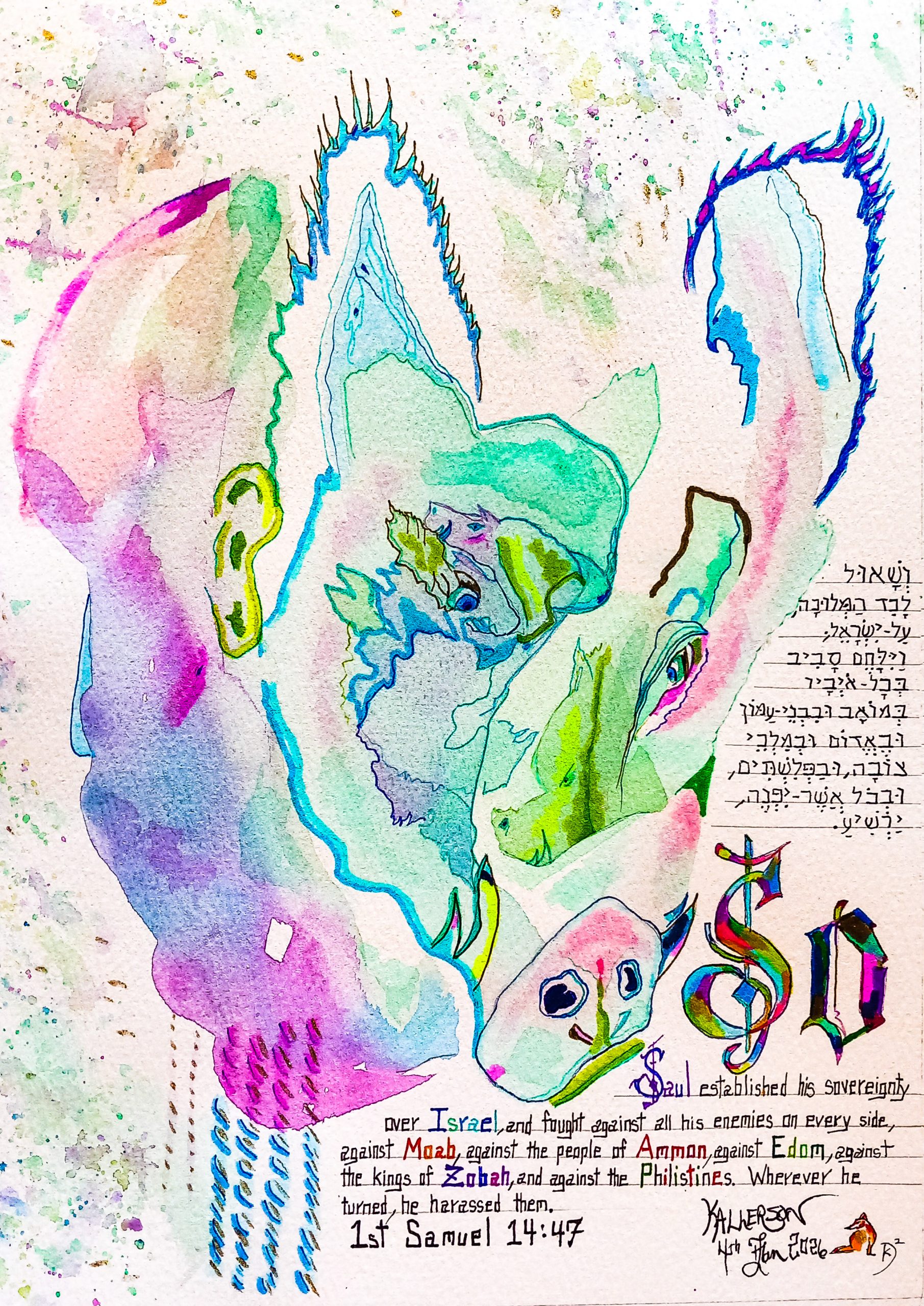
Artwork by Douglas Kallerson.
1 Samuel 14:46-52
And Saul, He Caught the Kingdom, Part II
(Typed 6 October 2025) In these verses, Saul has to figure out why the Lord will not respond to the question he asked Him. He will have to go through a step-by-step process to find the cause. Fortunately, he only has to go through a few steps to discover his answer.
A few days before typing this sermon, I had a problem. It was compounded by another problem that I have had at the house for almost a year. However, nobody could figure out the resolution to that.
My internet is amazingly fast, with the exception of one site. Unfortunately, it is a site I use multiple times every day, the church website. A normal post will take 15 seconds to upload and process, maybe less. At the house, it takes two minutes or more. This happens on any device, mine or anyone else’s.
These devices, including my iPad that I use here at church, work normally. A Frontier specialist at the house couldn’t figure it out. He switched, in the middle of an upload, from my internet to his cell service, and it immediately changed to working normally.
After many more tests, he said that in 30 years, he had never encountered this. The specialists at Frontier have no idea. So now imagine the time it took to fix the next problem.
When I went to upload a sermon on Tuesday morning, the upload was blocked. This has happened before if malicious code is inserted. That requires going to the server and rebooting it. That didn’t fix it.
The reason it didn’t work was that the only thing being blocked was the sermon. Everything else could be uploaded. So, I uploaded half the sermon. No problem. Then I tried posting the other half. Blocked. So I posted the first half of the second half. No problem.
Then I posted the second half of it. Blocked. I kept doing this until I figured out it was my translation of 1 Samuel 9. I tried half of it. Blocked. I posted the second half, and it was OK. I then tried the first three verses. Blocked. The rest posted ok.
Then I tried to post it verse by verse. Verse 2 was blocked. I then posted each half. No problem. Oh my! So I sent the verse to Sergio. He figured there was a virus hidden in that verse. So I made a new post and typed it manually. Blocked. Not a virus.
We went to a site that evaluated such things and put the verse in. It came up with about eighty pages of code. He ran that through ChatGPT. It analyzed it and said –
“… Saul – select and good … From his shoulders. Many WAF rules (including Sucuri) look for the SQL pattern SELECT … FROM in a case-insensitive way and often ignore punctuation and line breaks. Your wording creates that exact sequence.”
The words Select and From are used to form a code that malicious viruses use to ruin other people’s stuff. It took me two hours to get this figured out.
Text Verse: “And to him, it was son, and his name Saul – select and good. And not man from sons Israel good from him. From his shoulders and upward higher from all the people.” 1 Samuel 9:2 (CG)
Someday, we won’t have to worry about hackers, coding, and slow internet. Until then, we have to live through these things. Saul wanted to figure out why the Lord wouldn’t respond to him. At times, we might think the Lord isn’t listening to us, but He is.
We don’t need to worry about that. If a response to a prayer seems overdue in coming, that’s just the way the Lord’s timing works sometimes. If God answered every prayer we made right when we made it, we, not He, would never get anything done.
The way things are is just how they should be. This is a truth that we can learn from His superior word. And so, let us turn to that precious word once again, and… May God speak to us through His word today, and may His glorious name ever be praised.
I. He Struck Amalek (verses 46-48)
In the previous verses, Saul’s rash vow that no man should eat until the evening brought Israel a considerable amount of loss in their battle against the Philistines. The army was weakened due to a lack of nourishment, fatigue set in, and the victory was not as pronounced as it could have been.
Along with that, Jonathan didn’t hear Saul’s adjuration and ate some honey. This brought Saul to the point of exclaiming that Jonathan should die for what he did. Were it not for the men of the army speaking up for Jonathan and redeeming him from death, Saul would have carried out his word.
Along with these events, without any word from the Lord to instruct him concerning continued battle, Saul had no choice but to remain at the camp, allowing the Philistines to continue their retreat without further engagement by Israel. Because of this…
46 Then Saul returned from pursuing the Philistines,
vayaal shaul meakhare pelishtim – “And he ascended, Saul, from after Philistines.” This means that not only did Saul cease the attack, but he would have turned and ascended to his previous location of Gibeah, noted in verse 2, forsaking any further battle at this time.
Saul means Asked. As a consequence of his actions…
46 (con’t) and the Philistines went to their own place.
u-phelishtim halekhu limqomam – “And Philistines, they walked to their place.” The Philistines did not suffer complete defeat. They were able to return to their five cities and would be able to rest, rearm, and eventually reengage in the battle.
Despite this, the victory for Israel was considered a resounding success. They had caused the complete retreat of the Philistines from Israelite territory. These words begin to close out the previous section. Next, the narrative turns to a parenthetical explanation of the state of Israel with Saul as its head. Then, the rest of the previous narrative will resume and complete the chapter…
47 So Saul established his sovereignty over Israel,
Rather: veshaul lakhad hamelukhah al Yisrael – (“And Saul, he caught the kingdom upon Israel.” The NKJV says “so,” implying that these words are a result of the previous thought. This is not the intent. Rather, that thought was complete. What is presented here through the end of the chapter is a summary of Saul’s kingship.
This can be deduced because a general listing of the various foes he faced will be detailed. Following this will be a listing of various family members. After that, there is a note that Saul battles against the Philistines all his days. As such, this verse begins this short summary of Saul’s kingship.
First is the word lakad. It signifies to catch or capture. It is generally used to indicate taking a city in battle. It is also used when someone is taken during the casting of the lots. In all of its uses, there is a sense of purposeful capturing that has taken place.
It was used in this latter way when Saul was taken in the lots, having been selected as the first king of Israel. It was also used in verses 41 & 42 when Saul and Jonathan were taken by lot, and then Jonathan was taken when the lot was cast between the two of them.
The sense, then, is the seizure of something. Saying that he established his sovereignty is correct to a point, but it was his selection by lot, which was followed by his military victories as leader of the army, that is being highlighted. The kingly power was caught, and the full authority that goes with it was solidified under him.
The use of this word is specifically designed to help us understand what is going on. Therefore, because he has caught the kingdom and solidified his power, the next thought is better understood…
47 (con’t) and fought
Still speaking of Saul: vayilakhem – “And he was fought.” Notice that it doesn’t say that Israel was fought. Though that is understood, Saul now stands as representative of the forces of Israel. One can see this thought expressed elsewhere –
“When it was told David, he gathered all Israel, crossed over the Jordan, and came to Helam. And the Syrians set themselves in battle array against David and fought with him. 18 Then the Syrians fled before Israel; and David killed seven hundred charioteers and forty thousand horsemen of the Syrians, and struck Shobach the commander of their army, who died there.” 2 Samuel 10:17, 18
Saul, as the leader of Israel’s armies was fought…
47 (con’t) against all his enemies on every side,
saviv bekhal oyevav – “around in all his hatings.” Saying that Saul was fought in this matter intensifies the state of Israel at that time. They were surrounded by those with whom they were at enmity. The kingdom began in a state of troubled vexation leading to constant battles…
47 (con’t) against Moab, against the people of Ammon, against Edom, against the kings of Zobah, and against the Philistines.
bemoav u-vivne amon u-veedom u-vemalkhe tsovah u-bapelishtim – “in Moab, and in sons Ammon, and in Edom, and in kings Zobah, and in the Philistines.” The foes mentioned almost encompass Israel. Moab is to the east of the Dead Sea, and Ammon is north of that, to the northeast corner of the Dead Sea. Edom is south of Moab, to the south and southeast of the Dead Sea.
The kings of Zobah were to the north and northeast of Israel. They extended far past Damascus, between the Euphrates and the Orontes. The Philistines held territory in the west of Canaan along the Mediterranean Sea.
Moab means From Father. Ammon signifies A People. Edom means Red or Ruddy, being etymologically connected to Adam. Zobah (Tsovah) is introduced here. Though probably not a Hebrew name, several Hebrew words that would be on the mind of a reader would give the possible sense of Engagement (as in interacting), Collective, or Beauty. Strong’s, however, defines it as Station. Philistines signifies Weakeners. With all these foes around…
47 (con’t) Wherever he turned, he harassed them.
u-vekhol asher yiphneh yarshia – “And in all which he will turn, he will cause to condemn.” The word rasha is used here. It signifies to do or declare wrong, thus, to condemn. For example –
“For any kind of trespass, whether it concerns an ox, a donkey, a sheep, or clothing, or for any kind of lost thing which another claims to be his, the cause of both parties shall come before the judges; and whomever the judges condemn [rasha] shall pay double to his neighbor.” Exodus 22:9
The use of this word in such an unusual context is striking and has caused a lot of debate as to the intent. Translations, not knowing what to do with it, are all over the place: inflicted punishment, vexed, distressed, disturbed, harassed, routed, struck down, was victorious, overcame, was successful, to the worse, conquering, caused havoc, troubled, discomfited, handled them as wicked, etc.
There is no need, however, to depart from the word’s intended meaning. What is being said is that “he was fought” by these nations, implying that they felt they had a right to his kingdom. However, in fighting back and prevailing, he condemned their actions. Next, Israel’s ancient foe is highlighted…
48 And he gathered an army
vayaas khayil – “And he made valor.” The noun khayil is widely rendered. It is derived from khul, to whirl or twist. Thus, it literally signifies a whirling, as in, “and he made a whirling.” That, however, gives the sense of a force. Something twisted is under tension. Something whirling is a force as it spins.
The word valor would be an aspect of such a force where courage and gallantry are highlighted, such as in combat. This is then reflected in the next words…
48 (con’t) and attacked the Amalekites,
vayak eth amaleq – “and he caused to strike Amalek.” Amalek is not mentioned in the previously listed nations because they generally comprised bands of marauding raiders, not being established in a particular location. The main battle against this foe is described in Chapter 15.
Amalek is derived from the word am, people, and malaq, to nip or wring off the head of a bird with or without severing it from the body. They are The People Who Wring Off. They are those who are disconnected from the body and strive to disconnect the body.
48 (con’t) and delivered Israel from the hands of those who plundered them.
vayatsel eth Yisrael miyad shosehu – “and he caused to snatch Israel from hand plundering him.” The meaning is derived from when Amalek would raid Israel when they were weak or unsuspecting. Samuel refers to the first instance as the reason for engaging them –
“Samuel also said to Saul, ‘The Lord sent me to anoint you king over His people, over Israel. Now therefore, heed the voice of the words of the Lord. 2 Thus says the Lord of hosts: ‘I will punish Amalek for what he did to Israel, how he ambushed him on the way when he came up from Egypt.’” 1 Samuel 15:1, 2
With the military aspect of Saul’s kingdom noted, the next thought presented is that of his royal family…
Fighting the enemy on every side
But it’s no sweat when you know the Lord
It’s like going for a Sunday ride
When you stay grounded in His word
Yes, the enemies can be trying at times
They can seem overwhelming, but not for long
As soon as Bible reading hour chimes
Then comes the encouragement to make you strong
Then you get back in the fight, sure to win
Because you remember you are aligned with Jesus
The enemy won’t prevail. No, he’s done in
Because of the great thing God has done for us
II. Son of Valor (verses 49-52)
49 The sons of Saul were Jonathan, Jishui, and Malchishua.
vayihyu bene shaul Yonathan veyishvi u-malkishua – “And they were, sons Saul, Jonathan, and Ishvi, and Malchishua.” Jonathan means Yah Has Given. Ishvi either comes from “man” and a shortened form of Yehovah, and thus, Man of Yah, or it comes from shavah, to level, and thus Equal or Equalize. It is believed that he is the same person as Abinadab in 1 Samuel 31:2.
Malchishua is derived from melekh, king, along with one of several possible roots. And so, it means something like King of Salvation, King of Help, My King is Opulence, or King of Wealth.
One other son of Saul is mentioned elsewhere, Ishbosheth (aka Eshbaal). It is not known why he isn’t listed here.
49 (con’t) And the names of his two daughters were these: the name of the firstborn Merab, and the name of the younger Michal.
veshem shete venotav shem ha’bekhirah merav veshem ha’qethanah mikhal – “And name two his daughters: name the firstborn, Merab, and name the diminutive Michal.” Merab means Multiplication or Increase, coming from ravav, a verb signifying to multiply or increase.
Michal is identical to mikal, a rivulet. But it could also be a shortened form of Michael, derived from mi (who), k (according to), and el (God), and thus means Who Is Like God.
50 The name of Saul’s wife was Ahinoam the daughter of Ahimaaz.
veshem esheth shaul akhinoam bath akhimaats – “And name, wife Saul, Ahinoam – daughter Ahimaaz.” Ahinoam is derived from akh, brother, and the verb naem, to be pleasant. Therefore, various possibilities are Brother of Pleasantness, My Brother is Delight, Kindred to Sweetness, or Delightful Ally. The last two look at “brother” in the figurative sense.
Ahimaaz is derived from akh, brother, and the Arabic maats, enraged. Thus, it is believed to mean Brother of Anger or My Brother is Wrath. Strong’s defines it as coming from atsah, to fasten. If so, it may mean something like My Brother is Fastened, Brother of Closure, or something similar.
50 (con’t) And the name of the commander of his army was Abner the son of Ner, Saul’s uncle.
veshem sar tsevao aviner ben ner dod shaul – “And name, commander his host, Abiner son Ner, uncle – Saul.” The name is normally spelled Abner. Here, it is uniquely spelled Abiner. The name comes from av, father, and ner, lamp. Thus, it would mean Father of Light, Father Is a Lamp, etc. However, the inclusion of the i would make it possessive, My Father Is Light (a Lamp). Ner means Lamp.
51 Kish was the father of Saul, and Ner the father of Abner was the son of Abiel.
This ends the parenthesis that began in verse 47: veqish avi shaul vener avi avner ben aviel – “And Kish, father Saul, and Ner, father Abner, son Abiel.)” Kish was previously defined as Ensnared. The difficulty with the relationships between these men was discussed in 1 Samuel 9. Refer to the comments there if you need to. Abiel means God Is My Father. Next, the words of verse 46 resume to close out the chapter…
52 Now there was fierce war with the Philistines all the days of Saul.
vatehi ha’milkhamah khazaqah al pelishtim kol yeme shaul – “And it was the battle strong upon Philistines all days Saul.” One can see how the thought of verse 46 flows directly into these words –
“And he ascended, Saul, from after Philistines. And Philistines, they walked to their place. … 52 And it was the battle strong upon Philistines all days Saul. And he saw, Saul, all man powerful, and all son valor, and he gathered him unto him.”
Saul was not able to completely subdue the Philistines due to his rash vow, leading to a lack of response by the Lord, even after the troops were refreshed. This meant he had to face the enemy time and again throughout his reign.
In order to meet the demands of warfare against the Philistines and the other foes mentioned above, this final thought is presented…
*52 (fin) And when Saul saw any strong man or any valiant man, he took him for himself.
veraah shaul kal ish gibor vekhal ben khayil vayaasphehu elav – “And he saw, Saul, all man powerful, and all son valor, and he gathered unto him.” This statement seems a bit disconnected from a typical ending to the chapter. Some think it is an explanation of the previous sentence. That is true, but it is setting up the later narrative of David as well –
“Then one of the servants answered and said, ‘Look, I have seen a son of Jesse the Bethlehemite, who is skillful in playing, a mighty man of valor [khayil], a man of war, prudent in speech, and a handsome person; and the Lord is with him.’
19 Therefore Saul sent messengers to Jesse, and said, ‘Send me your son David, who is with the sheep.’” 1 Samuel 16:18, 19
Saul’s theocratic reign essentially ended in Chapter 13. The ending of his earthly reign and the need to anoint his successor begins in the next chapter. That will bring about the events that eventually lead to the death of Saul and his sons at the end of 1 Samuel. Thus, the words closing out this chapter anticipate David joining Saul’s army as a part of that process.
A list of names is found in His word
Without any reason given for it being there
But remember the lesson that you’ve heard
To find Jesus, just research the word with care
He is found in what God is telling us
He is the reason for the giving of the word
So be sure to think about how it all points to Jesus
Yes, remember this lesson that you’ve heard
The Lord wants us to see His Son in it
To search for Him, because He is there
It may take time and study – more than a bit
But you will be rewarded with Jesus everywhere
III. Christ in the Contents
There are two accounts to be evaluated. The first encompasses the contents of verses 31-46 and also includes verse 52. The second comprises verses 47-51.
The first began in verse 31 with the statement that Israel had driven back the Philistines from Michmash to Aijalon. It is saying that the Weakeners were driven from the Treasury to Place of Strength. Thus, it means that Israel held Aijalon (Place of Strength), and it is where the subsequent events take place.
Thus, the spiritual battle being described shows that the Weakeners will be beaten. They will no longer mishandle the Bible, and Israel will be in the place of strength when they are battling in faith. This is based on Jonathan’s leading the battle solely through faith in the Lord.
The next thing introduced in verse 32, which is never condemned elsewhere, is the unusual note that the people supposedly sinned to Yehovah by eating the blood. But what was their action based on? It was based on Jonathan’s act of faith, which eventually led to Saul’s rash oath that no one should eat.
Jonathan had eaten, and he was strengthened. The people followed Jonathan’s act of faith –
“Then Jesus said to them, ‘Most assuredly, I say to you, unless you eat the flesh of the Son of Man and drink His blood, you have no life in you. 54 Whoever eats My flesh and drinks My blood has eternal life, and I will raise him up at the last day. 55 For My flesh is food indeed, and My blood is drink indeed. 56 He who eats My flesh and drinks My blood abides in Me, and I in him. 57 As the living Father sent Me, and I live because of the Father, so he who feeds on Me will live because of Me. 58 This is the bread which came down from heaven—not as your fathers ate the manna, and are dead. He who eats this bread will live forever.’” John 6:53-58
The specific animals point to Christ as the plunder of the Philistines. The sheep, tson, comes from a root signifying to migrate. Think of the migration of people in search of Christ, just as they are in search of food. Of the tson, the Topical Lexicon rightly states, “The history of flock sacrifices informs present gratitude for the once-for-all sacrifice of Christ.”
The cattle, baqar, comes from a root signifying to inquire or seek, which is what those who want to find Christ will do. These cattle are the plunder of the Weakeners, meaning those who rob others of Christ. Slaughtering them “earthward” looks to the internment of Christ in the tomb. This was followed by the people eating the blood –
“Likewise He also took the cup after supper, saying, ‘This cup is the new covenant in My blood, which is shed for you.’” Luke 22:20
Saul, however, defaults to the law in verse 33 after being told that the people were sinning against Yehovah. But the blood is the life. As such, the blood of Christ is eternal life. Saul, however, sees this as a covert act and calls for a stone to be rolled unto him. This would be used to properly slaughter the animals.
In verse 34, Saul changes the names of the animals, calling for the people to bring their ox, shor, and seh, sheep. The roots give the sense of turning and making desolate. In this case, they are to be taken in a negative sense of the people turning from their faith, making it desolate.
Instead of honoring the Lord through faith as Jonathan had, Saul has a confused sense of what is right. He is seeking the truth, but he is theologically confused and can never seem to put his foot down in the right place, meaning trusting by faith.
Verse 35 noted, “And he built, Saul, altar to Yehovah. It, he caused to begin to build, altar to Yehovah.” Just after the Ten Commandments were given, the law of the altar was detailed. Saul took the stone that he used for the sacrifices and began to build an altar with it.
What was the altar described in Exodus 20 intended to anticipate? Jesus. Saul has missed the point of salvation by faith and is determined to build an altar to Yehovah, thus building his own anticipation of the Messiah instead of what God offered through faith. Despite battling the Weakeners, Saul can never seem to defeat them because his actions lack the faith necessary to traverse that gap, something Jonathan readily did.
The next thing mentioned was in verse 36. Saul desired to go down by night after the Philistines, the Weakeners, plundering them until the morning. But that is contrary to the message of Jesus. He notes in John 9:4 that the “night is coming when no one can work.”
The people, desiring to do Saul’s will, told him that he should do what was good in his eyes. However, that alerted the priest that they should first “near, here, unto ‘the God.’” It would be unfathomable to build an altar to Yehovah and then not ask God if He was with them in the venture they planned to set out on.
Understanding the priest’s words is necessary to understanding what is going on. The article before God is always used to express being in a right relationship with God or to contrast those who are not. In this case, the answer for Saul comes back right away, but it comes through the lack of any answer!
He asks his questions of the Lord in verse 37. The first is whether he should descend after the Philistines. The second is whether the Lord will deliver them into his hand. As noted, if only the first question had been asked, the Lord could have said yes but have handed Israel into the hands of the Philistines.
Such could be expected after the men had eaten the blood. However, neither question was answered that day. Saul completely misunderstood what was going on and called over the corners of the people in verse 38. They are defined by the word pinnah, a corner or cornerstone. It is the place of stability, strength, and support.
They represent the stability of people, a stability only found in Christ, the Chief Cornerstone of Psalm 118. In verse 39, Saul tells the people that if the sin he assumes is the cause for the Lord not responding is found, even in Jonathan, Yah Has Given, he would die. Jonathan represents those who are given their gift (faith) from the Lord.
These men never responded. Instead, they awaited the falling of the lot. As such, in verse 40, Saul divided himself and Jonathan from them, side against side. Again, as in verse 36, they emphatically told Saul ha’tov beenekha aseh, “the good in your eyes, you must do.”
Therefore, in verse 41, Saul said to the Lord God of Israel, “You must give-ward spotless.” In response from the Lord, Saul and Jonathan were taken. Therefore, in verse 42, Saul called for the lot to fall between himself and Jonathan. When it was cast, it said, “And he was caught, Jonathan.”
Saul assumed that this meant there was guilt in Jonathan. But Saul had said, “You must give-ward spotless.” The result was Jonathan being caught. Saul assumed the lot favored him, meaning he must be innocent. But that is not the case. Only Saul assumes the guilt is in others.
However, he is the one who has failed to understand Jonathan’s act of faith. Everyone else seemed to understand it except Saul. Saul next pressed Jonathan, asking what he did. Jonathan, now assuming he had done wrong because of Saul’s adamancy, admitted he tasted honey with the end of his branch.
This foreshadows going to the word and tasting Paul’s writings, finding in them grace through faith. Because Saul found error in that, Jonathan acknowledges he should die. Saul agreed with an emphatic statement (verse 44) that this is surely what would come about.
Saul was more concerned with saving face than acknowledging Jonathan’s proven ability. However, this was not the case with the people. In verse 45, they recognized what Saul had been unable or unwilling to acknowledge, exclaiming, “The ‘Yah Has Given’ will die?” Rather, it is the faith given to him by the Lord that brought about the salvation in Israel!
The intent of the words is obvious. Unless one uses the gift of the Lord, grace through faith, salvation will never come about. The contrast to Saul returning to the law for a sacrificial altar is highlighted in their words.
It is reflective of the words of Hebrews 10:26, “For if we sin willfully after we have received the knowledge of the truth, there no longer remains a sacrifice for sins.” Sacrifices after the coming of Christ are no longer acceptable. Only faith in what He has done is accredited to man for salvation.
The people’s words concerning Jonathan not being harmed acknowledge that it is he who is right with God, something the lot had already disclosed. Because of that, it said that the people redeemed Jonathan. In other words, the doctrine of salvation by grace through faith has been upheld.
Next, the narrative jumps to verse 52 as a closing thought, noting that the battle remained strong upon the Philistines all the days of Saul. The typological meaning is that during the days of asking for the truth, the spiritual battle will continue. Only when the truth is decided upon will it be complete.
During his rule, however, it noted that when Saul, Asked, saw powerful sons of valor, he gathered them unto him. The purpose of that statement will find its most important realization in Chapter 16 with the selection of David to serve him.
The reason why Saul did not fully defeat the Philistines, and the reason he will continue to fight them for the rest of his life, is that he cannot get himself to come down solely on the doctrine of salvation by grace through faith alone. He keeps inserting himself into the equation.
Understanding this, the second section, which comprises verses 47-51, was inserted as an explanation of the rule of Saul. The meaning can be seen in the names provided.
It essentially says, “And Asked caught the kingdom upon Israel. And he was fought around in all his hatings.” Those seeking the truth, represented by Saul, will lead Israel before the time of the millennial kingdom. This fight will be against several named enemies. The first is Moab, From Father, representing those who have rejected Christ –
“You are of your father the devil, and the desires of your father you want to do. He was a murderer from the beginning, and does not stand in the truth, because there is no truth in him. When he speaks a lie, he speaks from his own resources, for he is a liar and the father of it.” John 8:44
Next is Ammon, A People. They are the Jews who are “not My people,” meaning those who rejected Jesus, according to Hosea 1 and Romans 9.
That is followed by Edom, Red, representing those who have not transferred from the headship of Adam to that of Christ. They are still unregenerate and fallen.
Lastly, Zobah, was named. Of the various root words the name resembles, one gets the sense of it reflecting those who engage against the will of the Lord, taking their station against the Lord’s people. The words concerning Saul’s engagement with these foes were unusual but understandable: “And in all which he will turn, he will cause to condemn.”
In other words, these contrary spiritual groups come with their falsities, and each is shown to be false and condemned as such.
Verse 48 noted Saul making valor, meaning a strong force, and striking the ancient foe, Amalek. The Amalekites are not of the body, and they strive to disconnect the body, just as the Philistines and others do. The whole picture is that of law versus grace and those who strive from one side or the other.
With that short section complete, the naming of those in Saul’s family was provided. They form a marvelous picture of God in Christ. Saul’s sons are Yah Has Given, Man of Yah, and King of Salvation. It forms a picture of the incarnation and what Jesus would accomplish.
Saul’s daughters are Multiplication (Increase) and Who Is Like God. They describe the effect of Christ’s work in the people of the world. His people form a body that has multiplied and that bears the resemblance of Christ.
The wife of Saul is “Kindred to Sweetness, the daughter of Brother of Closure.” The verb translated as sweetness naem, was used in describing Solomon’s beloved, representing the church, in Song of Songs 7:6. It is those God cherishes and to whom He then provides eternal salvation. The names reflect the relationship of Christ to His people.
Next, Abiner was named. Understanding that the word dod, uncle, also means beloved, the words say, “And name commander his host, My Father Is Light, son Lamp, beloved – Asked.” The symbolism is explained in Revelation, where the Son is said to be the Lamp of God through which God radiates to His people.
One can see the Father/Son relationship that is expressed in light upon those who have asked for and received the truth in Christ.
The last words of verse 51 refer to those ensnared by the law and living without Christ (Kish), but who then lead to those who will seek the truth (Asked). They will find what they seek in Christ whose Father is God.
The family of Saul is given to provide these hints of Christ. They reveal His relationship within the Godhead and with the people of God. Like other such clusters of names, the word highlights these things while giving a real account concerning some of those we will interact with again as we continue through the coming chapters.
Like the words concerning Saul mentioned at the beginning of the sermon, Select and From, God is giving us coded information in His word. The way to retrieve it is like the process I went through to figure out what was wrong with our website.
We have to carefully, methodically, and meticulously search each word and its possible connection to what God is telling us elsewhere. Once that is determined, we can then take that coded information and lay it out to reveal what is being expressed.
The process is long and tiring at times, but it is worth the effort. Then we can see what is on the mind of God and adjust our lives to what is being expressed. Unfortunately, I know people who have been told about the problem with law and how it is opposed to grace, and yet they continue down the path of law observance.
It is as if their operating system is broken and they choose not to fix it. Regarding that translation, the easiest thing for me to do once I found out what was causing the uploading problem would have been to change the translation, tweaking it so that the problem would just go away. That is what ChatGPT suggested.
But that doesn’t solve the greater problem. The word is set, and it cannot be manipulated to suit our whims. Rather, we must find the “exemption code” and apply it to our walk with God. In the case of the church website, the translation remained unchanged, and I added my IP address to the exemption list.
By doing that, anything I publish for the website from my home IP address is overlooked, even if it is suspicious. In the case of our sin, we must have an exemption in place, or we will remain in our sin. The exemption comes by moving from law to grace. Without that, we will never be restored to God.
All people are born under law, be it the law Adam violated or the Law of Moses. None are exempt from law without receiving Christ’s perfect righteousness. Take to heart what is being expressed in these stories of 1 Samuel. The same theme keeps getting repeated again and again in various ways to instruct us on how to find the right path.
Let us look to Jesus in faith. In doing so, our steps will be in line with what God intends.
Closing Verse: “And we have stable the prophetic word which attending we do well, as a lamp shining in an obscure place until that day – it shall gleam through, and light bearing – it shall arise in your hearts.” 1 Peter 1:19 (CG)
Next Week: 1 Samuel 15:1-12 Funner than chicken dinners with no check, super fun… (Anathematize the Sinners – Amalek, Part I) (30th 1 Samuel Sermon)
The Lord has you exactly where He wants you. He has a good plan and purpose for you. He is the One who abases the haughty and exalts the humble. He regards the lowly, and the proud, He knows from afar. So yield yourself to Him, trust Him, and believe His word. In this, He will do great things for you and through you.
1 Samuel 14:46-52 (CG)
46 And he ascended, Saul, from after Philistines. And Philistines, they walked to their place.
47 And Saul, he caught the kingdom upon Israel. And he was fought around in all his hatings: in Moab, and in sons Ammon, and in Edom, and in kings Zobah, and in the Philistines. And in all which he will turn, he will cause to condemn. 48 And he made valor, and he caused to strike Amalek, and he caused to snatch Israel from hand plundering him.
49 And they were, sons Saul, Jonathan, and Ishvi, and Malchishua. And name two his daughters: name the firstborn, Merab, and name the diminutive Michal. 50 And name, wife Saul, Ahinoam – daughter Ahimaaz. And name, commander his host, Abiner son Ner, uncle – Saul. 51 And Kish, father Saul, and Ner, father Abner, son Abiel.
52 And it was the battle strong upon Philistines all days Saul. And he saw, Saul, all man powerful, son valor, and he gathered unto him.
1 Samuel 14:46-52 (NKJV)
46 Then Saul returned from pursuing the Philistines, and the Philistines went to their own place.
47 So Saul established his sovereignty over Israel, and fought against all his enemies on every side, against Moab, against the people of Ammon, against Edom, against the kings of Zobah, and against the Philistines. Wherever he turned, he harassed them. 48 And he gathered an army and attacked the Amalekites, and delivered Israel from the hands of those who plundered them.
49 The sons of Saul were Jonathan, Jishui, and Malchishua. And the names of his two daughters were these: the name of the firstborn Merab, and the name of the younger Michal. 50 The name of Saul’s wife was Ahinoam the daughter of Ahimaaz. And the name of the commander of his army was Abner the son of Ner, Saul’s uncle. 51 Kish was the father of Saul, and Ner the father of Abner was the son of Abiel.
52 Now there was fierce war with the Philistines all the days of Saul. And when Saul saw any strong man or any valiant man, he took him for himself.