
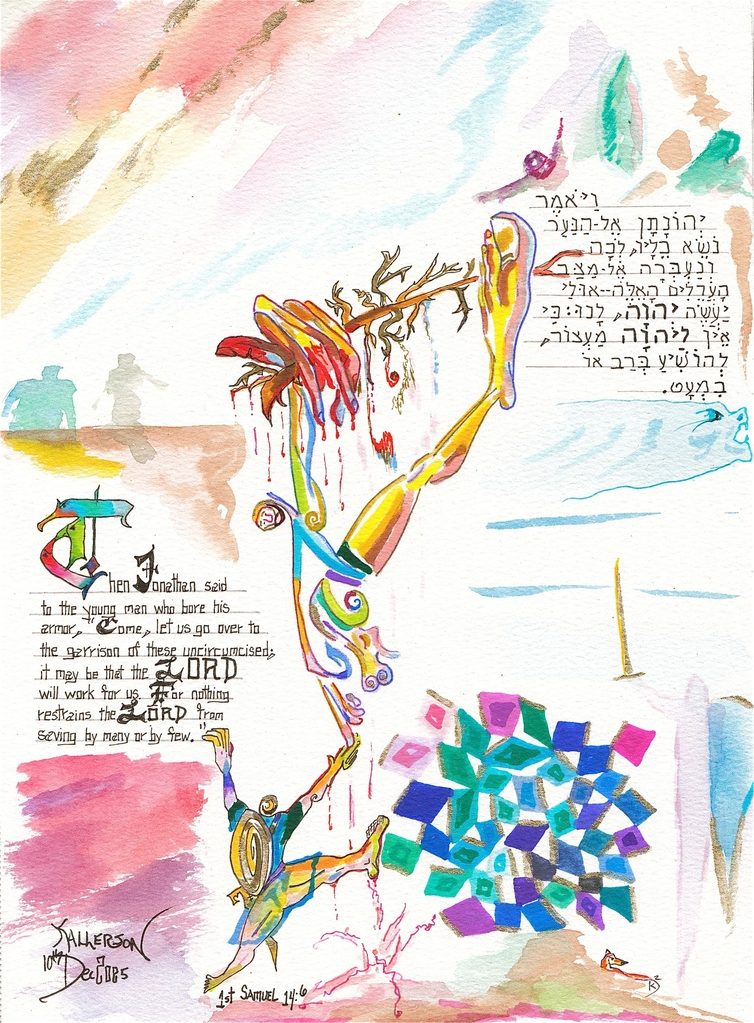
Artwork by Douglas Kallerson.
1 Samuel 14:1-14
To Save in Many or in Few
(Typed 15 September 2025) I have wanted to evaluate these verses for years. One reason is that ten or more years ago, as Sergio read them in his morning reading, he tried to figure out what is being said with the giving of the names of the sharp rocks.
The words are unusual, and the story is captivating. So he spent time looking it over. He didn’t come to any resolution, nor did I after looking at them myself. Proper study requires understanding the surrounding context and what is typologically being conveyed. Such information takes innumerable hours of study.
One cannot just start evaluating a few verses alone and come to a correct conclusion about what is being said. But this is how many people approach Bible study. Therefore, if you go online and search for the meaning behind the surface text, you will get all kinds of analyses that have nothing to do with what God is telling us.
The normal thing you find is that people come to conclusions based upon what they want the passage to say, not what God is telling us.
Text Verse: “…whose minds the god of this age has blinded, who do not believe, lest the light of the gospel of the glory of Christ, who is the image of God, should shine on them.” 2 Corinthians 4:6
The second reason for waiting excitedly to evaluate this story is that it bears on something that occurred in World War I. Amended from an article online, this is what took place –
During the Sinai-Palestine Campaign in 1918, the British had plans to attack Ottoman forces entrenched in an area known as Michmash. Recognizing the name, British Major Vivian Gilbert got his Bible and found where Michmash is mentioned. He then reported it to his commanding officer. In an excerpt from the events detailed in The Romance of the Last Crusade, it says:
“And the major read on how Jonathan went through the pass, or passage of Mickmash, between Bozez and Seneh, and climbed the hill dragging his armour-bearer with him until they came to a place high up, about “a half acre of land, which a yoke of oxen might plow”; and the Philistines who were sleeping awoke, thought they were surrounded by the armies of Saul and fled in disorder, and “the multitudes melted away.” Saul then attacked with his whole army. It was a great victory for him; his first against the Philistines, and “so the Lord saved Israel that day, and the battle passed over into Beth Aven.”
The major figured the general layout of the land would probably have remained unchanged. So he roused the brigadier, and they read the story again. Scouts were sent out. On their return, they reported finding the pass with a few Turks holding it.
The rocky crags on either side were as the Bible described. As the account says, it was “obviously Bozez and Seneh; whilst in the distance, high up in Mickmash the moonlight was shining on a flat piece of ground just big enough for a team to plough.”
The general changed the plan of attack. Instead of the whole brigade, “one infantry company alone advanced at dead of night along the pass of Mickmash. A few Turks met were silently dealt with. We passed between Bozez and Seneh, climbed the hillside and, just before dawn, found ourselves on the flat piece of ground.”
The sleeping Turks awoke, figured they were surrounded by the armies of Allenby, and fled.
The Bible is that reliable. Amazing things are to be found in His superior word. And so, let us turn to that precious word once again, and… May God speak to us through His word today, and may His glorious name ever be praised.
I. Bozez and Seneh (verses 1-5)
Now it happened one day
The words are specific: vayhi ha’yom – “And it was, the day.” This is a continuation of the closing words of Chapter 13 –
“And it was, in day battle, and not it was found sword and spear in hand all the people who with Saul and with Jonathan. And it was found to Saul and to Jonathan his son. 23 And it went, post Philistines, unto passage Michmash. … And it was, the day.” 1 Samuel 13:22, 23
1 (con’t) that Jonathan the son of Saul said to the young man who bore his armor,
vayomer Yonathan ben shaul el ha’naar nose khelav – “and he said, Jonathan, son Saul, unto the lad lifting his vessels.” The person with Jonathan is almost universally translated as some form of the words “armor bearer.” That may be correct, but it is a paraphrase. The exact words are “lifting his vessels.”
He may be an attendant at all times, such as bringing his nightly meals, carrying water for a bath, or bearing his armor. It may also be that he only attended to him when going into battle. In this case, verse 13 will tell exactly what purpose he had in this battle.
In the Bible’s poignant way of using only relevant information to reveal typology, the name of this person, who is so carefully described and specifically mentioned nine times, is never given.
Jonathan means Yah Has Given. Saul means Asked, as in Asked for.
1 (con’t) “Come, let us go over to the Philistines’ garrison that is on the other side.”
lekhah venaberah el matsav pelishtim asher meever halaz – “You must walk-ward, and let us traverse unto garrison Philistines from across this.” The words “You must walk-ward,” are a way of saying, “Let’s get going,” probably while nodding in the direction he wanted to go.
From there, he then explains his intended target. It is the same place noted in the final verse of Chapter 13. Philistines means Weakeners. The narrative is being prepared. That is next highlighted…
1 (con’t) But he did not tell his father.
u-leaviv lo higid – “And his father, not he caused to declare.” Jonathan was probably itchy to engage the Philistines. With his father encamped in a different location, it would have taken time to send a runner to explain his intentions, and there was always the chance of a return message telling him not to take any action.
From here until the start of 14:4, the following words are a parenthetical explanatory insert…
2 And Saul was sitting in the outskirts of Gibeah
veshaul yoshev biqtseh hagivah – “(And Saul sitting in extremity the Gibeah.” If this is the northern extremity of Gibeah, as some scholars think, it would be about an hour’s march from where Jonathan was in Geba. Saying “sitting” is a literal translation. It could be he had a thronelike chair set there. It could also mean his tent was there. The word yoshev, to sit, carries a wide variety of meanings.
The Gibeah means The Hill. At this time, Saul was…
2 (con’t) under a pomegranate tree which is in Migron.
Rather: takhath ha’rimon asher bemigron – “under the pomegranate which in Migron.” The exact intent is debated. All it says is “the pomegranate.” It thus could mean a particular pomegranate tree. This would be similar to the thought of 1 Samuel 22:6, which says, “…and Saul sitting in the Gibeah under the tamarisk.”
This could also be speaking of “Rock the Rimmon,” meaning “Rock the Pomegranate,” in Judges 20:47. Thus, he would be sitting under a large crag known by this name. Without further information, being dogmatic may mean barking up the wrong tree.
Strong’s says that Migron is from magar, to yield up. Intensively, it would mean to precipitate. Therefore, it may mean Precipice. Jones’ says it is derived from garah, to excite as in strife, and defines it as Place of Great Conflict. The final letters of the word, a vav and nun, are probably locative.
Along with Saul…
2 (con’t) The people who were with him were about six hundred men.
veha’am asher imo keshesh meoth ish – “And the people which with him according to six hundreds man.” These words correspond to those of the previous chapter –
“And he arose, Samuel, and he ascended from the Gilgal – Gibeah Benjamin. And he visited, Saul, the people, the ‘being found with him’ according to six hundreds man.” 1 Samuel 13:15
Six hundred is a multiple of six and tens.
Bullinger says, “Six is either 4 plus 2, i.e., man’s world (4) with man’s enmity to God (2) brought in: or it is 5 plus 1, the grace of God made of none effect by man’s addition to it, or perversion, or corruption of it: or it is 7 minus 1, i.e., man’s coming short of spiritual perfection. In any case, therefore, it has to do with man; it is the number of imperfection; the human number; the number of MAN as destitute of God, without God, without Christ.” In short, it speaks of fallen man.
Ten signifies “Completeness of order, marking the entire round of anything, is, therefore, the ever-present signification of the number ten. It implies that nothing is wanting; that the number and order are perfect; that the whole cycle is complete.”
3 Ahijah the son of Ahitub, Ichabod’s brother, the son of Phinehas, the son of Eli,
vaakhiyah ven akituv akhi ichavod ben pinekhas ben eli – “And Ahijah, son Ahitub, brother Ichabod, son Phinehas, son Eli.” It is apparent at this time that, despite the death of Eli and his two sons, the priesthood still belonged to the line of Ithamar. This line will end, as noted in a previous sermon, in 1 Kings 2.
As for the names, Ahijah means Brother(s) of Yah, and thus maybe Ally of Yah, or even An Ally (Brother) is Yah. Ahitub means My Brother is Goodness or Brother of Goodness. Ichabod means Inglorious. Phinehas means Mouth of Brass and thus Mouth of Judgment. Eli means Foster Child.
As Phineas and his wife died at the time of Ichabod’s birth, it means that Ahitub is older than Ichabod. It is generally believed that Ahijah is the same person as Ahimelech in 1 Samuel 22:9. This is because he is not mentioned again after this narrative. The name means Brother of the King. Thus, the name can speak of Yah as the King, being an appellative.
However, this being the same person is only a supposition. His son may have been named Ahimelech. Being dogmatic about this may be sniffing in the wrong spot.
3 (con’t) the Lord’s priest in Shiloh, was wearing an ephod.
kohen Yehovah beshilo nose ephod – “priest Yehovah in Shilo, lifting ephod.” The term “lifting ephod” is more expressive than “wearing an ephod,” as any of the priests might. Without directly saying it, it is a reference to the office of high priest, which included the breastplate that carried the Urim and Thummim.
As such, the meaning is probably not as it first appears. Are these words referring to Ahijah or Eli? The two possibilities would be –
And Ahijah (son Ahitub, brother Ichabod, son Phinehas, son Eli) priest Yehovah in Shilo, lifting ephod.
Or…
And Ahijah, son Ahitub, brother Ichabod, son Phinehas, son Eli –
priest Yehovah in Shilo, lifting ephod.
The latter is the favored meaning, because it says in Psalm 78 –
“So that He forsook the tabernacle of Shiloh,
The tent He had placed among men,
61 And delivered His strength into captivity,
And His glory into the enemy’s hand.” Psalm 78:60, 61
At the time of the captivity of the ark, the tabernacle in Shiloh was forsaken. Therefore, Ahitub would not be lifting the ephod in Shiloh. Rather, the intent is that Ahitub is a descendant of Eli, who was the high priest in Shiloh.
Shilo means Tranquility, but it is missing the final H normally associated with it.
3 (con’t) But the people did not know that Jonathan had gone.
veha’am lo yada ki halakh Yonathan – “And the people, not he knew for he walked, Jonathan.)” Saying this right after naming the priestly line is probably intended to tell us that, despite a priest of the Lord being there, Jonathan did not request for him to determine if he would have success in his endeavor.
Rather, Jonathan is acting in faith. This ends the parenthetical insert that will fit in later in the narrative…
4 Between the passes, by which Jonathan sought to go over to the Philistines’ garrison, there was a sharp rock on one side and a sharp rock on the other side.
Though correct in meaning, the Hebrew is more alive with analogy: u-ven hamaberoth asher biqesh Yonathan laavor al matsav pelishtim shen ha’sela meha’ever mizeh veshen ha’sela meha’ever mizeh – “And between the passages which he sought, Jonathan, to traverse upon garrison Philistines, tooth the crag from ‘the across from this,’ and tooth the crag from ‘the across from this.’”
The area has been clearly identified in modern times, just as described here in 1 Samuel. There is a deep valley, and on both sides it is very steep with sharp, toothlike crags. Beside these crags lie the passages that Jonathan intended to use to go down one side and up the other.
In Scripture, teeth have a variety of meanings, but can be summed up as representing the state of a person.
Of these jutting crags…
4 (con’t) And the name of one was Bozez, and the name of the other Seneh.
veshem ha’ekhad botsets veshem ha’ekhad seneh – “And name the one, Bozez, and name the one Seneh.” The meanings are obscure, and scholars debate the roots from which they are derived. It is believed that Bozez is from the same root as buts, white linen. Thus, it would signify Shining. It was probably named this because of the bright, chalky rock.
The other, seneh, is found only here. Many translations say Acacias, but that is an interpretation based on the presence of acacias, not the acacia’s actual name, which is shittim. Rather, the word is probably derived from seneh, to prick, and thus a bramble bush.
That word was used only when referring to the bush of the Lord in Exodus and Deuteronomy. As such, Seneh signifies Thorn Bush or Thorny, which an acacia is. One other source, Jones’, thinks it is from an Arabic verb meaning to lift up. Thus, he says High.
5 The front of one faced northward opposite Michmash, and the other southward opposite Gibeah.
Rather: ha’shen ha’ekhad matsug mitsaphon mul mikhmas veha’ekhad minegev mul gava – “The tooth, the one, compressing from north before Michmash, and the one from south before Geba.” Here is the second and last use of matsuq, a compressing, in Scripture. The first use was in 1 Samuel 2:8 in the Song of Hannah. It signifies something narrow, and thus a compressing.
The passage runs due east. Michmash is north of Geba. Thus, the “compressing from” speaks of looking at it from the opposite direction, as it is being compressed. The meaning is that these two compressings were opposite one another and were facing in the direction of these two cities. The word “before” means the rock as it is in relation to the city.
This matches the layout perfectly. Bozez, Shining, is to the north, before Michmash. Seneh, Thorn, is to the south, before Geba. Bozez has a crown of gleaming white chalk that rests in the full sun most of the day. Seneh is where the thorn bushes were.
Michmash is derived from kamas, to store away, and figuratively, storing as in the memory. It signifies Treasure or Treasury. Geba means Hill, but it is lacking the hey, the H ending. Etymologically, it is connected to the word Gabbatha.
What is your state before the Lord?
Have you trusted Him alone, or are you adding more
Haven’t you understood His word?
It’s faith alone, or you won’t come through His door
He’s not interested in what you can do
When it comes to works of law, He just don’t care
He did it all to rescue you
By faith alone will you pay heaven’s fare
God rejects the unholy attitude
When you add in what you have done
And, quite frankly, to Him that’s rude
You are rejecting the work of His Son
II. Hebrews Coming From the Holes (verses 6-14)
6 Then Jonathan said to the young man who bore his armor, “Come, let us go over to the garrison of these uncircumcised;
The word uncircumcised is not incorrect, but the words more exactingly say: vayomer yehonathan el ha’naar nose khelav lekhah venaberah el matsav ha’arelim ha’eleh – “And he said, Jehonathan, unto the lad lifting his vessels, ‘Walk-ward! And let us traverse unto garrison the foreskinned, the these.’” Rather than describing what the people are lacking, circumcision, the focus is on what they possess, meaning foreskins.
Jonathan is ready to engage the garrison of the foreskinned with only his vessel lifter. It is in a defensive position, and Jonathan has to traverse rugged territory to engage it, but he is game to do so.
As an interesting note, the name Jonathan has been used eight times so far, including three in this chapter. This verse now changes the spelling to Jehonathan by adding the letter hey. It is the fifth letter of the aleph-bet and means look, reveal, and breath.
יוֹנָתָ֗ן
יְהוֹנָתָ֜ן
From this point, both spellings will be used intermittently. However, out of twenty uses of his name in this chapter, only verses 6 and 8 will have this variant spelling. After this, it will not be seen again until Chapter 18. Yeho still refers to the divine name. Thus, the meaning of the name doesn’t change, even if the intent behind it does.
6 (con’t) it may be that the Lord will work for us.
ulay yaaseh Yehovah lanu – “if not He will work, Yehovah, to us.” The word ulay, if not, means that Jonathan has not been inspired by the Lord to do this. Rather, he is acting in faith, trusting that the Lord will do it if it is His will.
6 (con’t) For nothing restrains the Lord from saving by many or by few.”
ki ein l’Yehovah matsor lehoshia berav o vimat – “For naught to Yehovah hindrance to cause to save in many or in few.” Jonathan’s words speak of absolute faith in the Lord to act when He so chooses. In the law, it promised, “Five of you shall chase a hundred, and a hundred of you shall put ten thousand to flight” (Leviticus 26:8).
Jonathan understands that such a rout is possible when the Lord determines. Nothing can hinder Him. The word he uses is found only here in Scripture, matsor, a hindrance. It is derived from atsar, to enclose. Thus, it refers to an inability or restraint. In seeing Jonathan’s trust in the Lord…
7 So his armorbearer said to him, “Do all that is in your heart. Go then; here I am with you, according to your heart.”
The words are emphatic: vayomer lo nose khelav aseh kal asher bilvavekha neteh lakh hini imekha kilvavekha – “And he said to him, ‘lifting his vessels,’ ‘You must do all which in your heart. You must stretch to you. Behold me, with you according to your heart.’” Jonathan’s confidence has this guy’s emphatic assurance that he supports the challenge.
The words, “You must stretch to you,” give the sense of Jonathan outstretching his arm for the battle, thus taking the initiative. With whatever Jonathan determines in his heart, the vessel lifter will comply.
8 Then Jonathan said, “Very well, let us cross over to these men, and we will show ourselves to them.
vayomer yehonathan hineh anakhnu overim el ha’anashim veniglinu alahem – “And he said, Jehonathan, ‘Behold! We traversing unto the men, and were denuded unto them.” This is the second and last instance of the variant spelling of Jonathan in this chapter. Because of the faithful and even excited agreement of his vessel lifter, Jonathan resolved to cross over where they would expose themselves to elicit a response from the foreskinned.
It should be remembered that other than the later added vowel points, the verb translated as traversing, overim, is identical in spelling to Hebrews, ivrim. Therefore, one can see the pun –
We traversing [עברים] unto the men.
We Hebrews [עברים] unto the men.
They will purposefully expose themselves as Hebrews in their traversing of the passage. Once their status as Hebrews is known…
9 If they say thus to us, ‘Wait until we come to you,’ then we will stand still in our place and not go up to them.
im koh yomeru elenu domu ad hagienu alekhem veamadnu takhtenu velo naaleh alehem – “If thus they will say unto us, ‘You must mute until we cause to touch unto you,’ and we stood under us, and not we will ascend unto them.” The reason for this is clear. If the foreskinned see Jonathan and his lifter and say they will come down, it means they are in a superior position to attack, prepared, and sufficiently outfitted for the engagement However…
10 But if they say thus, ‘Come up to us,’ then we will go up. For the Lord has delivered them into our hand, and this will be a sign to us.”
veim koh yomeru alu alenu vealinu ki netanam Yehovah beyadenu vezeh lanu ha’oth – “And if thus they will say, ‘You must ascend unto us!’, and we ascended, for He has given them, Yehovah, in our hand, and this, to us, the sign.” If the Philistines are reticent about leaving their stronghold, it means that they are careless about someone approaching, unprepared for battle, and unsure enough about the outcome that they could retreat to their stronghold.
Jonathan is not in any way lacking assurance of his chances of success. He has already said that the Lord can save by many or few. He is looking for a sign to determine if it is the will of the Lord that he proceed. With this understood and the decision made…
11 So both of them showed themselves to the garrison of the Philistines.
vayigalu shenehm el matsav pelishtim – “And they were denuded, they two, unto garrison Philistines.” Although it may seem a bit crude to contemplate the punning going on, the word galah means denude, to strip oneself. By implication, they would expose themselves.
A Hebrew is identifiable by his circumcision. Though they didn’t literally pull off their garments, this is the mental thought that is being presented. They are the circumcision. Those they intend to engage are foreskinned. The context of the words gives the sense, which is reiterated by the Philistines…
11 (con’t) And the Philistines said, “Look, the Hebrews are coming out of the holes where they have hidden.”
The words are contemptuous: vayomeru phelishtim hineh ivrim yotseim min ha’khorim asher hithhabeu sham – “And they said, Philistines, ‘Behold! Hebrews coming from the holes which they secreted themselves there.’” In being denuded, the Philistines see that they are Hebrews. But stating it without the article is like saying, “Look! Snakes coming out of their holes.”
This is a new word, khor, a cavity, socket, den, hole, etc. Of this word, the Topical Lexicon says it “illustrates the varied ways God employs ‘holes’ or ‘openings’ to reveal human vulnerability, divine provision, tender love, and ultimate accountability.”
In this case, there is the human weakness of Jonathan and his lifter against the superior forces they will face. This is then contrasted with the overwhelming victory that will take place. Having seen that they are Hebrews…
12 Then the men of the garrison called to Jonathan and his armorbearer, and said, “Come up to us, and we will show you something.”
vayaanu anshe ha’matsavah eth Yonathan ve’eth nose khelav vayomeru alu elenu venodiah ethkhem davar – “And they answered, men the garrison – Jonathan and ‘lifting his vessels,’ and they said, ‘You must ascend unto us and let us cause to know you – word.’” The Philistines were too lazy to come down, probably figuring the climb would be too much for the two of them to bother with.
The Philistines held the high ground. It was evident there were only a couple of Hebrews, so they probably figured there was no way they would respond to the challenge. It may even be that they didn’t bother checking to see if Jonathan and his lifter were coming. But this only encouraged Jonathan even more…
12 (con’t) Jonathan said to his armorbearer, “Come up after me, for the Lord has delivered them into the hand of Israel.”
vayomer Yonathan el nose khelav aleh akharay ki netanam Yehovah beyad Yisrael – “And he said, Jonathan, unto ‘lifting his vessels,’ ‘You must ascend after me, for He has given them, Yehovah, in hand Israel!’” Knowing that the Lord can save by many or few, and understanding that the Lord approved of his actions, up they went…
13 And Jonathan climbed up on his hands and knees with his armorbearer after him;
vayaal Yonathan al yadav veal raglav venose khelav akharav – “And he ascended, Jonathan, upon his hands and upon his feet, and ‘lifting his vessels’ after him.” The description of the climb is exactly as one would expect, looking at the terrain today. It is steep. Only by climbing with one’s hands and feet is it possible to ascend. But ascend, they did…
13 (con’t) and they fell before Jonathan. And as he came after him, his armorbearer killed them.
vayipelu liphne Yonathan venose khelav memotheth akharav – “And they fell to faces, Jonathan, and ‘lifting his vessels’ killing after him.” The abruptness of the Hebrew in the whole verse gives a sense of the rapidity of Jonathan’s actions.
He climbed up on his hands and feet and immediately began cutting down the opponents. He also never stopped pressing the charge, going from person to person, hacking at them, and then leaving them squirming in a pool of goo while he rushed to the next person.
Although one can speculate that Jonathan cut them down with his sword, that is never mentioned in the account, something one would expect. Instead, it says they fell before him as he wounded them. After that, his lifter followed behind, probably with a spear, and dispatched them off to the pit. With that noted, a summary of the battle is given…
14 That first slaughter which Jonathan and his armorbearer made was about twenty men
vatehi ha’makah ha’rishonah asher hikah Yonathan venose khelav keesrim ish “And it was, the wound, the first, which he caused to strike, Jonathan and ‘lifting his vessels,’ according to twenty man.” This tells us that it was Jonathan’s first engagement against the Philistines.
In other words, he was a novice at warfare, and yet he was able to come against the entire garrison, defeating twenty of them. As for the number twenty, Bullinger says –
“TWENTY is the double of ten, and may in some cases signify its concentrated meaning. But its significance seems rather to be connected with the fact that it is one short of twenty-one, 21 – 1 = 20; that is to say, if 21 is the three-fold 7, and signifies Divine (3) completion as regards spiritual perfection (7), then twenty, being one short of 21, it would signify what Dr. Milo Mahan calls expectancy.” E. W. Bullinger
*14 (fin) within about half an acre of land.
The meaning here is widely debated: kevakhatsi maanah tsemed sadeh – “according to in the half furrow – pair field.” The word maanah is rare, being seen only here and in Psalm 129:3. It is derived from anah, to abase. Thus, it signifies a depression and hence a furrow. The sense is easily understood from the psalm –
“Upon my back, they plowed,
Plowers – they cause to lengthen to their furrow.” Psalm 129:3 (CG)
The term “pair field” refers to a field that a pair of yoked animals can plow in a single day. Therefore, half a furrow of a day’s plowing is being referred to. Jonathan faced one enemy after another so vehemently that by the time he was done, twenty men were lined up within the space of a single furrow that stretched halfway across a field.
Grace! How great is that five-letter word
God’s grace, poured out on you
If you trust in what you have heard
The gospel message! Only it will do
God’s grace is sufficient to carry you through
So don’t add to it and shame what He has done
Inserting yourself into the equation just won’t do
Rest in Jesus alone! Trust the work of the Son
The lesson is clearly taught in His word
God’s grace, poured out on you
If you trust in what you have heard
The gospel message! Only it will do
III. Trusting in Grace
The passage is centered on Jonathan as the hero. The lifter, though mentioned again and again, is never named. Thus, the focus is directed solely on Jonathan.
The account begins with a note concerning “the day.” It is a particular day defined as a day of battle. On that day, Jonathan, Yah Has Given, the son of Asked, determined to go against the Philistine garrison. The Philistines are the Weakeners. They are those who hold to law observance and who try to weaken the faith of others through law observance. If one is trusting in law, he is not living by faith.
The Philistines are noted as being meever, across, meaning on the other side of where Jonathan is. They are in an opposite theological camp. Jonathan did not tell his father his plans. Saul represents those seeking the truth. Jonathan is not seeking. Rather, he already knows what he believes.
On the other hand, in verse 2, Saul is “sitting extremity the Gibeah.” Gibeah and Gaba both mean Hill and both are etymologically connected to Gabbatha. His location is more specifically defined as under the pomegranate, which is in Migron.
The pomegranate symbolizes harvest-ready fruit, so it signifies Mature Mind or Harvest Ready. Thus, a picture is formed of one seeking the truth in the extremity of Christ’s judgment, having a mature mind, and in the place of yielding.
With Saul are six hundred men, the number of fallen man, at the end of the completion of a cycle, where nothing is wanting. Along with them, in verse 3, is Ahijah, A Brother is Yah, whose family traces back to Eli the High Priest who ministered at Shilo, specifically leaving off the “h” ending of the location.
Shilo means Tranquility, but without the hey, the h, ending, the fifth letter of the aleph-beth, it signifies a lack of grace and a lack of the Spirit. It is an explanation of the state of being under the law. Saul and those with him were not aware of Jonathan’s intentions or where he was going. As noted, verses 2 and 3 were a parenthetical insert that anticipates later verses.
Verse 4 referred to the passages Jonathan wanted to take, but the focus was on the tooth-crags. As noted, the symbolism of teeth represents the state of a person. Understanding this, the names were given: Bozez and Seneh, Shining and Thorn.
Based on their roots, the meaning gives a clear picture of Grace and Law. The grace is the tooth called Shining. There are numerous examples in the New Testament to see this, such as our Text Verse. John 1:5 is a good verse to see this, the grace of God, as seen in the giving of His Son, clearly reveals it –
“And the light shines in the darkness, and the darkness did not comprehend it.” John 1:5
Another exacting set of verses is –
“But even if our gospel is veiled, it is veiled to those who are perishing, 4 whose minds the god of this age has blinded, who do not believe, lest the light of the gospel of the glory of Christ, who is the image of God, should shine on them.” 2 Corinthians 4:3, 4
The other tooth, Seneh, is derived from seneh, the thornbush found only in Exodus and Deuteronomy, which is specifically noted as being on Horeb, the mountain of the Law. It signifies the thorny, piercing nature of the law.
The particular wording of verse 5 was noted concerning the layout of the tooth-crags. One, Bozez, was on the side of Michmash. The other, Seneh, is on the side of Geba (Hill without the h). The meaning that can be determined from this is that Jonathan has his back to the cross, which lacks grace. He is looking toward grace, and the Treasury (the word of God) found there, meaning the whole council of Scripture.
Those on the other side have their back to the Treasury, but they are looking at the law (Seneh: the bush on the mountain of the law) in relation to the cross (Geba), but the cross is lacking the h that is in Gibeah. It is lacking the grace. They are blinded to it. The picture is perfectly clear. It is exactly what one sees in Judaizers and other law-observant sects.
And more, verse 6 highlights those on the other side as foreskinned. The people who claim circumcision in the flesh (meaning Judaizers) are actually those who are uncircumcised! As Paul says –
“Beware of dogs, beware of evil workers, beware of the mutilation! 3 For we are the circumcision, who worship God in the Spirit, rejoice in Christ Jesus, and have no confidence in the flesh,” Philippians 3:3
Romans 2 clearly defines their state as well. Be sure to read that Chapter tonight. But even more, verse 6 introduced the alternate spelling of Jonathan, adding the H, Jehonathan. Verses 6 and 8 clearly indicate that not only is he Yah Has Given, son of Asked, but grace is subtly included in the name. He pictures the saved believer, given salvation by grace through faith.
Why at this point? Because his words are solely of faith, trusting that if the Lord wills to perform, nothing can stop or hinder Him. Verse 8 confirms this by again using the h in his name when he acknowledges that they were crossing over [עברים: overim] to the men with the added pun that they were Hebrews [עברים: ivrim] to the men.
As has been seen time and again, those who have crossed over the Jordan, meaning Christ, are the true Hebrews, the true people of God. Verses 9 and 10 gave the conditions for the attack, and verse 11 determined which it would be when they denuded themselves before the foreskinned.
The Philistines acknowledged that they were Hebrews coming out of their holes, indicating they are weak humans who face a superior foe, and yet their victory will be overwhelming. When the Philistines thought they would show Jonathan something, it was Jonathan who was set to destroy them.
With that noted, in verse 12, Jonathan emphatically told his lifter to come up after him because the Lord had given the Philistines into his hand. Next, verse 13 noted his ascension by his hands and feet. These are the symbols of authority, dominion, and conquest.
Jonathan has the authority of the Lord and is moving forward in conquest to wield dominion over the Weakeners. No sooner did he reach the top, without even describing what he did, than the enemies fell before him while his lifter finished the job.
From there, it noted that this was Jonathan’s first wound brought upon the foe, consisting of twenty men. It is the number of expectancy of divine completion. This was accomplished in half a furrow. This gives the sense that the Weakeners were abased so rapidly that Jonathan didn’t even have to cover an entire furrow of a single day’s plowing.
It is a remarkable passage to introduce the chapter, especially given that the sword, though certainly being used, was never mentioned. This shows us that the enemy is capable of being completely defeated simply by holding to the grace of God in Christ. No need for adding in law observance is necessary to obtain the victory.
Jonathan was facing the grace as recorded in the Bible. The Weakeners were facing the graceless cross and the thorn of the law. The battle was a complete victory.
The passage asks us to evaluate ourselves and what we trust in to win the battles we face. This is especially true in spiritual battles where the enemy is legalism, law observance, self-trust, and a boastful attitude, supposedly proving to God how we can do better than He can in the sending of Jesus.
May we never have such a cold, flippant attitude toward the cross. Rather, think about what John Lange said earlier. As I read, remember that those who are truly circumcised and Hebrews in the sight of God are those who have entered the New Covenant –
“Over against the ‘uncircumcised’ Jonathan is clearly conscious: 1) that his people is the chosen one, belonging to the Lord, with whom the Lord has made a covenant, and 2) that the Lord cannot deny His almighty help to this people as their covenant-God. This word of Jonathan expresses the genuine theocratic disposition of the liveliest consciousness of God and the firmest trust in God, whence alone could come a true deliverance of the people from their oppressive burden.”
Trust in God as opposed to yourself. The law brings about wrath, while God’s favor rests upon those who trust in His grace. Where will you hang your theological hat, law or grace? It is the most important decision you can make. Give up on self, and trust Jesus Christ alone. With this, God will be pleased to call you His own.
Closing Verse: “…looking unto Jesus, the author and finisher of our faith, who for the joy that was set before Him endured the cross, despising the shame, and has sat down at the right hand of the throne of God.” Hebrews 12:2
Next Week: Annual Christmas sermon
The Lord has you exactly where He wants you. He has a good plan and purpose for you. He is the One who abases the haughty and exalts the humble. He regards the lowly, and the proud, He knows from afar. So yield yourself to Him, trust Him, and believe His word. In this, He will do great things for you and through you.
1 Samuel 14:1-14 (CG)
14 And it was, the day, and he said, Jonathan, son Saul, unto the lad lifting his vessels, “You must walk-ward, and let us traverse unto garrison Philistines from across this.” And his father, not he caused to declare.
(2 And Saul sitting in extremity the Gibeah under the pomegranate which in Migron. And the people which with him according to six hundreds man. 3 And Ahijah, son Ahitub, brother Ichabod, son Phinehas, son Eli – priest Yehovah in Shilo, lifting ephod. And the people, not he knew for he walked, Jonathan.)
4 And between the passages which he sought, Jonathan, traverse upon garrison Philistines, tooth the crag from ‘the across from this,’ and tooth the crag from ‘the across from this.’ And name the one, Bozez, and name the one Seneh. 5 The tooth, the one, compressing from north before Michmash, and the one from south before Geba.
6 And he said, Jehonathan, unto the lad lifting his vessels, “Walk-ward! And let us traverse unto garrison the foreskinned, the these, if not He will work, Yehovah, to us. For naught to Yehovah hindrance to cause to save in many or in few.”
7 And he said to him, ‘lifting his vessels,’ “You must do all which in your heart. You must stretch to you. Behold me, with you according to your heart.”
8 And he said, Jehonathan, “Behold! We traversing unto the men, and were denuded unto them. 9 If thus they will say unto us, ‘You must mute until we cause to touch unto you,’ and we stood under us, and not we will ascend unto them. 10 And if thus they will say, ‘You must ascend unto us!’, and we ascended, for He has given them, Yehovah, in our hand, and this, to us, the sign.
11 And they were denuded, they two, unto garrison Philistines. And they said, Philistines, “Behold! Hebrews coming from the holes which they secreted themselves there.” 12 And they answered, men the garrison – Jonathan and ‘lifting his vessels,’ and they said, “You must ascend unto us and let us cause to know you – word.”
And he said, Jonathan, unto ‘lifting his vessels,’ “You must ascend after me, for He has given them, Yehovah, in hand Israel!” 13 And he ascended, Jonathan, upon his hands and upon his feet, and ‘lifting his vessels’ after him. And they fell to faces, Jonathan, and ‘lifting his vessels’ killing after him. 14 And it was, the wound, the first, which he caused to strike, Jonathan and ‘lifting his vessels,’ according to twenty man according to in the half furrow – pair field.
1 Samuel 14:1-14 (NKJV)
Now it happened one day that Jonathan the son of Saul said to the young man who bore his armor, “Come, let us go over to the Philistines’ garrison that is on the other side.” But he did not tell his father. 2 And Saul was sitting in the outskirts of Gibeah under a pomegranate tree which is in Migron. The people who were with him were about six hundred men. 3 Ahijah the son of Ahitub, Ichabod’s brother, the son of Phinehas, the son of Eli, the Lord’s priest in Shiloh, was wearing an ephod. But the people did not know that Jonathan had gone.
4 Between the passes, by which Jonathan sought to go over to the Philistines’ garrison, there was a sharp rock on one side and a sharp rock on the other side. And the name of one was Bozez, and the name of the other Seneh. 5 The front of one faced northward opposite Michmash, and the other southward opposite Gibeah.
6 Then Jonathan said to the young man who bore his armor, “Come, let us go over to the garrison of these uncircumcised; it may be that the Lord will work for us. For nothing restrains the Lord from saving by many or by few.”
7 So his armorbearer said to him, “Do all that is in your heart. Go then; here I am with you, according to your heart.”
8 Then Jonathan said, “Very well, let us cross over to these men, and we will show ourselves to them. 9 If they say thus to us, ‘Wait until we come to you,’ then we will stand still in our place and not go up to them. 10 But if they say thus, ‘Come up to us,’ then we will go up. For the Lord has delivered them into our hand, and this will be a sign to us.”
11 So both of them showed themselves to the garrison of the Philistines. And the Philistines said, “Look, the Hebrews are coming out of the holes where they have hidden.” 12 Then the men of the garrison called to Jonathan and his armorbearer, and said, “Come up to us, and we will show you something.”
Jonathan said to his armorbearer, “Come up after me, for the Lord has delivered them into the hand of Israel.” 13 And Jonathan climbed up on his hands and knees with his armorbearer after him; and they fell before Jonathan. And as he came after him, his armorbearer killed them. 14 That first slaughter which Jonathan and his armorbearer made was about twenty men within about half an acre of land.