
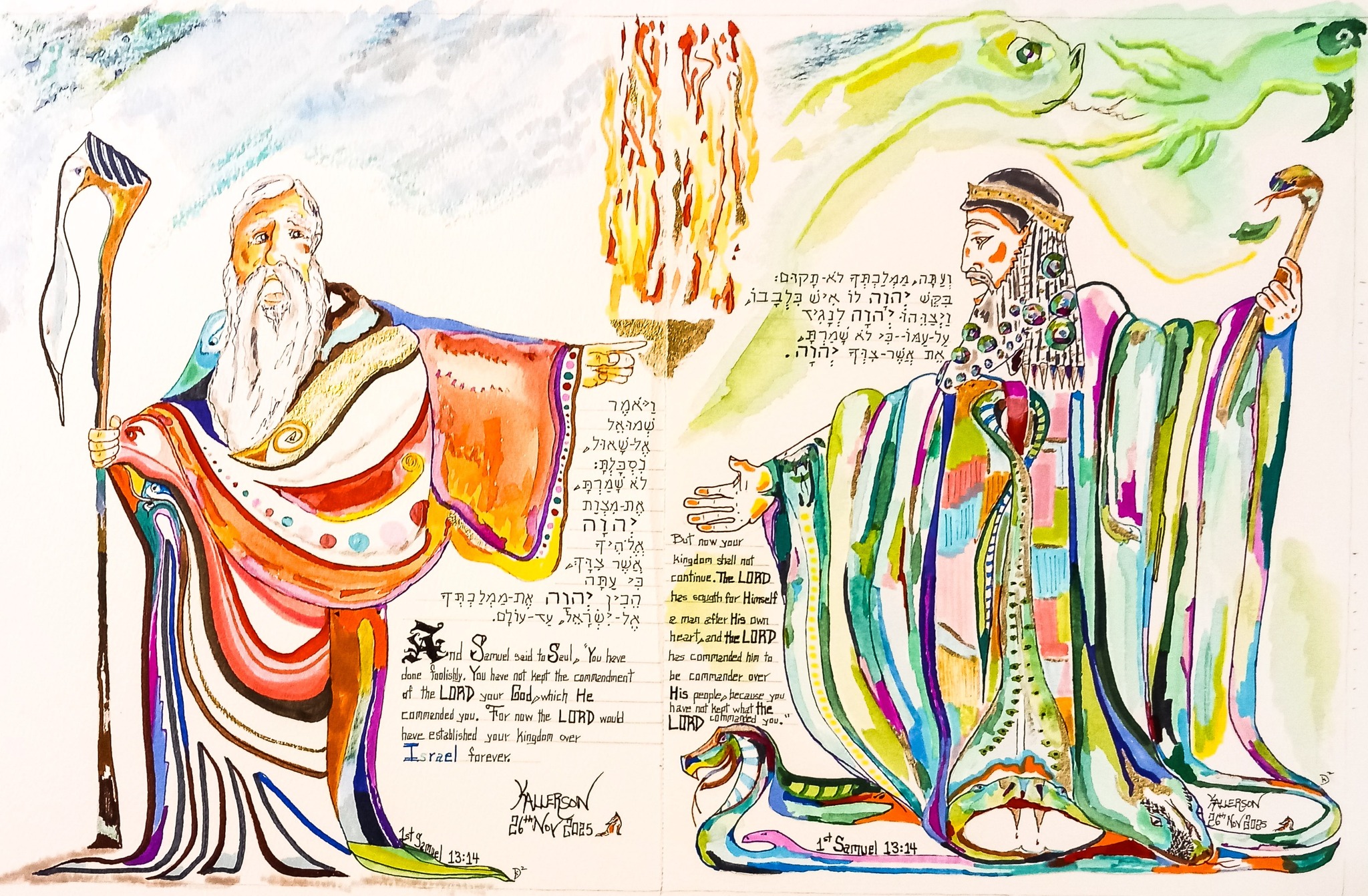
Artwork by Douglas Kallerson
1 Samuel 13:1-15
Your Kingdom, Not It Will Rise
(Typed 1 September 2025 – Labor Day) We have an idiomatic expression that is perfectly understandable from the context, even if you have never heard it before: “Stay in your lane.”
It first became popular in the mid-seventies as a sports metaphor, especially in football. It signifies sticking to one’s designated profession, area of expertise, permissible duties, etc.
The term gained real momentum in 2018 when the National Rifle Association used it to criticize emergency room doctors who were speaking out about gun violence, telling them to stick to their medical expertise. In response, the doctors started using the phrase, “This is our lane,” even though it wasn’t their lane at all.
A doctor’s lane is to heal people, regardless of how the person is hurt. A pharmacist’s lane is to dispense prescribed medicines, whether they agree with the doctor’s prescription or not. A journalist’s lane is to report news, not make it up.
A couple of years ago, I was mowing out front of the mall I take care of. A lady stopped me and told me to put on shoes, insisting I do it immediately. In my case, she was way, way out of her lane, somewhere on the grassy area…
Saul gets out of his lane in our passage today. It will be the end of his possible dynasty.
Text Verse: “Say to them: ‘As I live,’ says the Lord God, ‘I have no pleasure in the death of the wicked, but that the wicked turn from his way and live. Turn, turn from your evil ways! For why should you die, O house of Israel?’” Ezekiel 33:11
At times, people in the Bible get out of their lane. Moses did. Instead of obeying the Lord’s directive to speak to the rock in order to bring out water, he struck it. That cost him the right to cross over the Jordan into the land of promise.
Priests were given a particular lane they were to stay in. The same is true with prophets and kings. Israel was given a lane to walk in. The Lord, through Ezekiel, told the people to get back in that lane. This was the purpose of the law for them. It was like a blueprint for the various lanes the people of Israel were to stick to.
As a king under the law, Saul strayed from his lane into Samuel’s specifically explained and authorized duties. Uzziah did this as well, violating the lane of the priestly office –
“Then Uzziah became furious; and he had a censer in his hand to burn incense. And while he was angry with the priests, leprosy broke out on his forehead, before the priests in the house of the Lord, beside the incense altar. 20 And Azariah the chief priest and all the priests looked at him, and there, on his forehead, he was leprous; so they thrust him out of that place. Indeed he also hurried to get out, because the Lord had struck him.
21 King Uzziah was a leper until the day of his death. He dwelt in an isolated house, because he was a leper; for he was cut off from the house of the Lord.” 1 Chronicles 26:19-21
Today, the church has a lane to stay in. It is to walk in the grace of Jesus Christ. Returning to the law is getting out of our lane. So as believers in Jesus, stay in your lane.
As a side note, the Air Force used to require airmen who mowed lawns to wear steel coverings over their boots to avoid damage to their feet. However, they eventually found out that the torque on a lawnmower is so strong that it not only cuts through those steel coverings, but it also twists them inward, mutilating the feet they were supposed to protect.
It doesn’t matter if you wear shoes or not when you mow. I save money on stuff like that for other things, like durian.
Important lessons, like staying in your own lane are to be found in His superior word. And so, let us turn to that precious word once again, and… May God speak to us through His word today, and may His glorious name ever be praised.
I. Hebrews – They Traversed the Jordan (verses 1-7)
This first verse of Chapter 13 is considered hopelessly corrupt by most scholars. There are innumerable opinions on what each clause means and how it could possibly have been retained in the manner it is.
Other texts have made changes in an attempt to have it make sense. Later translations rarely stick to the wording. The NKJV, following the KJV and older translations, gives an impossible rendering.
Other translations leave the ages out, make up ages and bracket them, etc.
Saul reigned one year; and when he had reigned two years over Israel,
My translation is word-for-word literal: ben shanah shaul bemalekho ushete shanim malakh al Yisrael – “Son year, Saul, in his reign, and two years he reigned upon Israel.” This is the typical formula for introducing a king. His age when he assumes the throne is given, and then the number of years he reigned is stated. For example –
“Son forty year Ishbosheth, son Saul in his reign upon Israel, and two years he reigned. Only house Judah, they were after David.” 2 Samuel 2:8 (CG)
This means that Ishbosheth was forty years old when he assumed the throne, and he reigned two years over Israel. The tribe of Judah alone followed David. As such, verse 13:1 means, “Saul was one year old when he assumed the throne, and he reigned two years over Israel.”
Because it is impossible that he was one year old when anointed, texts, translations, and scholars have made up a long list of variations having nothing to do with the words. The text being impossible means one thing is probably true: it reads exactly as the Lord intended.
To say otherwise means that a scribe so badly bungled his duties that he never should have graduated kinderyeshiva, and then on the first read through his botched job, the one reviewing it ignored the error. I suggest that this verse is connected to my analysis of verses 10:8, 9.
In my translation, I marked verse 8 off as parenthetical and then explained why, noting the events of Chapter 13. What happened there bears on this account. Saying Saul was a year old when he began to reign is based on what happened to him at his anointing.
He was the first king of Israel to be anointed. Thus, the kingship began at that time. When he was anointed, my translation and analysis said –
“‘And it was according to his causing to turn his neck to walk from with Samuel, and He overturned him, God, heart another. And they came, all the signs, the these, the day, the it.’
With the parentheses complete, God gave Saul a new self and direction, making him a new man, represented by his new heart.”
In other words, Saul became a new man as the kingship began. Thus, he was in his first year (son year) according to this new man for the purpose of the new kingdom. Saying he reigned for two years is based on the events that take place in this chapter. This is solidified in Chapter 15 at the anointing of David, regardless of when David’s anointing took place.
Though Saul continued as king until his death, the ending of his reign in God’s eyes for future redemptive purposes comes at the time of the events of this chapter.
Saul means Asked, as in Asked for. Israel means He Strives with God. Despite Saul reigning in the flesh, the kingdom, of which this verse is concerned, was taken from Saul in his second year. During his reign…
2 Saul chose for himself three thousand men of Israel.
vayivkhar lo shaul shelosheth alaphim miyisrael – “And he will select to him, Saul, three thousands from Israel.” As the anointed king, Saul is given the authority to appoint an army for the defense of the kingdom. At this time, those selected for the army total three thousand. It is a multiple of three (divine fullness) and ten (divine order).
Three “stands for that which is solid, real, substantial, complete, and entire. … Hence the number three points us to what is real, essential, perfect, substantial, complete, and Divine.” Bullinger
Ten signifies “Completeness of order, marking the entire round of anything, is, therefore, the ever-present signification of the number ten. It implies that nothing is wanting; that the number and order are perfect; that the whole cycle is complete.” Bullinger
Of this number…
2 (con’t) Two thousand were with Saul in Michmash and in the mountains of Bethel,
vayihyu im shaul alapayim bemikhmas u-vehar beith el – “And they were with Saul two thousands in Michmash and in Mount Bethel.” Ellicott notes, “Michmash was a position strongly situated at the head of a pass some nine miles north-east of Jerusalem.”
Saul, despite his faults, was a brilliant choice to lead Israel at this time. He understood the layout of the land, knew how to conduct war, and started with a small army that could be properly disciplined before expanding the army that would eventually subdue so much of the land. David’s rule could then later expand beyond the borders, making defensive posts to protect Canaan.
By the time Solomon was anointed king, the land was subdued, and many alliances had been made. The fame of Israel among the nations finds its early foundations with the kingship of Saul.
Saul has a personal force of two thousand men. Two is the number of division or difference. Despite this, the number two confirms a whole.
Michmash is first noted here. Strong’s says it is derived from kamas, to store away, and figuratively, storing as in the memory. Jones’ agrees and defines it as Treasure or Treasury.
In Scripture, a har, mountain, is a lot of something gathered. In typology, it is synonymous with a large but centralized group of people. Bethel means House of God.
2 (con’t) and a thousand were with Jonathan in Gibeah of Benjamin. The rest of the people he sent away, every man to his tent.
veeleph hayu im Yonathan begivath Binyamin veyether ha’am shilakh ish leohalav – “and thousand, they were with Jonathan in Gibeah Benjamin. And excess, the people, he sent, man to his tents.” Gibeah was Saul’s hometown (1 Samuel 10:26). Leaving Jonathan there allows for a suitable group that could be called up and relied upon when needed.
Jonathan is introduced here. His name means Yah Has Given. Gibeah means Hill. Benjamin means Son of the Right Hand.
Jonathan’s age has led some to question the dating of Saul’s kingship. How could he have a grown son if he was only king for a year? But there is nothing to suggest Saul’s marital status or age at any point in the account thus far. Further, Jonathan’s age is unknown. The text does not address these things.
Also, Saul’s son Ishbosheth was forty years old when he became king over Israel at Saul’s death. As Jonathan was Saul’s heir apparent (1 Samuel 20:31), it means that Jonathan was likely the firstborn and older than Ishbosheth. This is how he is listed in 1 Chronicles 8:33. As such, the narrative fits. Next…
3 And Jonathan attacked the garrison of the Philistines that was in Geba, and the Philistines heard of it.
vayakh Yonathan eth netsiv pelishtim asher begevah vayishmeu pelishtim – “And he caused to strike, Jonathan, garrison Philistines which in Geba. And they heard, Philistines.” Attacking a Philistine garrison at Geba, by storm would be beneficial in obtaining weapons. At this time, there were none among the people. That will be noted later in the chapter.
Nothing is said about why Geba was chosen. The matter is stated as a fact. The result of this attack is that the Philistines, meaning the people as a whole, heard about it.
Geba means Hill. Philistine signifies Weakeners.
3 (con’t) Then Saul blew the trumpet throughout all the land, saying, “Let the Hebrews hear!”
veshaul taqa bashophar bekhal ha’arets lemor yishmeu ha’ivrim – “And Saul, he blew in the shophar in all the land, to say, ‘You will hear, the Hebrews!’” Because of Jonathan’s attack against Geba, and the matter being heard by the Philistines, Saul “blew in the shophar.”
This signifies a mustering of the people. Having it blown “in all the land” means that runners went everywhere in Israel calling the whole nation to the muster. This was necessary because in the Philistines hearing, they would have mustered for battle.
The Hebrews would readily respond to this call because of what happened when Saul first called the people, telling them that anyone who didn’t go out would have his oxen cut in pieces (1 Samuel 11:7). There would be no need to state this again. The people understood the call of the king and knew to comply immediately.
The word shophar comes from shaphar, comely or beautiful. One can think of the shape of a ram’s horn being like that of a woman due to its curves.
The term Hebrew is one of distinction. It is how foreigners spoke of the people of Israel, how the people of Israel spoke of themselves to foreigners, or how the people are contrasted to foreigners. Saul is contrasting the Hebrew people with the Philistines. The name Hebrew signifies Crosser Over.
4 Now all Israel heard it said that Saul had attacked a garrison of the Philistines, and that Israel had also become an abomination to the Philistines.
vekhal Yisrael shameu lemor hikah shaul eth netsiv pelishtim vegam nivash Yisrael ba’pelishtim – “And all Israel, they heard to say he caused to strike, Saul, garrison Philistines. And also he malodorous, Israel, in the Philistines.” In hearing the call of the shofar, the people would excitedly gather in each city to hear what had happened.
In this case, word of Jonathan’s attack and the Philistine response would immediately become legendary in the people’s eyes. Finally! They have a king to challenge their oppressors, and his own son had initiated the action.
However, they had now become an offensive stench in the noses of the Philistines, which everyone knew would necessitate their response…
4 (con’t) And the people were called together to Saul at Gilgal.
vayitsaaqu ha’am akhare shaul ha’gilgal – “And they shrieked, the people, after Saul – the Gilgal.” Gilgal was the agreed-upon place of such a national gathering. This is just what the parenthetical thought of 1 Samuel 10:8 stated –
(8 And you descended to my faces the Gilgal. And behold! I descending unto you to cause to ascend burnt offerings to sacrifice sacrifices repayments. Seven days may you cause to wait until I come unto you. And I caused to know, to you, what you will do.”) 1 Samuel 10:8 (CG)
At the time of Saul’s anointing, Samuel gave him these instructions for such a gathering. As this was a national call, every city would hear the shofar, receive the news, and respond accordingly. Samuel told Saul to wait seven days for him to arrive in such situations.
The Gilgal signifies a rolling, but the meaning is derived from the account of Joshua 5:9, where the Lord “rolled away the reproach of Egypt.” Thus, it means The Liberty. While Israel was gathering at Gilgal…
5 Then the Philistines gathered together to fight with Israel,
u-phelishtim neesphu lehilakhem im Yisrael – “And Philistines, they gathered to be fought with Israel.” As in Israel, there was a general mustering of the men of Philistia. The stink of what occurred could not go unchallenged. Therefore, a massive force was called up…
5 (con’t) thirty thousand chariots and six thousand horsemen, and people as the sand which is on the seashore in multitude.
sheloshim eleph rekhev veshesheth alaphim parashim veam kakhol asher al sephath ha’yam larov – “thirty thousand chariot, and six thousands calvary, and people according to the sand which upon lip the sea to the abundance.” There is immense disagreement on the number of chariots. Some texts say it is three thousand. Some think the letter lamed was inadvertently repeated, and it should say one thousand.
Sticking with the text, thirty “being 3 x 10, denotes in a higher degree the perfection of Divine order, as marking the right moment” (Bullinger).
Ten has already been defined. Six is the number of man, especially fallen man. It is also the number of labor, distinct from God’s rest. Of this massive force, it says…
5 (con’t) And they came up and encamped in Michmash, to the east of Beth Aven.
vayaalu vayakhanu bemikhmas qidmath beith aven – “And they encamped in Michmash, eastward Beth Aven.” The location of Saul before mustering the people to Gilgal appears to have been purposefully occupied by the Philistines, maybe as a snub to Saul. It is also a strategically logical place.
Saying the location is east of Beth Aven seems out of place. Beth Aven is further north and not much west of Michmash. And more, it seems irrelevant to the narrative to give its name. It will be mentioned again in Chapter 14, but on the surface, it appears to have no bearing on this story. Despite this, the narrative carefully details this fact.
Beth Aven was seen twice in Joshua. There, it was defined as House of Wickedness. This is not incorrect, and it is often translated that way, but it more literally signifies House of Nothingness, coming from avon, nothingness. That is then used to describe idolatry, iniquity, wickedness, etc.
6 When the men of Israel saw that they were in danger (for the people were distressed), then the people hid in caves, in thickets, in rocks, in holes, and in pits.
veish Yisrael rau ki tsar lo ki nigas ha’am vayithkhaveu ha’am bamearoth u-vakhavakhim u-vaselaim u-vatserikhim u-vaboroth – “And man, Israel he saw for it distressed to him, for he driven, the people. And they will secrete themselves, the people, in the caves, and in the thorns, and in the crags, and in the citadels, and in the cisterns.” The immense size of the Philistine army brought distress to the people. Therefore, a list of hiding places is carefully stated.
The first is the mearah, cave. That is from ur to be made naked, thus, exposed or bare. The next is a new word, khoakh. It is derived from an unused root meaning to pierce, thus a thorn. Being plural, it refers to thickets. Next is the sela, from a root meaning to be lofty. It signifies a craggy rock.
That is followed by the tseriakh. It is from tsarakh, to cry or roar. Thus, Strong’s sees the connection as clearness of vision. As such, he takes this as a high place, a citadel, although this is debated. This is the last use of the word in Scripture. Lastly, there is the bor, a pit hole or cistern. That is derived from bur, to declare or figuratively to examine.
7 And some of the Hebrews crossed over the Jordan to the land of Gad and Gilead.
Rather: veivrim averu eth ha’yarden erets gad vegilad – “And Hebrews – they traversed the Jordan, land Gad and Gilead!” Scholars as dismissive of the words as being doubtful, incorrect, requiring change, or referring to people other than “the men of Israel” in the previous verse. None of that is necessary. The insertion of “some of” obliterates the meaning.
My word-for-word translation provides the necessary understanding. Offsetting the words “And Hebrews,” and then placing an exclamation point at the end provides the sense. To understand, one must see the connection being made from the Hebrew wording.
The designation Hebrew is from their ancestor Eber, who descends from Noah’s son, Shem. His name is from ever, a region across, thus He Who Crossed Over. The word ever is from the verb avar, to traverse, cross over, pass over, etc. It is the same word used in this verse to say the Hebrews traversed the Jordan.
To get what is being said, history needs to be considered. Because it is recorded that Eber’s descendants lived in Ur, which is on the opposite side of the Euphrates from Babylon (Genesis 11:28), it is probable that his family moved away from Babylon to Ur. This was at some point after the time of the Tower of Babel. He was likely named because of this move.
He is an ancestor of Abraham, the first person known as a Hebrew. Abraham’s father, Terah, moved from Ur to Haran. From there, he was called by the Lord to move to Canaan. Though the text doesn’t say it, Eber may have been with him because Abraham was born 179 years before Eber died.
This group of people traversed the Euphrates, and the family continued to move west. Eber was alive at the time of the division of languages. His descendants and their language are what became the Hebrew people today.
This title, Hebrew, points to a celebration of passing over the great waters of the world. They passed over the Euphrates, they passed through the Red Sea, and they passed over the Jordan into the Land of Promise. The name and title are directly connected with both a physical and a spiritual crossing over.
The sad pun being made in this verse can be paraphrased as, “And Crossers Over – they crossed over the Jordan to the land of Gad and Gilead!” There is no article, as in “the Hebrews.” Nor is there a further definition of them, as in “Some Hebrews.”
Rather, it is an emphatic statement, as in “And Hebrews, they…!” It conveys the idea of shame that instead of continuing to go westward at a time of national crisis, these Hebrews headed back to the east, essentially uncrossing what they had once crossed.
The Jordan means The Descender. Gad means Fortune. Gilead means Perpetual Fountain.
7 (con’t) As for Saul, he was still in Gilgal, and all the people followed him trembling.
veshaul odenu va’gilgal vekhal ha’am haredu akharav – “And Saul, he yet in the Gilgal. And all the people, they shuddered after him.” Unlike so many others who hid or headed over the Jordan, Saul remained in the Gilgal with those who trusted him enough to face the challenge ahead, despite the trepidation they felt.
What is it the Lord is looking for?
Is it crossing every t and dotting every i?
Those things may be important, but even more
He desires pure hearts, and here is why
A heart not set on the Lord
Is one already out of whack
Without it, obedience to His word
Is self-directed and a foolish track
Have your heart set on Him
And all else will find its place
Your light will be bright – not dim
When you reflect the radiance of His face
II. You Were Silly (verses 8-15)
8 Then he waited seven days, according to the time set by Samuel.
The words end abruptly and without a conclusion: vayikhel shivath yamim lamoed asher shemuel – “And he was waited seven days, to the appointment which Samuel…” This is according to what was cited earlier –
(8 And you descended to my faces the Gilgal. And behold! I descending unto you to cause to ascend burnt offerings to sacrifice sacrifices repayments. Seven days may you cause to wait until I come unto you. And I caused to know, to you, what you will do.”) 1 Samuel 10:8 (CG)
The abruptness of the words is filled in by some manuscripts, but it is likely stated as an intentional fragment to highlight the tension. The reader must mentally fill the rest in. Samuel gave explicit instructions about such a national gathering. However…
8 (con’t) But Samuel did not come to Gilgal; and the people were scattered from him.
velo va shemuel ha’gilgal vayaphets ha’am mealav – “And not he came, Samuel, the Gilgal. And he was caused to disperse, the people, from upon him.” Despite being told that Samuel would come within seven days, he seemingly failed to show. It was during these seven days that the size of the Philistine force became known and the Hebrews started abandoning ship.
Saul’s saying that he was caused to disperse them probably indicates the excuses that arose, which necessitated allowing them to leave, such as “I left my donkey without food,” or “My wife is about to give birth,” etc. These, along with those who had just taken off, were pressing his patience.
Without Samuel’s arrival, Saul feared that even more would become disheartened and bail on him. Therefore, seeing no satisfactory resolution to his dilemma, he acts…
9 So Saul said, “Bring a burnt offering and peace offerings here to me.” And he offered the burnt offering.
vayomer shaul hagishu elay ha’olah vehashelamim vayaal ha’olah – “And he said, Saul, ‘You must cause to approach unto me the burnt offering and the repayments, and he caused to ascend the burnt offering.’” Saul sees that it is the seventh day and still Samuel has not arrived. He got out of his lane and directed his people to bring him the animal offerings held for Samuel to make. Once received from their hands, he did what was forbidden for him to do.
The same terminology of offering sacrifices is used of David in 2 Samuel 24 and Solomon in 1 Kings 3. Each of them is said to have made the sacrifices. What it probably means is that they directed the offerings to be made through the priests. This may have even been what Saul did.
However, Samuel’s instructions were that he alone was to make these sacrifices. Either way, the mandate of his anointing as king was violated. In rejecting Samuel’s word, he rejected the Lord’s word. The tragedy of his action is next fully realized…
10 Now it happened, as soon as he had finished presenting the burnt offering, that Samuel came;
vayhi kekhaloto leha’aloth ha’olah vehineh shemuel ba – “And it was according to his finish to cause to ascend the burnt offering, and behold, Samuel coming.” The “according to” highlights the sad irony of the words. Noting only the burnt offering may even mean that the peace offerings had not yet been made.
Saul either offered or directed to be offered burnt offerings that were meant for Samuel to offer. As that was finishing, Samuel was arriving…
10 (con’t) and Saul went out to meet him, that he might greet him.
vayetse shaul liqrato levarakho – “and he went, Saul, to meet him to bless him.” In hearing of the arrival of Samuel, Saul was probably hugely relieved, at least initially. However, as he went out to greet him in order to bless him…
11 And Samuel said, “What have you done?”
vayomer shemuel meh astia – “And he said, Samuel, ‘What you done?’” This is likely stated in a stern, rhetorical manner. Samuel could see the smoke and smell the burning animal as he neared. The reaction of Saul bolsters the idea. He could tell Samuel was not happy, and he provided weak excuses…
11 (con’t) Saul said, “When I saw that the people were scattered from me, and that you did not come within the days appointed, and that the Philistines gathered together at Michmash,
vayomer shaul ki raiti ki naphats ha’am mealav veatah lo vata lemoed ha’yamim u-phelishtim neesaphim mikhmas – “And he said, Saul, ‘For I saw for dispersed, the people, from upon me, and you, not you came to appointment the days, and Philistines being gathered Michmash.’” His first excuse is that the people had dispersed. If he waited any longer, he’d surely lose more.
This is seen in his next words, which are emphatic, “you, not you came.” Without Samuel, there would be no offering. The people would be disheartened and continue to abandon ship. The “appointment the days” is the seven days Samuel promised to keep, something he did, but Saul counted the five fingers on his right, got to the thumb and then the index on his other, and assumed that the appointment had not been kept.
On the seventh day, with no Samuel present, the Philistines would be all the more ready to engage…
12 then I said, ‘The Philistines will now come down on me at Gilgal,
vaomar atah yeredu phelishtim elay ha’gilgal – “And I said, ‘Now they will descend, Philistines, upon me the Gilgal.” Saul and his dwindling army will face a foe coming from higher ground. Gilgal is near the Jordan, so there would be little place to retreat to if they were overwhelmed. Therefore, it is likely that unless they move, there would be utter defeat.
But they couldn’t move without entreating the Lord…
12 (con’t) and I have not made supplication to the Lord.’ Therefore I felt compelled, and offered a burnt offering.”
u-phene Yehovah lo khiliti vaethapaq vaaaleh ha’olah – “and faces Yehovah not I rubbed, and I contained myself, and I caused to ascend the burnt offering.’” The word khalah signifies to rub. Thus, it can mean being sick, grieved, afflicted, etc. However, it is also used to signify entreating another, as if stroking a person’s face and asking for a favor.
This is the sense here. The offering is a way of appeasing the Lord in order to seek His favor. Seeing that disaster was not far off, he felt making the offering apart from Samuel was his only suitable course of action…
13 And Samuel said to Saul, “You have done foolishly. You have not kept the commandment of the Lord your God, which He commanded you.
vayomer shemuel el shaul niskaleta lo shamarta eth mitsvath Yehovah elohekha asher tsivakh – “And he said, Samuel, unto Saul, ‘You were silly. Not you guarded command Yehovah your God which He enjoined you.” Samuel’s instruction at Saul’s anointing was to do exactly what he has now failed to do.
If Samuel had the authority to anoint Saul king, which he obviously did, it means that authority was at the word of Yehovah. As Samuel’s word at Saul’s anointing was regarding the conduct of the king, that meant it was the Lord’s binding command to the king. The two are inseparable in thought.
Understanding this, Samuel sets forth a proposition based on the conditional nature of Saul’s obedience and then a declaration based on Saul’s disobedience…
13 (con’t) For now the Lord would have established your kingdom over Israel forever.
The word “would” is not stated, but it is implied, just in a less obvious manner: ki atah hekin Yehovah eth mamlakhtekha el Yisrael ad olam – “For now – He caused to establish, Yehovah, your kingdom upon Israel until vanishment.’” It seems like Samuel is saying that he had established Saul’s kingdom ad olam (until vanishment, meaning forever).
However, to get the sense, we can put the stress on “For now.” It’s like saying, “At that time and up till now.” That is immediately negated with the next words…
14 But now your kingdom shall not continue.
veatah mamlakhtekha lo taqum – “And now – your kingdom, not it will rise.” One can get the sense of the words by watching a parent deal with a disobedient child. “You know, for now – I told you that I would buy you a car for your birthday. And now – that ain’t gonna to happen.”
The parent set whatever conditions, stated or implied, for the car to appear in the driveway. The child didn’t meet those conditions, and now the car ain’t showing up. Samuel is dealing with Saul like a disobedient child.
This is how we know that the thought in verse 1 about Saul’s reign ending after two years is correct. If Saul’s kingdom is not going to continue ad olam, it means that it has ended. This is why there are kings after David, but they are known as the House of David or the Kingdom of David.
In 1 Kings 2:12, after David’s death, it says of Solomon’s rule, “Then Solomon sat on the throne of his father David; and his kingdom was firmly established.” In Mark 10:11, the people called out, “Blessed is the kingdom of our father David…” Saul’s kingdom has ended as far as God’s redemptive purposes are concerned in relation to a kingdom.
The next words are telling concerning the state of things…
14 (con’t) The Lord has sought for Himself a man after His own heart, and the Lord has commanded him to be commander over His people, because you have not kept what the Lord commanded you.”
biqesh Yehovah lo ish kilvavo vaytsavehu Yehovah lenagid al amo ki lo shamarta eth asher tsivekha Yehovah – “He searched, Yehovah, to Him man according to His heart, and He enjoined him, Yehovah, to commander upon His people, for not you guarded which He enjoined you, Yehovah.”
Saul was anointed king. He was then explicitly told about three signs that would come to pass after he left Samuel. What Samuel said to Saul at that time were the conditions set upon him concerning what to do at Gilgal. Immediately after that, Saul departed, and the three signs came to pass.
It was a way for the Lord to show him, without any doubt, that He was there with Saul, that His word could be trusted, and that He was to be obeyed. The one thing commanded Saul at that time is the one thing he failed to keep.
The sin of Saul, though immediately seen as a violation of the Lord’s word, had the underlying and more substantial failure of lacking faith in that word. David, on the other hand, at times violated the Law of Moses, but his heart never lacked faith in the presence and promises of Yehovah.
15 Then Samuel arose and went up from Gilgal to Gibeah of Benjamin.
vayaqam shemuel vayaal min ha’gilgal givath Binyamin – “And he arose, Samuel, and he ascended from the Gilgal – Gibeah Benjamin.” Nothing is said concerning the reason for Samuel’s walk to Gibeah instead of his hometown. This was where Jonathan was located in verse 2, so it may be that Samuel went there to meet with him.
If so, Samuel may have talked to him about what occurred and what it meant for Jonathan’s future. In 1 Samuel 23:17, Jonathan will tell David, “You shall be king over Israel, and I shall be next to you. Even my father Saul knows that.” Thus, he was aware of the situation.
It is speculation, but Samuel’s going to Gibeah seems to have such an unstated purpose in mind. As for Saul in Gilgal…
*15 (fin) And Saul numbered the people present with him, about six hundred men.
vayiphqod shaul eth ha’am hanitseim imo keshesh meoth ish – “And he visited, Saul, the people, the ‘being found with him’ according to six hundreds man.” The very thing Saul hoped to avoid happened.
He had two thousand men, and Jonathan had a thousand. Then the entire nation gathered at Gilgal. Now, he has six hundred men left, one-fifth of what he had when he started.
Samuel said that the Lord looked for a man according to His heart. It is true that the Lord expects obedience, but there must be a reason for it. The Pharisees and Sadducees were the epitome of obedience to the outward precepts of the law. Yet they failed to have a heart for the Lord, meaning trusting in Him and searching for the reasons behind His precepts.
Saul failed at the explicit command on which his kingship was established, but his failure to trust the Lord caused his disobedience. Jonathan, in the next chapter, will say –
“Come, let us go over to the garrison of these uncircumcised; it may be that the Lord will work for us. For nothing restrains the Lord from saving by many or by few.” 1 Samuel 14:6
Jonathan understood what Saul failed to grasp. In reading these things and seeing how the people of God respond to the Lord in their lives, we can learn valuable lessons to apply to our own lives.
God has given us explicit instructions on how to be saved. They are stated by Jesus as an anticipation of His completed work in John 3:16. They are also stated in Acts in several ways concerning the work of the Lord. Later, they are also repeated in the epistles.
One is saved by grace through faith. As this is so, why do we keep reinserting the law into our lives as if we are somehow obligated to pick up the law and attempt to recomplete what Jesus has already finished?
In Christ, the battle for man’s salvation is won, the victory is realized, and the path to God is set. Let us trust this. Nothing restrained the Lord from saving. He did it, and now we can rest in what He did.
Walking in obedience is intended to be pleasing to Him after salvation, not for it. So let us learn what pleases Him based on that, not on what He did to save us in the first place. Hold fast to the grace of God that is found in Jesus Christ our Lord. Amen.
Closing Verse: “And afterward they asked for a king; so God gave them Saul the son of Kish, a man of the tribe of Benjamin, for forty years. 22 And when He had removed him, He raised up for them David as king, to whom also He gave testimony and said, ‘I have found David the son of Jesse, a man after My own heart, who will do all My will.’” Acts 13:21, 22
Next Week: 1 Samuel 13:16-23 Get ready for a big surprise, yes, yes YOU… (Your Kingdom, Not It Will Rise, Part II) (25th 1 Samuel Sermon)
The Lord has you exactly where He wants you. He has a good plan and purpose for you. He alone is the perfect example of love – untarnished, unblemished, and completely pure and holy. He offers this love to you. So, follow Him, live for Him, and trust Him, and He will do marvelous things for you and through you.
1 Samuel 13:1-15 (CG)
13 Son year, Saul, in his reign, and two years he reigned upon Israel. 2 And he will select to him, Saul, three thousands from Israel. And they were with Saul two thousands in Michmash and in Mount Bethel, and thousand, they were with Jonathan in Gibeah Benjamin. And excess, the people, he sent, man to his tents.
3 And he caused to strike, Jonathan, garrison Philistines which in Geba. And they heard, Philistines. And Saul, he blew in the shophar in all the land, to say, “You will hear, the Hebrews!” 4 And all Israel, they heard to say he caused to strike, Saul, garrison Philistines. And also he malodorous, Israel, in the Philistines. And they shrieked, the people, after Saul – the Gilgal.
5 And Philistines, they gathered to be fought with Israel, thirty thousand chariot, and six thousands calvary, and people according to the sand which upon lip the sea to the abundance. And they encamped in Michmash, eastward Beth Aven. 6 And man, Israel, he saw for it distressed to him, for he driven, the people. And they will secrete themselves, the people, in the caves, and in the thorns, and in the crags, and in the citadels, and in the cisterns. 7 And Hebrews – they traversed the Jordan, land Gad and Gilead!
And Saul, he yet in the Gilgal. And all the people, they shuddered after him. 8 And he was waited seven days, to the appointment which Samuel… And not he came, Samuel, the Gilgal. And he was caused to disperse, the people, from upon him. 9 And he said, Saul, “You must cause to approach unto me the burnt offering and the repayments, and he caused to ascend the burnt offering.” 10 And it was according to his finish to cause to ascend the burnt offering, and behold, Samuel coming, and he went, Saul, to meet him to bless him.
11 And he said, Samuel, “What you done?” And he said, Saul, “For I saw for dispersed, the people, from upon me, and you, not you came to appointment the days, and Philistines being gathered Michmash.” 12 And I said, “Now they will descend, Philistines, upon me the Gilgal, and faces Yehovah not I rubbed, and I contained myself, and I caused to ascend the burnt offering.”
13 And he said, Samuel, unto Saul, “You were silly. Not you guarded command Yehovah your God which He enjoined you. For now – He caused to establish, Yehovah, your kingdom upon Israel until vanishment. 14 And now – your kingdom, not it will rise. He searched, Yehovah, to Him man according to His heart, and He enjoined him, Yehovah, to commander upon His people, for not you guarded which He enjoined you, Yehovah.”
15 And he arose, Samuel, and he ascended from the Gilgal – Gibeah Benjamin. And he visited, Saul, the people, the ‘being found with him’ according to six hundreds man.
1 Samuel 13:1-15 (NKJV)
Saul reigned one year; and when he had reigned two years over Israel, 2 Saul chose for himself three thousand men of Israel. Two thousand were with Saul in Michmash and in the mountains of Bethel, and a thousand were with Jonathan in Gibeah of Benjamin. The rest of the people he sent away, every man to his tent.
3 And Jonathan attacked the garrison of the Philistines that was in Geba, and the Philistines heard of it. Then Saul blew the trumpet throughout all the land, saying, “Let the Hebrews hear!” 4 Now all Israel heard it said that Saul had attacked a garrison of the Philistines, and that Israel had also become an abomination to the Philistines. And the people were called together to Saul at Gilgal.
5 Then the Philistines gathered together to fight with Israel, thirty thousand chariots and six thousand horsemen, and people as the sand which is on the seashore in multitude. And they came up and encamped in Michmash, to the east of Beth Aven. 6 When the men of Israel saw that they were in danger (for the people were distressed), then the people hid in caves, in thickets, in rocks, in holes, and in pits. 7 And some of the Hebrews crossed over the Jordan to the land of Gad and Gilead.
As for Saul, he was still in Gilgal, and all the people followed him trembling. 8 Then he waited seven days, according to the time set by Samuel. But Samuel did not come to Gilgal; and the people were scattered from him. 9 So Saul said, “Bring a burnt offering and peace offerings here to me.” And he offered the burnt offering. 10 Now it happened, as soon as he had finished presenting the burnt offering, that Samuel came; and Saul went out to meet him, that he might greet him.
11 And Samuel said, “What have you done?”
Saul said, “When I saw that the people were scattered from me, and that you did not come within the days appointed, and that the Philistines gathered together at Michmash, 12 then I said, ‘The Philistines will now come down on me at Gilgal, and I have not made supplication to the Lord.’ Therefore I felt compelled, and offered a burnt offering.”
13 And Samuel said to Saul, “You have done foolishly. You have not kept the commandment of the Lord your God, which He commanded you. For now the Lord would have established your kingdom over Israel forever. 14 But now your kingdom shall not continue. The Lord has sought for Himself a man after His own heart, and the Lord has commanded him to be commander over His people, because you have not kept what the Lord commanded you.”
15 Then Samuel arose and went up from Gilgal to Gibeah of Benjamin. And Saul numbered the people present with him, about six hundred men.