
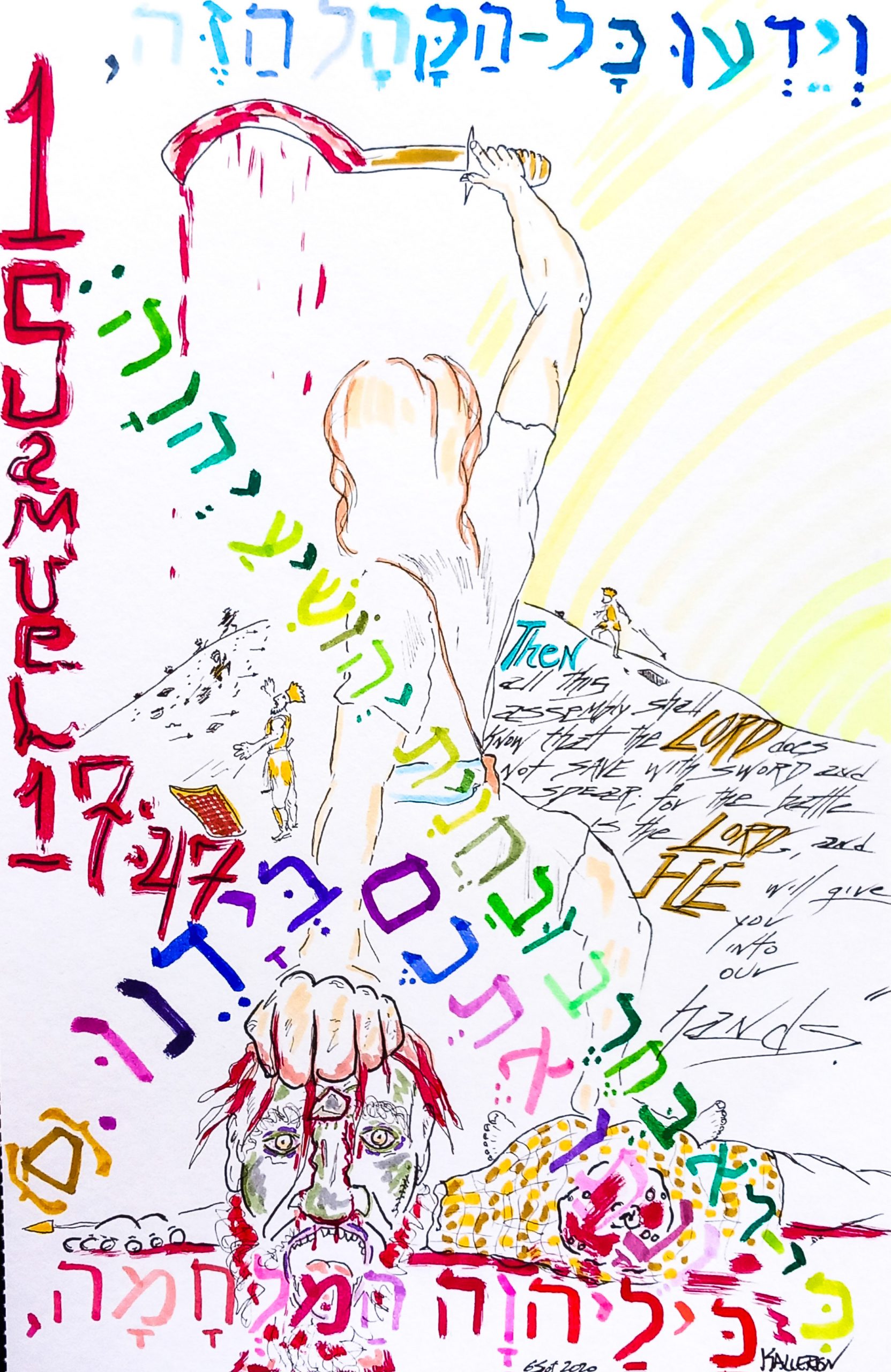
Artwork by Douglas Kallerson
1 Samuel 17:41-58
(David and Goliath, Part IV)
(Typed 19 November 2025) Life is filled with anticipation. This is true regardless of age, and it isn’t limited to humans either. I have eight dogs, and I can assure you of it. Every day at 3 am, a few of my dogs anticipate a walk in the yard. At 5:50 am, they all get antsy as they anticipate Hideko getting up.
This is because after she gets up, they all go out and then they… they… they… (are you anticipating?) they get a treat. Sometimes they get too antsy and start barking before she wakes up. If that happens, and they wake her up early, no treat will be forthcoming.
They usually don’t have to be told more than once, “Shut up or no treat for you.” They know and comply. In today’s passage, Israel and the Philistines have been anticipating a battle. Before that, however, Goliath had spent forty days anticipating an opponent coming out to face him.
As we have gone through the verses, we have been anticipating more insights into what is being said. When the verses are complete, we will be anticipating what they are pointing to and why God chose this story with the particular details to include in His word.
Text Verse: Text Verse: “But God has chosen the foolish things of the world to put to shame the wise, and God has chosen the weak things of the world to put to shame the things which are mighty; 28 and the base things of the world and the things which are despised God has chosen, and the things which are not, to bring to nothing the things that are, 29 that no flesh should glory in His presence.” 1 Corinthians 1:27-29
Paul’s words can be applied to David. He was the youngest of his family. He was looked down on by his oldest brother. Saul told him he was not capable of defeating the enemy because he was young and untrained. He was just a shepherd boy tending his father’s flock.
But the Lord knew David’s abilities, his heart and determination, and that David was the right person to move from shepherding his father’s flocks to shepherding the House of Israel.
The battle against Goliath will solidify this in the minds of the people, even if it will be a long time before David begins to rule over them. Whatever our abilities are, even if seemingly weak, base, or even foolish to others, God can use them for His glory.
We can have confidence in ourselves because of confidence in the Lord, and also do great things. And more, the things we do which are “great” may not seem great to anyone else, but if they are done in faith, they are great in the Lord’s eyes.
A carpet cleaner who serves the Lord with his life certainly pleases Him more than a prime minister, president, or king who has no heart for Him. Let us remember this and be people of faith, living lives for His glory, not our own.
This is commendable before God. It is a truth found in His superior word. And so, let us turn to that precious word once again, and… May God speak to us through His word today, and may His glorious name ever be praised.
I. I Come Unto You in Name – Yehovah Sabaoth (verses 41-47)
41 So the Philistine came, and began drawing near to David,
The Hebrew is alive with motion: vayelekh ha’pelishti holekh veqarev el David – “And he walked, the Philistine, walking, and neared unto David.” The energy of the words shows determined purpose. Goliath waited weeks for a challenger. Each step now is one of delight and anticipation. “Finally, a worthy foe has left the ranks of Israel to meet my challenge.” This is further supplemented by the words…
41 (con’t) and the man who bore the shield went before him.
veha’ish nose ha’tsinah lephanav – “And the man lifting the shield to his faces.” The words are close to verse 7 but they leave out the verb “walking.”
“And lifter the shield walking to his faces.” (v.7)
“And the man lifting the shield to his faces.” (v.41)
The movement, and thus the purpose and intent of the action, is ascribed to Goliath. And so, it is as if the shield-bearer is a single unit with him, being propelled on by Goliath’s movement.
The giant, adorned in all of his military gear, with a shield-bearer as well, is actually not alone. Someone guards him. But no one goes before David. The contrast is made all the more poignant by the use of the words in this verse. In his state, and in the confidence he surely felt, we next enter the very thoughts of Goliath.
As he gets close enough to see David, he is incredulous. So much so that he leans his head forward another few inches as if he needs better focus, and then a sense of disbelieving amazement fills his face. His nose scrunches, his eyes squinch, his forehead crimps down, and he says, “Huh?” As the narrative says…
42 And when the Philistine looked about and saw David,
vayabet ha’pelishti vayireh eth David – “And he caused to scan, the Philistine, and he saw David.” The word navat signifies to look intently and thus to scan. Goliath was scanning the field, watching as David approached. Once he was close enough, his eyes zoomed in on his opponent. Surely with a stupid but astonished look on his face, Goliath carefully observed David, and…
42 (con’t) he disdained him;
vayivzehu – “And he disesteemed him.” The word was first seen in the account of Esau when he sold his birthright. For a mere bowl of red soup, he sold off what was of such high value, showing disdain for it. Here, Goliath looks at David and disesteems him. He sees nothing of value in regard to a battle…
42 (con’t) for he was only a youth,
ki hayah naar – “For he was lad.” The Israelites had sent a boy to fight a man. They had sent an inexperienced person to challenge a champion. It was the first reason to disesteem David…
42 (con’t) ruddy
veadmoni – and red.” Here, admoni, red, is used for the third and last time. It was first used of Esau when he was born –
“And the first came out red [admoni]. He was like a hairy garment all over; so they called his name Esau.” Genesis 25:25
It was next used in Chapter 16 when describing David –
“And he sent, and he brought him. And he red [admoni] with beautiful eyes and good visage. And He said, Yehovah, “Arise! Anoint him! For this he!” 1 Samuel 16:12
Admoni comes from the same root as the verb adom, to be red. It can speak of the hair or the complexion. Either way, the connection to Esau should not be missed. To understand why, take a break and go watch the sermons on Esau and Jacob from Genesis 25 and 27.
It is all the more interesting that the words “despise” and “red” are used in both accounts. A connection between the two has been established. Being red – in hair or complexion – was another reason to disesteem David. To Goliath, David had no gray hairs of an adult. He also had the weak complexion of a ruddy young boy. As such, Goliath saw him as an unfit challenger…
42 (con’t) and good-looking.
im yepheh mareh – “with beautiful appearance.” This would be a complete surprise. All who were trained in battle would have the look of a warrior. Some may paint their faces to make them look more aggressive. They may also have scars, missing teeth, and so on. And more, for sure, they would snarl and show contempt for their opponent.
David displayed none of these features. He looked like any regular person that you might meet on the street. Thus, it was a third reason to disesteem him…
43 So the Philistine said to David, “Am I a dog, that you come to me with sticks?”
vayomer ha’pelishti el David ha’khelev anokhi ki atah va elay bamaqloth – “And he said, the Philistine, unto David, ‘The dog, I? For you come unto me in the sticks.’” Verse 40 said in the singular that David “took his stick in his hand.” Here, Goliath says, “sticks.” This is certainly an expression of derision, like saying to someone, “Grow up and stop playing with tinker toys.” But more, he adds in ha’kelev anoki – “the dog, I?”
In other words, “Fighting the dog with sticks may be effective. Is that what you think I am?” The Philistine stands there arrayed in battle armor, with weapons far fiercer than just angry flashing teeth. Sticks will be entirely ineffective against such a foe. Because of this…
43 (con’t) And the Philistine cursed David by his gods.
vayqalel ha’pelishti eth David belohav – “And he lightened, the Philistine, David in his God.” Out of twenty-seven translations I checked for this sermon, only two state this in the singular, “his God.” Goliath is cursing David b’elohav, or “in his God,” meaning the God of Israel. It is a direct insult to Yehovah.
No Philistine god is named in the account. Goliath has purposefully come out morning and evening to challenge Israel – assuredly at the time of the daily sacrifices. Thus, he is not relying on his false god or gods, but is verbally attacking Israel’s God.
44 And the Philistine said to David, “Come to me,
vayomer ha’pelishti el David lekhah elay – “And he said, the Philistine unto David, ‘You must walk-ward unto me.” Goliath was no longer in the mood for advancing. He must have thought the challenge was a joke or some type of ruse by Saul.
Either way, it is obvious that he takes David as no true challenge. Because of this, instead of continuing to press forward, he called for David to come to him, certainly not expecting him to do so. But if he did, only then would he act…
44 (con’t) and I will give your flesh to the birds of the air and the beasts of the field!”
veetenah eth besarekha leoph ha’shamayim u-levehemath ha’sadeh – “and let me give your flesh to bird the heavens and to beast the field.” Goliath was so confident of the outcome that he was prepared to dispatch his opponent with little effort and leave his carcass out for whatever came to collect it. He had not moved away from his side of the ravine, and no Israelite would dare come and carry him away. In his mind, David is already dead and no threat at all.
45 Then David said to the Philistine, “You come to me with a sword, with a spear, and with a javelin.
vayomer David el ha’pelishti atah ba elay bekherev u-vakhanith u-vekidon – “And he said, David, unto the Philistine, ‘You come unto me in sword and in the spear, and in javelin.’” In the earlier verses describing Goliath, nothing was said of a sword. Here, it becomes apparent that he carried one.
David, noting the weaponry of Goliath contrasts that with his own armament, something much more potent in battle…
45 (con’t) But I come to you in the name of the Lord of hosts,
veanokhi va elekha beshem Yehovah tsevaoth – “And I come unto you in Name – Yehovah Sabaoth.” David sets an absolute contrast between himself and Goliath. Goliath is using what is created but then manipulated within the creation (fashioning implements for battle out of elements) to conduct his warfare. However, David comes forward in the name of Yehovah – the self-existent God.
As He is self-existent, He is separate from the creation, meaning He is transcendent over it. As this is so, trusting in His name means trusting in the sum of who He is. He has presented Himself already to Israel in numerous ways: Yehovah Yireh – the Lord will Provide, Yehovah Rapha – the Lord is my Healer, Yehovah Nisi – the Lord is my Banner, Yehovah Meqadishkhem – the Lord who Sanctifies you, and Yehovah Shalom – the Lord is Peace.
These are but a few ways the Lord has revealed Himself to His covenant people. David presents Him to Goliath as Yehovah Tsevaoth, the Lord of Hosts. It is a term introduced in 1 Samuel 3. This is its fifth use in Scripture. The name comes from tsava, signifying a massing, such as of persons. Being a plural, it indicates He is the Lord of Hosts. Later, David will use this term in the 24th Psalm –
“Who is this King of glory?
The Lord of hosts,
He is the King of glory. Selah” Psalm 24:10
David next expands on this name, saying that He is…
45 (con’t) the God of the armies of Israel,
elohe maarkhoth Yisrael – “God arrangements Israel.” The many-faceted Lord who is a Provider, Healer, source of Peace, and so forth, is also the Captain and Ruler of the ranks of His army – the army that Goliath has openly defied. David will trust in this One to take away the reproach of the uncircumcised Philistine. His confidence in the Lord was unwavering throughout his life –
“Some trust in chariots, and some in horses;
But we will remember the name of the Lord our God.
8 They have bowed down and fallen;
But we have risen and stand upright.” Psalm 20:1
David is trusting solely in the Lord as his Helper. Goliath thinks he sees victory. David, however, looks beyond the moment to the ultimate defeat of the enemy. This is seen in how he has treated the name of Yehovah…
45 (con’t) whom you have defied.
asher kheraphta – “whom you exposed.” This is the fifth and last time the verb kharaph, to expose, is seen in this chapter. It comes from the noun khoreph, harvest time, or autumn, as in the time of a gathered crop.
David notes that Goliath has not only stripped the ranks of Israel as a reaper would strip the fields at harvest, laying them bare and exposing them, but he has also done this to Yehovah’s name. The taunt cannot be allowed to stand. Therefore…
46 This day the Lord will deliver you into my hand,
ha’yom ha’zeh yesagerkha Yehovah beyadi – “The day, the this, He will shut you, Yehovah, in my hand.” The word sagar signifies to close or to shut up. As such, David is saying that Goliath will be ensnared in his hand, unable to escape. In such an incapacitated state, David says…
46 (con’t) and I will strike you and take your head from you.
vehikitikha vahasirothi eth roshekha mealekha – “And I will cause to strike you. And I will cause to veer your head from upon you.” The confidence of David is so great that not only will Goliath be shut up in his hand, but David will have complete control over him, prophesying that he will remove Goliath’s head from his body. Plus…
46 (con’t) And this day I will give the carcasses of the camp of the Philistines to the birds of the air and the wild beasts of the earth,
venathati peger makhaneh phelishtim ha’yom ha’zeh leoph ha’shamayim u-lekhayath ha’arets – “And I gave carcass camp Philistines the day, the this, to bird the heavens and to living the earth.” The word is singular, “carcass.” David looks at the entire camp of the Philistines as one body that will be slain and presented as an offering to the birds and the beasts. In defeating Goliath, the deed will be accomplished.
46 (con’t) that all the earth may know that there is a God in Israel.
veyedeu kal ha’arets ki yesh elohim leyisrael – “And they will know, all the earth, for exists God to Israel.” Israel means He Strives With God. It can be for God or against God. The idea is that God is not “for” Israel, but that God possesses Israel. They are His people, and He displays that fact through them.
47 Then all this assembly shall know that the Lord does not save with sword and spear;
veyedeu kal ha’qahal ha’zeh ki lo bekherev u-vankhanith yehoshia Yehovah – “And they will know, all the assembly, the this, for not in sword and in the spear, He will cause to save, Yehovah.” The implements of battle used by Goliath are unnecessary for the Lord to gain the victory.
Even if used, it is not they that win the battle, but the Lord Himself who does. It is right to understand the etymology of these implements. The kherev, sword, comes from the verb kharav, to be dry or dried up. It is identical to the name of the mountain, Horeb, where the Law of Moses was received, and which comes from the same root word, kharav.
The khanit, spear, comes from the verb khanah, to incline (and thus to camp) or decline (as the sun in the afternoon). The connection is that a spear is for thrusting, like pitching a tent. That is from the same root as khanan, to stoop or bend in kindness to an inferior, as in God dealing graciously with someone.
There is more to the word, though. It is the same word as the feminine form of khen, grace, the word from which Hannah, Grace, is ultimately derived. Of note is that in verse 13:19, it said, “sword or spear.” Here it says, “in sword and in the spear.”
Understanding these things will help us to understand the typology being presented and why the Lord included such things in this marvelous account of David facing the giant Philistine. David says that it is not in a sword or spear that the victory in battle is attained. Rather…
47 (con’t) for the battle is the Lord’s, and He will give you into our hands.”
ki leYehovah ha’milkhamah venathan etkhem beyadenu – “For to Yehovah the battle! And He gave you [all] in our hand.” The battle belongs to Yehovah alone. Only in Yehovah can the enemy be defeated. It is a victory he then hands to His people.
David’s confidence in Yehovah is such that Goliath and all of the hosts of the Philistines will be handed to Israel. His confident attitude is reflected many years later in a psalm penned by the sons of Korah –
“For I will not trust in my bow,
Nor shall my sword save me.
7 But You have saved us from our enemies,
And have put to shame those who hated us.
8 In God we boast all day long,
And praise Your name forever. Selah” Psalm 44:6-8
I come to you in the name of the Lord of hosts
The God of the armies of Israel, whom you have defied
You may have the power to pull up fence posts
But when this battle is over, it is you who will have died
The Lord of Hosts! The God of Israel
In Him is our trust and our hope this day
What happens here, to our children we will tell
When you are dead, and your corpse is cast away
Blessed be the Lord! And blessed be His name
My trust is in Him to do away with you today
Great will be the victory, and the honor of His fame
When you are gone, Israel will shout ‘Hooray!’
I. In the Sling and in the Stone (verses 48-58)
48 So it was, when the Philistine arose and came and drew near to meet David, that David hurried and ran toward the army to meet the Philistine.
vehayah ki qam ha’pelishti vayelekh vayiqrav liqrath David vaymaher David vayarats ha’maarakhah liqrath ha’pelishti – “And it was, for he arose, the Philistine, and he walked, and he approached to encounter David. And he hurried, David, and he ran – the arrangement, to encounter the Philistine.” With the parley ended, Goliath could no longer remain still.
The challenge had been made. It was apparent that his opponent was serious, so he rose to his full height and went into motion. The double verbs enhance the excitement of the narrative – Goliath arose, “and he walked, and he approached.” Likewise, “And he hurried, David, and he ran…” No Hollywood movie could improve on the tension of the moment…
49 Then David put his hand in his bag and took out a stone; and he slung it and struck the Philistine in his forehead,
vayishlakh David eth yado el ha’keli vayiqakh misham even vayqala vayakh eth ha’pelishti el mitskho – “And he sent, David, his hand unto the vessel. And he took from there stone. And he slung, and he caused to strike the Philistine unto his forehead!” The account gives a simple description of how the marvelous blow came about. He put his hand to the bag, pulled out a single stone, and slung it with the precision of a sniper, hitting Goliath directly in his forehead.
For David tending to the sheep, there would be little else to do in the wilderness than practice with his sling. His skill would be so refined that the account is not only likely, but it would be hard to imagine how he could miss, even while at a full run. He was proficient with the sling. And more, the Lord’s honor was at stake, and the Lord’s presence was with him. The victory was a given…
49 (con’t) so that the stone sank into his forehead,
vatitba ha’even bemitskho – “And it sank, the stone, in his forehead!” The forehead in the Bible signifies the place of conscience and identification. David identified with Yehovah, but Goliath identified himself against Him. He had made his stand, and he was judged for it. So great was the blow that the stone not only crushed his forehead, but it also sank into it, becoming one with it…
49 (con’t) and he fell on his face to the earth.
vayipol al panav aretsah – “And he fell upon his face earthward!” This shows that not only was Goliath injured, but he was completely incapable of any further action. Being facedown, he was left completely exposed to whatever fate awaited him.
50 So David prevailed over the Philistine with a sling and a stone,
vayekhezaq David min ha’pelishti baqela u-vaeven – “And he seized, David, from the Philistine, in the sling and in the stone.” In twenty-seven translations checked for the sermon, only the NET Bible includes the definite articles before “sling” and “stone.” The strength of David is placed in the sling and in the stone. It is through this means that Lord won the victory.
50 (con’t) and struck the Philistine and killed him.
vayakh eth ha’pelishti vaymithehu – “And he caused to strike the Philistine. And he caused to kill him.” It says that David struck the Philistine and killed him. The means by which the kill is credited is the sling and the stone. David hit his mark, and the victory was won. It then says of this…
50 (con’t) But there was no sword in the hand of David.
vekherev ein beyad David – “And sword, naught, in hand David.” It is specific and unambiguous. David did not have his own sword. This is stated specifically for a purpose. David prevailed not with his own sword…
51 Therefore David ran and stood over the Philistine, took his sword and drew it out of its sheath and killed him, and cut off his head with it.
vayarats David vayaamod el ha’pelishti vayiqakh eth kharbo vayishlephah mitarah vaymothethehu vayikhrath bah eth rosho – “And he ran, David, and he stood unto the Philistine, and he took his sword, and he drew her from her sheath, and he killed him…” David had no sword, and yet he prevailed over the Philistine.
However, to complete the victory, while ensuring that the wound didn’t only appear terminal, David drew out the sword of the Philistine and killed him with it, “…and he cut, in her, his head.”
Whether they were two actions or one, the giant’s life was ended with his own sword, and his head was removed with it as well. The events are minutely recorded to provide specific details of other events coming in redemptive history.
This is the last time the sword is mentioned in this passage, but this same sword will be brought back into the narrative later in 1 Samuel –
“And he said, the priest, ‘Sword Goliath the Philistine whom you struck in Valley the Elah. Behold! It wrapped in the mantle behind the ephod. If it you will take to you, take. For naught other beside it in this.’” 1 Samuel 21:9 (CG)
It is a marvelous passage which plays on the name of Goliath – the Exposer – and his sword, which was covered in a cloth. Goliath thought he would expose with his sword, but his sword lay covered behind the ephod.
51 (con’t) And when the Philistines saw that their champion was dead, they fled.
vayiru ha’pelishtim ki meth giboram vayanusu – “And they saw, the Philistines, for he dead, their powerful, and they fled.” Here, the word translated as “champion” by the NKJV is completely different than the previous two uses.
The word is gibor. It signifies strong or mighty. Though Goliath had made an agreement that the Philistines would become the slaves of Israel if he was defeated, the people were so shocked to see him dead that they turned on their heels and fled.
With this, the entire mood of the battle lines changed, and Israel went on the offensive…
52 Now the men of Israel and Judah arose and shouted, and pursued the Philistines as far as the entrance of the valley
vayaqumu anshe Yisrael vihudah vayariu vayirdephu eth ha’pelishtim ad boakha gay – “And they arose, mortals Israel and Judah, and they caused to shout, and they pursued the Philistines until your coming – ravine.” It says, “ravine,” not “the ravine.”
Because of this, scholars have raised many questions and much speculation. One possibility is that the word gai, valley, is a misspelling of Gath. The Greek translation says “Gath,” and so this is possible, but not a preferred choice. It could be some indiscriminate valley.
Regardless, the men of Israel and Judah took the initiative, raised the war cry, and went hot on the heels of the Philistines…
52 (con’t) and to the gates of Ekron.
vead shaare eqron – “and until gates Ekron.” The name Ekron comes from aqar – to uproot or pluck up. Thus, it signifies Uprooting or Extermination. Zephaniah makes a play on the name in his book –
“For Gaza shall be forsaken,
And Ashkelon desolate;
They shall drive out Ashdod at noonday,
And Ekron shall be uprooted.” Zephaniah 2:4
Ekron is noted in 2 Kings 1:2 as the location of the god Baal-Zebub, a false deity that Jesus will equate with the ruler of demons in Matthew 12:24.
52 (con’t) And the wounded of the Philistines fell along the road to Shaaraim, even as far as Gath and Ekron.
vayipelu khalele phelishtim bederekh shaarayim vead gath vead eqron – “And they fell pierced, Philistines, in road – Shaaraim, and until Gath, and until Ekron.” Shaaraim is the plural of shaar, gate. Thus, it signifies “Two Gates.” It is the scene of a bloody battle where the bodies lie strewn for, literally, miles. Israel took the initiative and overcame its enemies because David first vanquished their champion.
53 Then the children of Israel returned from chasing the Philistines,
vayashuvu bene Yisrael mideloq akhare phelishtim – “And they returned, sons Israel, from flaming after Philistines.” The word dalaq, pursue, comes from a root signifying a flame. Thus, this is a heated, burning pursuit, cutting down the enemy like stubble, which is then burned. When that was accomplished, they returned…
53 (con’t) and they plundered their tents.
Rather: vayashosu eth makhanehem – “And they plundered their camps.” This means that the army of the Philistines was divided into various camps, probably based on the villages from which they came. They destroyed the inhabitants of those cities, and then they returned and plundered their various camps.
54 And David took the head of the Philistine and brought it to Jerusalem,
vayiqakh David eth rosh ha’pelishti vayviehu yerushalim – “And he took, David, head the Philistine, and he caused to bring it – Jerusalem.” The meaning of the name “Jerusalem” is debated, but the meaning of the second half it is not. It comes from the verb shalem, “to be complete,” or “to be sound.” That gives the sense of the word shalom, peace.
It isn’t merely a quiet peace, but a state of wholeness or completion. The first part could come from one of several sources, which lead to various significations, but Foundation of Peace is sufficient to get the point.
David takes Goliath’s head there, but no explanation as to why is given. Nor is the head mentioned again in Scripture. At the time, the fortress of Zion was not yet captured, but Jerusalem was possessed by Israel. It is possible that he took the head there to terrify the Jebusites, letting them know that they, too, would be defeated in due time.
Others think that this was written later when David conquered Zion and brought the head to this fortress at that time. This would mean that he kept it as a trophy all along, and Jerusalem was where it finally ended up when David ruled over Israel. That seems a stretch, and, in turn, it would make the next clause seem out of place.
54 (con’t) but he put his armor in his tent.
veeth kelav sam beaholo – “And his vessels, he put in his tent.” David was obviously given the right to all of Goliath’s goods, which would have included his armor, weapons, and personal effects. But is that what this is referring to? The Hebrew leaves open an obvious set of possibilities.
Is this speaking of David putting Goliath’s goods in his tent, or David putting his goods in Goliath’s tent? It says, “and his goods he put in his tent.” Translational and scholarly comment is unanimous that it is the former. The second option isn’t even considered.
However, the pattern of the previous clause makes David the subject and Goliath the object. If that pattern continues in this clause, it would read –
* And David took the head of the Philistine and brought it to Jerusalem
* And his (David’s) goods he put in his (Goliath’s) tent
If the Israelites plundered the camp of the Philistines, it means they also procured the tents along with everything else. David came to the camp to deliver supplies to his brothers, and then he would have returned to his father’s beith, house. Therefore, not being a warrior, it is likely he didn’t even have a tent.
Therefore, David took over the tent of Goliath, placing his goods there. That means everything belonging to Goliath became the possession of David.
Another question that arises is, “Why would it speak of Goliath’s head being taken to Jerusalem a long time in the future and then revert to this note just after the battle?”
It seems more likely that the head of Goliath was taken to Jerusalem as a note of the victory. The city of Jerusalem was granted to Benjamin, but it bordered Judah, and was occupied by people from the tribe of Judah. As Judah means “Praise,” and Jerusalem means “Foundation of Peace,” it seems to be a symbolic gesture playing on the two names.
Two important points to consider are that it says, “his head,” not his “skull,” and the name Goliath is not a derivative of the same root as the word “skull.” Thus, this cannot have any typological connection to “Golgotha,” although that would have been an interesting twist. Something else, rather, is being pictured…
55 When Saul saw David going out against the Philistine, he said to Abner, the commander of the army, “Abner, whose son is this youth?”
vekhiroth shaul eth David yotse liqrath ha’pelishti amar el avner sar ha’tsava ben mi zeh ha’naar avner – “And according to seeing, Saul, David going to encounter the Philistine, he said unto Abner, commander the hosts, ‘Son who this, the lad, Abner?’” The final verses of the chapter have long perplexed readers and scholars alike.
Indeed, many scholars fall back on the supposition that they are not a part of the original text since they are lacking from the Greek translation of it.
Others simply dismiss them with little or no commentary, hoping to avoid the dilemma altogether. The reason for this is that in Chapter 16, David was introduced to Saul and had tended to him during his time of mental affliction.
There are several possibilities concerning this. The first is that Saul focuses on who David’s father is. Unless one is sharp and has a great memory, he may have simply forgotten where David came from and who his father was.
These verses never ask who David is, just who his father is. Since David prevailed in the battle, Saul would need to know whose family was to be given his daughter and be exempted from taxes in Israel.
A second option is that the accounts are not necessarily chronological. This is actually likely, and it was what was concluded in our analysis of Chapter 16.
The events are being tied together categorially in order to present David logically in relation to how events fall into a greater picture of his life and of redemptive history.
David is anointed king by Samuel. At some point, his brothers are in the camp awaiting battle with the Philistines, and David comes to the camp. Eventually, he becomes the hero of the battle. During that time, Saul asks whose son he is.
At some point, Saul went or goes into fits of mental depression. It is found that the same person who was the hero against Goliath has other skills as well and is called into permanent service under Saul.
Following the narrative I laid out in Chapter 16 resolves all of these difficulties. Jonathan is never mentioned in relation to David before Chapter 18. It is true that the order is difficult, but it is no more difficult than understanding that the time frames of events, such as in Chapter 16, could have been over a period of years.
Such categorical rather than chronological accounts permeate Scripture. They may cause confusion when not understood, but they are actually logical progressions of thought when viewed from the greater plan of the redemptive narrative. For now, Abner responds…
55 (con’t) And Abner said, “As your soul lives, O king, I do not know.”
vayomer avner khe naphshekha ha’melekh im yadaeti – “And he said, Abner, ‘Alive, your soul, the king, if I knew!” Abner comes from two words, av, father, and ner, a lamp. Thus, it means something like Father Is a Lamp, or it could even extend to Father Is Light. As Abner’s father is named Ner, Lamp, it may simply be, “My Father Is Light.”
Abner doesn’t have any idea about David’s father, so the narrative continues…
56 So the king said, “Inquire whose son this young man is.”
vayomer ha’melekh sheal atah ben mi zeh ha’alem – “And he said, the king, Saul, ‘You must ask, you, son who this, the stripling?” The word elem, stripling, is used. It is only seen here and in 1 Samuel 20:22. The fact that Saul uses this word, indicating a young man, seems to indicate that the age of David here is not the same as the account in 1 Samuel 16.
With a few years between events, David’s appearance could have been completely different. At one time, he was a youth. Later, he will be a man with a beard. Understanding this, once the battle was over, David was presented to Saul…
57 Then, as David returned from the slaughter of the Philistine, Abner took him and brought him before Saul with the head of the Philistine in his hand.
u-kheshuv David mehakoth eth ha’pelishti vayiqakh oto avner vayviehu liphne shaul verosh ha’pelishti beyado – “And according to returning, David, from causing to strike the Philistine, and he took him, Abner, and he caused to bring him to faces Saul. And head the Philistine in his hand.” David is presented to Saul while he is still carrying Goliath’s head.
Note that when David was first brought before Saul in this chapter, he never asked his father’s name. It may be an indication that he never expected David to prevail.
Now that he has, Saul needs to know what family David belonged to in order to honor the father of the hero of the battle. This is likely the intent, so the inquiry is made…
58 And Saul said to him, “Whose son are you, young man?”
vayomer elav shaul ben mi atah ha’naar – “And he said unto him, Saul, ‘Son who, you, the lad?’” Again, the inquiry is made about who David’s father is. This, along with the unusual use of the word elem, young man, favors the notion that the accounts are categorically placed. Saul wants to know what family he belongs to, and…
*58 (fin) So David answered, “I am the son of your servant Jesse the Bethlehemite.”
vayomer David ben avdekha Yishai beith ha’lakhmi – “And he said, David, ‘Son, your servant, Jesse, House the ‘My Bread.’” It seems like an odd place for the narrative to end, but it’s not. Saul needed to know whose son David was, but we needed to know who David is.
It is this David who is the son of Jesse, and it is this Jesse who, according to Ruth 4, is the son of Obed. Also, it is this Obed who is the son of Boaz, the husband of Ruth, of whom the book of Ruth is written. The names are important because they keep taking us back to earlier stories.
The father of Boaz is Salmon, who was married to Rahab the harlot. Each time the Bible focuses on someone, we have to remember that we are reading something that was documented and already known to the people. The book of Joshua detailed who Rahab was, and the story eventually goes back to Perez and Zerah, who came from Judah.
The importance of these final verses of Chapter 17 means one thing to Saul, but they mean something completely different to those who want to know what God is doing in redemptive history. With the events of David’s life now being recorded, the next generation would have another clue concerning the promised Messiah.
Let us not forget this. When we come to a passage that seems out of place or irrelevant to the immediate narrative, it does not mean that it is.
We have discovered why it is important to know who David’s father is from these final verses of the chapter. We will next try to find out how the chapter itself is important to the overall redemptive narrative of the Bible.
It is great that an unprotected youth slew a giant all by himself in the Valley of Elah, but unless that story has some greater significance, it is just a curious story.
Many people have done great things, and their stories aren’t included in the Bible. But God has selected events to give us clues into what He is doing or will do, and how those things will come about.
Let us remember that Christ is the main focus of this marvelous gift we call the Holy Bible. Even if nothing else were to come out of the story, we know that David’s heroics are recorded, and he will eventually become the king of the nation. After that, covenant promises will be made to him concerning his house and his successors, including the greatest of them – our Lord.
David was a person of faith, even from his youth. He trusted with all of his being that he would prevail because he trusted in his God. For us, we are on the other side of the cross. If David could have such marvelous faith and confidence in the Lord from such an obscure perspective of God’s overall plan, shouldn’t we have so much more?
Let us trust in the Lord, have confidence in His promises, and stand fast in our faith. David pleased God. We too can please Him. That becomes possible by believing His word. And so, let us do so – to His glory.
Closing Verse: “I will sing a new song to You, O God;
On a harp of ten strings I will sing praises to You,
10 The One who gives salvation to kings,
Who delivers David His servant
From the deadly sword.” Psalm 144:9, 10
Next Week: 1 Samuel 17 You are curious about the typology. You ask, “It is whyeth?” You will find out – no jive… (David and Goliath, Part V) (39th 1 Samuel Sermon)
The Lord has you exactly where He wants you. He has a good plan and purpose for you. He is the One who abases the haughty and exalts the humble. He regards the lowly, and the proud, He knows from afar. So yield yourself to Him, trust Him, and believe His word. In this, He will do great things for you and through you.
1 Samuel 17:41-58 (CG)
41And he walked, the Philistine, walking, and near unto David. And the man lifting the shield to his faces. 42And he caused to scan, the Philistine, and he saw David. And he disesteemed him. For he was lad, and red, with beautiful appearance. 43And he said, the Philistine, unto David, “The dog, I? For you come unto me in the sticks.” And he lightened, the Philistine, David in his God. 44And he said, the Philistine unto David, “You must walk-ward unto me, and let me give your flesh to bird the heavens and to beast the field.”
45And he said, David, unto the Philistine, “You come unto me in sword and in the spear, and in javelin. And I come unto you in Name – Yehovah Sabaoth – God arrangements Israel, whom you exposed. 46The day, the this, He will shut you, Yehovah, in my hand. And I caused to strike you. And I caused to veer your head from upon you. And I gave carcass camp Philistines the day, the this, to bird the heavens and to living the earth. And they will know, all the earth, for exists God to Israel. 47And they will know, all the assembly, the this, for not in sword, and in the spear, He will cause to save, Yehovah. For to Yehovah the battle! And He gave you [all] in our hand.”
48And it was, for he arose, the Philistine, and he walked, and he approached to encounter David. And he hurried, David, and he ran – the arrangement, to encounter the Philistine. 49And he sent, David, his hand unto the vessel. And he took from there stone. And he slung, and he caused to strike the Philistine unto his forehead! And it sank, the stone, in his forehead! And he fell upon his face earthward! 50And he seized, David, from the Philistine, in the sling and in the stone. And he caused to strike the Philistine. And he caused to kill him. And sword, naught, in hand David. 51And he ran, David, and he stood unto the Philistine, and he took his sword, and he drew her from her sheath, and he killed him, and he cut, in her, his head.
And they saw, the Philistines, for he dead, their powerful, and they fled. 52And they arose, mortals Israel and Judah, and they caused to shout, and they pursued the Philistines until your coming – ravine, and until gates Ekron. And they fell pierced, Philistines, in road – Shaaraim, and until Gath, and until Ekron. 53And they returned, sons Israel, from flaming after Philistines. And they plundered their camps. 54And he took, David, head the Philistine, and he caused to bring it – Jerusalem. And his vessels, he put in his tent.
55And according to seeing, Saul, David going to encounter the Philistine, he said unto Abner, commander the hosts, “Son who this, the lad, Abner?”
And he said, Abner, “Alive, your soul, the king, if I knew!”
56And he said, the king, Saul, “You must ask, you, son who this, the stripling?”
57And according to returning, David, from causing to strike the Philistine, and he took him, Abner, and he caused to bring him to faces Saul. And head the Philistine in his hand. 58And he said unto him, Saul, “Son who, you, the lad?”
And he said, David, “Son, your servant, Jesse, House the ‘My Bread.’”
1 Samuel 17:41-58 (NKJV)
41 So the Philistine came, and began drawing near to David, and the man who bore the shield went before him. 42 And when the Philistine looked about and saw David, he disdained him; for he was only a youth, ruddy and good-looking. 43 So the Philistine said to David, “Am I a dog, that you come to me with sticks?” And the Philistine cursed David by his gods. 44 And the Philistine said to David, “Come to me, and I will give your flesh to the birds of the air and the beasts of the field!”
45 Then David said to the Philistine, “You come to me with a sword, with a spear, and with a javelin. But I come to you in the name of the Lord of hosts, the God of the armies of Israel, whom you have defied. 46 This day the Lord will deliver you into my hand, and I will strike you and take your head from you. And this day I will give the carcasses of the camp of the Philistines to the birds of the air and the wild beasts of the earth, that all the earth may know that there is a God in Israel. 47 Then all this assembly shall know that the Lord does not save with sword and spear; for the battle is the Lord’s, and He will give you into our hands.”
48 So it was, when the Philistine arose and came and drew near to meet David, that David hurried and ran toward the army to meet the Philistine. 49 Then David put his hand in his bag and took out a stone; and he slung it and struck the Philistine in his forehead, so that the stone sank into his forehead, and he fell on his face to the earth. 50 So David prevailed over the Philistine with a sling and a stone, and struck the Philistine and killed him. But there was no sword in the hand of David. 51 Therefore David ran and stood over the Philistine, took his sword and drew it out of its sheath and killed him, and cut off his head with it.
And when the Philistines saw that their champion was dead, they fled. 52 Now the men of Israel and Judah arose and shouted, and pursued the Philistines as far as the entrance of the valley and to the gates of Ekron. And the wounded of the Philistines fell along the road to Shaaraim, even as far as Gath and Ekron. 53 Then the children of Israel returned from chasing the Philistines, and they plundered their tents. 54 And David took the head of the Philistine and brought it to Jerusalem, but he put his armor in his tent.
55 When Saul saw David going out against the Philistine, he said to Abner, the commander of the army, “Abner, whose son is this youth?”
And Abner said, “As your soul lives, O king, I do not know.”
56 So the king said, “Inquire whose son this young man is.”
57 Then, as David returned from the slaughter of the Philistine, Abner took him and brought him before Saul with the head of the Philistine in his hand. 58 And Saul said to him, “Whose son are you, young man?”
So David answered, “I am the son of your servant Jesse the Bethlehemite.”