
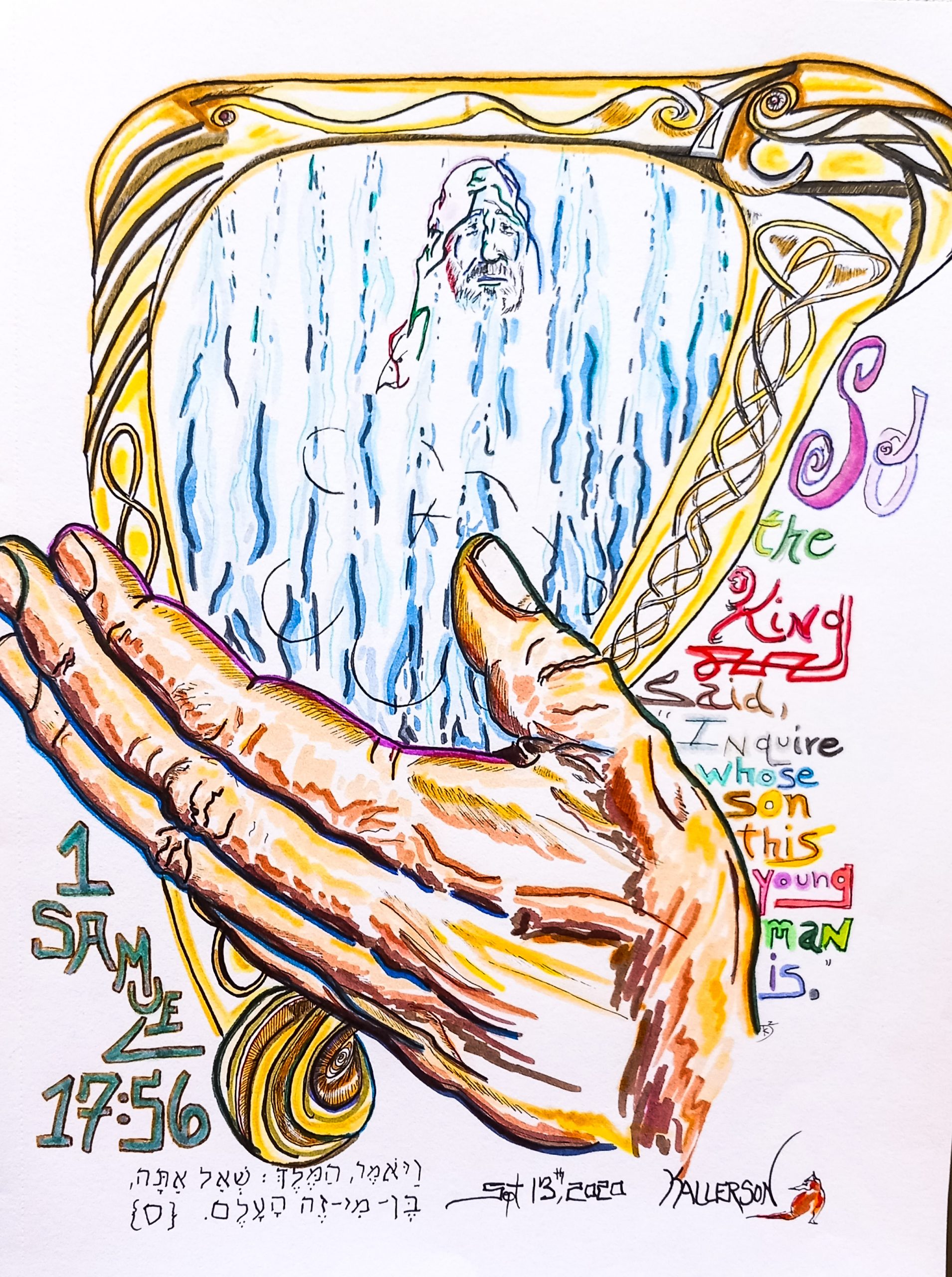
Artwork by Douglas Kallerson
1 Samuel 17
David and Goliath, Part V
The Typology Explained
If one understands the typology in 1 Samuel 17, he can see how marvelous it is in relation to the Ten Commandments and, indeed, the whole Law of Moses, and how that brought such trouble upon Israel.
This doesn’t mean that the law itself is sin. In asking the question, “Is the law sin?”, Paul answers, “Certainly not!” However, if you watch the Superior Word sermons on the Ten Commandments in Deuteronomy 5, you will see exactly why they brought such calamity upon Israel.
The problem does not rest in the law the Lord gave to Israel. Rather, the problem rests within each person of Israel. It is a problem that finds its source in mankind’s father, Adam, that actually affects all of us, but which is highlighted in Israel…
Text Verse: “Now I say that the heir, as long as he is a child, does not differ at all from a slave, though he is master of all, 2 but is under guardians and stewards until the time appointed by the father. 3 Even so we, when we were children, were in bondage under the elements of the world. 4 But when the fullness of the time had come, God sent forth His Son, born of a woman, born under the law, 5 to redeem those who were under the law, that we might receive the adoption as sons.” Galatians 4:1-5
Paul says that God sent forth His Son to redeem those who were under the law. If Israel had the law, why do they need to be redeemed from the law? Paul’s argument from the book of Galatians explains the matter.
The law is not a means to an end, but it is a means to a dead end. That is clearly presented in 1 Samuel 17. We will see this in the typology of this chapter and how we can avoid getting stuck there. There are a lot of details to review from the 1 Samuel 17 sermons to understand the typology being pictured.
Great truths concerning the law as a mere steppingstone to the grace provided by God in Christ are to be found in His superior word. And so, let us turn to that precious word once again, and… May God speak to us through His word today and may His glorious name ever be praised.
*****What has been presented in 1 Samuel 17 is a snapshot from history of a real event, which has been used by God to reveal pictures of the greater redemptive story found in the Bible. This is an ongoing means of conveying biblical truths. Genesis was filled with such typological and pictorial stories.
Likewise, the other books of the law contained typological information. This continues in the historical writings of Joshua, Judges, Ruth, Esther, and Jonah. Historical narratives are particularly disposed to presenting information in this way. They will normally reveal four set purposes –
1) A literal, historical record of what occurred.
2) A moral lesson.
3) Prophetic messages, and,
4) Typological/pictorial truths of other things.
Most sermons on the story of David and Goliath dwell particularly on the second purpose, a moral lesson for believers. However, in solely following this approach, true gems of what God is showing us are missed. We will dig through the story, seeking them out.
What we find is a concise picture of the ultimate battle explicitly stated in Scripture –the redemption of man. There are two great foes who face off in this battle, the Messiah and the serpent. In this battle, there are weapons of warfare, but one major weapon will bring about the total defeat of humanity by the serpent or the total vindication of humanity by the Messiah. That weapon is the law.
This battle began in the first pages of Scripture. The Lord created man, and then the first spoken words recorded were those of God giving the man a law, a single command, stated in the negative –
“And the Lord God commanded the man, saying, ‘Of every tree of the garden you may freely eat; 17 but of the tree of the knowledge of good and evil you shall not eat, for in the day that you eat of it you shall surely die.’” Genesis 2:16, 17
A few verses later, at the beginning of Genesis 3, the serpent is introduced. Using the law as his tool, he deceived the woman, she partook of the forbidden fruit, and then she gave it to her husband. In this, the spiritual connection between God and man was severed, and death entered the world.
The serpent thought he had gained the victory in this skirmish. He didn’t. It was only a single battle in a greater, ongoing war. This is certain because a Victor was promised by the Lord –
“So the Lord God said to the serpent:
‘Because you have done this,
You are cursed more than all cattle,
And more than every beast of the field;
On your belly you shall go,
And you shall eat dust
All the days of your life.
15 And I will put enmity
Between you and the woman,
And between your seed and her Seed;
He shall bruise your head,
And you shall bruise His heel.’” Genesis 3:14, 15
The Messiah is promised. He will be the Seed of the woman, and He will bruise the head of the serpent. 1 Samuel 17 is given as a snapshot of that event. The great warrior of Israel, King David, is a typological representation of the coming Messiah. Goliath represents the serpent. This is the overall theme. But the details reveal so much more.
The Philistines are the enemies of the people of God. Their name comes from palash, signifying to roll in the dust as an act of mourning. They are the Grievers, or outwardly, the Weakeners. It is reminiscent of the curse upon the serpent who was destined to eat dust all his days. Thus, being aligned with him are those who roll in the dust. One can see a hint of the curse upon Adam in this –
“For dust you are,
And to dust you shall return.” Genesis 3:19
Because man followed the serpent, he will return to the dust from which he came. But there is more. His body will be dust, but his soul will be consigned to Sheol, the pit. In the spot where the Philistines set up for battle, several names are given – Sochoh, Azekah, Judah, and Ephes Dammim. Each name hints at what is being pictured.
Sochoh signifies a Hedge or Fence. It is a boundary. Azekah signifies a place that is tilled. The root of that, azaq, is found only in Isaiah 5:2. There the Lord said –
“Now let me sing to my Well-beloved
A song of my Beloved regarding His vineyard:
My Well-beloved has a vineyard
On a very fruitful hill.
2 He dug it up [azaq] and cleared out its stones,
And planted it with the choicest vine.
He built a tower in its midst,
And also made a winepress in it;
So He expected it to bring forth good grapes,
But it brought forth wild grapes.” Isaiah 5:2, 3
There is a place set apart by the Lord, hedged in, which is tilled and expecting a good harvest, but it does not come about. It implies that the people are ineffective in accomplishing what the Lord intended for the place. Hence, the spelling of the name Sochoh changes between the first two clauses of verse 1 from שֹׂכֹ֖ה to שׂוֹכֹ֥ה.
The letter vav, the sixth letter of the aleph-beth, is added. This points to the fallen state of man living between the tilled vineyard and Ephes Dammin, Boundary of Blood Drops, a place where life ends. Life, according to Scripture, is in the blood. These locations are in the land of Judah, Praise.
Saul is introduced. His name signifies “Asked,” but it is identical in spelling to Sheol, the pit. This typologically reveals that at this time, the pit is the true leader of the people. In other words, Saul represents fallen man destined for the pit.
The serpent deceived the first man, and all were destined to follow their leader to the same place. One might even view him as a type of inherited sin, leading the people who are intended to be redeemed in the wrong direction. The pit asks for, and receives, those destined to perish. Can this be corrected?
Saul and his men are said to be “men of Israel.” Israel means, “He strives with God.” It is a double entendre – Israel strives with God (for God) or with God (against God). The difference between the two is seen in the army of Saul and the shepherd who fights the battle alone. The first strives against God, while the latter strives for Him.
Saul and his men encamped at emeq ha’elah, or “Valley of the Terebinth.” Based on the root words, this could be paraphrased as “Depth of the Mighty.” On both sides, the forces stand on the mountains.
Mountains in the Bible symbolize a large, centralized group of people, such as a government. In Isaiah, there is the mountain of the Lord. Babylon, in Jeremiah 51, is called the “destroying mountain.” One can imagine two forces vying for control of man’s destiny, following two different governmental forms in order to effect their purposes.
Between armies is the ravine, a different word, gai, than the emeq, valley, already mentioned. It comes from gevah, exaltation. That comes from gaah, exaltation, or triumph.
At this point, Goliath is introduced. His name signifies who he is. He is the Exposer, but also the Exiler. He typifies the serpent. This will become clearer. The serpent exposes man’s weakness and inevitably leads man into sin, and thus exile from God. The serpent, using law, deceived Adam and Eve, uncovering the fact that they were naked and leading them into separation from God.
Goliath is a Philistine, a Weakener, but he is repeatedly called “the Philistine.” Thus, he is the head Weakener. He has come to expose the weakness of Israel, the people of God’s law who continually fail to meet that standard, but also from whom is anticipated the promised Seed. If He, the Promised One, can be defeated, all Israel, and thus all humanity, will be forever exiled.
Goliath is from Gath, Winepress. In the Bible, the winepress is figuratively used as a place of the destruction of one’s enemies, just as grapes are stomped and crushed, so this destroyer acts. In both Testaments, the winepress figuratively speaks of the destruction of humans as they are trodden out in battle.
In the narrative, he is called benayim, or “the middleman.” He takes the space between the two parties, challenging the opponent. It reflects what it says about him elsewhere –
“Be sober, be vigilant; because your adversary the devil walks about like a roaring lion, seeking whom he may devour.” 1 Peter 5:8
The devil’s purpose was met at the beginning, and to him every new soul could be the Seed of the woman. But which will it be, and will He truly be able to prevail? Like the devil, Goliath is there to expose the failings in man. His height is carefully described – six cubits and a span.
First, the term used to describe his height, govah, signifies loftiness, or height, but figuratively it speaks of pride, such as in 2 Chronicles 32:26. Using this word to describe his height was purposeful. The sin of the devil is described by Paul in 1 Timothy –
“…not a novice, lest being puffed up with pride he fall into the same condemnation as the devil.” 1 Timothy 3:6
Six is the number of MAN as destitute of God, without God, without Christ. He was six cubits and a zereth, span. That comes from a root signifying to scatter or winnow. This indicates that he is the one who receives the man without Christ, who is thus winnowed from humanity. John the Baptist speaks of the One who will accomplish that process –
“His winnowing fan is in His hand, and He will thoroughly clean out His threshing floor, and gather the wheat into His barn; but the chaff He will burn with unquenchable fire.” Luke 3:17
Bronze speaks of judgment. He is literally covered with it from head to foot. The bronze kova, helmet, covers his head, signifying judgment upon his head. However, Isaiah 59:17 describes the Lord’s helmet as a “helmet of salvation.” It is a complete contrast between the two, because a helmet of salvation is not a physical thing, but spiritual.
However, the appearance of his main covering reveals the most vivid typology. He is arrayed in qasqeseth, scale armor. This is a picture of the judgment pronounced upon the serpent, a reptile covered in scales.
In this, we have a picture from earlier in Scripture when Moses was told to make a bronze representation of a fiery serpent and place it on a pole. Any person bitten by a serpent in the wilderness could look to it and live. To understand the significance of that marvelous passage, please be sure to refer to the Numbers 21:1-9 The Standard of the Lord sermon.
Goliath is given as a type of the serpent. His first battle implement is a kidon, javelin. That comes from kid, calamity or misfortune. This is what the devil brings upon man. Next was the spear, but its description was highly unusual, saying, vekhats khanito – “And arrow his spear.” It was further described as velahevet khanito, “and flame his spear.” The magnificent topology is described in Ephesians 6 –
“In addition to having clothed yourselves with these things, having taken up the shield of faith, with which you will be able to put out all the flaming arrows of the evil one.” Ephesians 6:16 (ISV)
Without the later-added vowel points, the khanith, spear, is identical to the feminine form of khen, grace, the word from which Hannah, Grace, is ultimately derived.
Goliath is also protected by a shield-bearer, meaning he knows he is not indestructible, but must be protected beyond his own abilities. It reveals a weakness in him. With his physical description complete, the account moves to his challenge.
He begins by noting that he is a Philistine, one who rolls in the dust. He is completely covered in bronze. His scales are those of a snake. He is a type of the serpent whose judgment was to go on his belly in the dust.
He calls out for Israel to provide their own champion. In his challenge, he cried out, beru lakhem ish veyered elay – “You must eat to you (pl.) man, and he will descend unto me.” This calls for spiritual understanding. “Who will eat of the Man who can defeat me?”
In John 5, Jesus said that all of Scripture speaks of Him. He then referred to the antichrist whom Israel would receive instead of receiving Him. Then in John 6, he got to the heart of the matter, saying –
“Most assuredly, I say to you, unless you eat the flesh of the Son of Man and drink His blood, you have no life in you. 54 Whoever eats My flesh and drinks My blood has eternal life, and I will raise him up at the last day.” John 6:53, 54
For us who know the outcome, the question is, “Who will eat of the Man who challenges and defeats the serpent?” Goliath’s challenge is one of total ownership. He says if we lose, we will be your servants. If you lose, you will be our servants.
The battle is for the rule of the servants of Saul or the rule over the armies of Goliath. In type, it pictures the spiritual battle for the souls of man, all who are destined for the pit (as typified by Saul/Sheol).
Can they be saved from that state, or will the devil retain control over them forever? Can a champion be brought forth to defeat the devil and redeem man from Sheol?
They need a hero to save them from the pit as Goliath cries out ani kheraphti eth maarkhoth Yisrael – “I, I expose arrangements Israel.” He knows none can prevail. They are like the sheaves in the field that are easily cut down. Their history has proven it. The record of Israel’s failure to meet the law of God has condemned them. As Jeremiah says –
“The harvest is past,
The summer is ended,
And we are not saved!” Jeremiah 8:20
Israel had no champion. All among them continued to die, year after year. The pit was never sated by what it received, and none could overcome it. But then! A name was introduced into the narrative, David, Beloved. He is noted as the son of Jesse, Yehovah Exists.
His home is Ephrath, Fruitful, which is in Bethlehem, meaning both House of Bread and House of Battle. The irony of the two names being fulfilled in Christ is not to be missed. He is both the provider of bread for His people (the true Manna of John 6) and He is the One who is mighty in battle (such as in Psalm 24:8).
David’s tribe is Judah, Praise. He is the eighth son, the number of both superabundance and of new beginnings. He became the anointed king in place of Saul in Chapter 16. The play on words was important.
The root of both oil and eight is the same. He is the anointed, and he is the eighth son. He typifies the Messiah, the One to make all things new. He will make fruitful (Ephrath) that which is barren, and He is the Praise (Judah) of God and of His people. He is the Son of the Father, Yehovah Exists. He is the One to make known the divine revelation of God, that He is taking a people unto Himself as a bride through Christ.
Next, his three oldest brothers, the greats (ha’gedolim), are named – Eliab, Abinadab, and Shammah. David is contrasted to them, being called the youngest (ha’qatan). That comes from qut, “to feel a loathing.” They are the greats; he is despised. They picture the Pharisees, Sadducees, and Scribes noted in the gospels – representatives of the people in religious matters. That will be explained later.
Following after Saul (Sheol) means they are exactly as Jesus described those who look for converts and then make them twice as much a son of hell. As it said, “And the three oldest followed Saul.” Instead of pursuing that which leads to life, they pursued that which leads to death.
In contrast to them, David pictures Jesus who, as Isaiah says, was despised and rejected (Isaiah 53:3). With that thought, the narrative returned to Goliath, presenting himself to Israel in a challenge for forty days. Forty signifies “…a period of probation, trial, and chastisement.”
It speaks of the duration of Israel’s history until the coming of Christ. They were tried. Could any come forward and defeat the serpent? The Old Testament bears out the answer, “No.”
The account specifically notes that Goliath defied them, “morning and evening.” This was a challenge to Israel each time they observed the morning and evening prayers. The sacrifices of Israel would be made, the Shema would be recited by the people, and Goliath would defy them. Day after day, nobody would come forward to answer the challenge. Someone else would have to enter the narrative.
Despite Goliath’s taunts, someone had entered the narrative from time to time. In verse 15, it said, “And David, walking and returning from upon Saul to pasture flock his father – Bethlehem.” It is true of Jesus who appeared on the Father’s behalf throughout the Old Testament.
He walked up to Abraham in Genesis 18, where He is openly called Yehovah, the Lord. He wrestled with Jacob in Genesis 32. He appeared to Joshua in Joshua 5 as the Commander of the Lord’s army. He appeared to Gideon in Judges 6, and to the parents of Samson in Judges 13. The Lord went and returned many times prior to His ultimate battle with Satan, pictured by the events at David’s arrival at the camp.
Just at this climactic point in the narrative, Jesse told David to take supplies to his brothers and to their captain, check on how they were doing, and – as it says – v’eth arubatam tiqakh – “and pledges you will take.” The shepherd was being asked to personally carry any debt of his brothers so that payment could be made.
Likewise, David was specifically instructed to take an ephah of dried grain and ten loaves of bread to his brothers. Also, he was to take ten cheeses (literally, “milk”) to the captain of their thousand. As seen, one ephah equates to ten omers. Thus, we have:
10 omers of grain
10 loaves of bread
10 cheeses (milk)
Ten signifies the perfection of divine order. It implies that nothing is wanting, that the number and order are perfect, and that the whole cycle is complete. The Son was to carry bread from the House of Bread for his brothers just when it was needed, as noted in our text verse –
“But when the fullness of the time had come, God sent forth His Son, born of a woman, born under the law, 5 to redeem those who were under the law, that we might receive the adoption as sons.” Galatians 4:4, 5
Christ, the true Manna and the Bread of Life, came at the precise moment appointed by His Father, being born in Bethlehem, the House of Bread. Further, milk is equated to pure and basic doctrine in the Bible –
“Therefore, laying aside all malice, all deceit, hypocrisy, envy, and all evil speaking, 2 as newborn babes, desire the pure milk of the word, that you may grow thereby, 3 if indeed you have tasted that the Lord is gracious.” 1 Peter 2:1, 2
The ten milks taken to the captain typologically say that the basic word of the Lord is provided to the leaders. They should be able to perceive who Christ is when He comes. He, the Bread, and the word which reveals Him, were fully presented when the fullness of time came. Nothing was lacking for Israel to know who He was to accept Him.
In verse 20, it said that David came to the magalah, camp. As seen, the word comes from agol, round. That comes from an unused root meaning to revolve or circular, and thus round. It speaks of the incarnation of Christ, coming to our circular, revolving planet on a mission. But it also points to the circular nature of Scripture, where man is cast out of paradise and the presence of God, but he will eventually be brought back there once again.
The divine Son of God came, born to Jesse (Yehovah Exists), in Ephrath (Fruitful), which is Bethlehem (House of Bread/War), into the tribe of Judah (Praise), and of the people Israel (He Strives with God). Every word speaks of Him. He came to the earth on a mission –
- To bring needed supplies (boy, are we in need),
- To determine the people’s welfare (have we saved ourselves yet?), and
- To carry the debt of His brothers (a debt we cannot pay).
When David arrived, the battle lines were drawn up. When Christ arrived, the same was true! It says he first inquired after his brothers, how is their peace? His main concern, even at the risk of exposing himself to danger, was the welfare of his brothers. The same is true with Christ.
At that time, the Philistine came up from “caves, the Philistines” to challenge any and all who heard, including David. The caves look to the five books of Moses, as was explained in the Joshua 10 sermons. Satan is of the law and destroys people through the use of law. Christ, on the other hand, was among the multitudes of Israel. Each Israelite was in his own battle, attempting to prevail over sin and losing.
The devil challenged Christ after forty days in the wilderness through the three temptations recorded in the gospels. The parallel between the two accounts is given to confirm that Christ is the fulfillment of the typology. The time of testing and probation leading to revival and renewal had arrived.
When Goliath made his challenge, it said, “And all man Israel in their seeing the man, and they fled from his faces, and they feared vehemently.” The word “man” is singular. Every person in the battle failed to meet the challenge.
To defy Israel is to defy the God of Israel, laying bare His authority and greatness. Goliath exposed and laid bare the cowardly hearts and incapable actions of the people. This explains these somber words –
“And I saw in the right hand of Him who sat on the throne a scroll written inside and on the back, sealed with seven seals. 2 Then I saw a strong angel proclaiming with a loud voice, “Who is worthy to open the scroll and to loose its seals?” 3 And no one in heaven or on the earth or under the earth was able to open the scroll, or to look at it.” Revelation 5:1-3
None was found worthy because all were held captive by sin. Who could meet the challenge? David heard Saul’s offer to any champion. It consisted of three things –
- Great riches,
- A daughter of the king, and
- Exemption in Israel.
There is the arrival of David (Beloved), the Son of Yehovah Exists. There is the failure of anyone in the ranks of Israel to step forward and accept the challenge. And there is the stated promise of reward for a victor over the foe. The tone is somber, and yet… hopeful.
Verse 28 began with words of contempt from eliav akhiv ha’gadol – “Eliab, brother the great.” He immediately shows disdain for his youngest brother. He asked, “To why this you descended (yarad)?” So it was with the “greats,” the leaders of Israel. The name Eliab means, “My God Is Father.” He typifies the Pharisees who strongly challenged Christ. As it says in John 8 –
“Then they said to Him, ‘We were not born of fornication; we have one Father—God.’
42 Jesus said to them, ‘If God were your Father, you would love Me, for I proceeded forth and came from God; nor have I come of Myself, but He sent Me.’” John 8:41, 42
John 1 says that Christ came to His own, and His own did not receive Him. Instead, they heaped abuse upon Him. They rejected the Shepherd who came down (explaining yarad) at His Father’s bidding. It is the same attitude displayed by Joseph’s brothers in Genesis, which also pictured their rejection of Christ.
The poignant nature of Eliab’s words is seen in the use of the word yarad, descend, twice in one verse. “To why this you descended?” “For to end purpose: ‘see the battle,’ you descended.” It is an accusation against the One who claimed to be the Messiah. “If you are the Messiah, then what are you doing? Be the Messiah!”
Israel looked for a Messiah to cast off Roman rule. That is not what Christ came to do. He came to destroy a much deadlier foe. At this time, however, Saul hears about David’s words and calls for him. One can think of Sheol calling out, “Nobody else prevailed. Can this One?”
David’s words concerning the Philistine were heard. Christ demonstrated raising the dead, and Israel’s leaders heard about it. If He can raise the dead, can He prevail over death? The parallels are given to show us the marvel of what Christ would accomplish.
When David was brought before Saul, he said, “Not it will fall, heart human, upon him.” As noted, the words “man or “mortal” were used about 20 times in the chapter. However, this was the only use of adam, rather than ish, or enosh. It speaks of the state of being human.
From man’s fall in the garden, the Lord promised to redeem adam, man. Humanity needed to be redeemed from the power of the serpent. David anticipates Christ, who would do just that. Jesus took on our humanity to do what no one else in Adam could do.
David said, “Your servant, he will walk, and he was fought with the Philistine, the this.” Likewise, Christ came to fight and prevail over the devil. In his words, David set himself apart from not only every other man in Israel whose heart had failed him, but above the Philistine as well.
If David elevated himself above the Philistine, and none other in Israel was willing to challenge the Philistine, then – by default – David was not only set apart from all of Israel, but he was above all of Israel. This is perfectly reflected in Jesus’ words in John 10 –
“Is it not written in your law, ‘I said, you are gods’? 35If those people to whom the word of God came were called ‘gods’ (and the scripture cannot be broken), 36do you say about the one whom the Father set apart and sent into the world, ‘You are blaspheming,’ because I said, ‘I am the Son of God’? John 10:34-36 (NET Bible)
Saul heard David and consented, allowing him to go forward and accept the challenge. As noted, the agreement stood that the losers would become the servants of the victor, so Saul was tying up the fortunes of the entire nation with his consent. That is true concerning Jesus Christ’s battle with the serpent. If He did not prevail, all humanity would belong to the devil forever.
But like David who went forth, Christ did also. David was offered the garments and weapons of the king, including a bronze helmet and other items of war, including Saul’s sword. But he found that they were not suited to the battle he would wage. He was trained to battle against beasts using much less, and he was willing to do as he had done before, and so, he laid aside the warrior’s garments.
An interesting nugget in the Hebrew is found in the word helmet. The helmet used by Goliath was a kova, spelled with the letter kaph. The helmet offered by Saul was a qova, spelled with the letter quph.
Verse 5 kova כּוֹבַע
Verse 38 qova קוֹבַע
Kaph is the 11th letter, the number of disorder, disorganization, imperfection, and disintegration. This is what Goliath is crowned with. Quph is the 19th letter, the number of divine order connected with judgment. As Christ was judged for our sin, not His, the helmet was also set aside.
Further, David nasah, proved or tested the implements. It is the same word used when Israel “tested” the Lord at the waters of Massah in Exodus 17. The people failed to trust that the Lord would be with them after they had been brought out of Egypt.
David was referring to the implements of war, but he had already said that it is the Lord who would deliver him. David would not test the Lord by wearing implements of warfare that he had not brought with him, knowing the Lord would protect him.
Likewise, Jesus used only the weapons that He came to visit us with – the implements of His warfare – His sinless nature and holding fast to the word of God. He spoke out of the book of Deuteronomy when He was tempted by the devil in the wilderness. Jesus said to him, “It is written again, ‘You shall not tempt (nasah) the Lord your God.’” (Deuteronomy 6:16/Matthew 4:7)
In the same manner, Christ refused to employ the heavenly armaments available to Him. Speaking to His disciples, He said –
“Put your sword in its place, for all who take the sword will perish by the sword. 53 Or do you think that I cannot now pray to My Father, and He will provide Me with more than twelve legions of angels? 54 How then could the Scriptures be fulfilled, that it must happen thus?” Matthew 26:52-54
Christ knew the battle had to be won on His own through the power of the Lord alone. A bronze helmet, one of judgment, would mean failure. But with the helmet of the Lord’s salvation, He would prevail. And rather than a sword, He went forth with only the implements of a Good Shepherd. Indeed, nothing else would suffice.
In David’s hand was a stick, just as shepherds carry. He went to the nakhal, wadi, and picked up five (the number of grace) smooth stones. The noun nakhal comes from the verb nakhal, to take as a heritage or to inherit. Christ went forward to retake what had belonged to the devil. The devil said to Christ in His temptation –
“All this authority I will give You, and their glory; for this has been delivered to me, and I give it to whomever I wish. 7 Therefore, if You will worship before me, all will be Yours.” Luke 4:6, 7
Christ, instead of receiving what the devil offered and usurping the will of His Father, refused the temptation. He was in the process of regaining what was lost by holding solely to the will and word of God. In refusing the three temptations, He three times cited words from the book of Deuteronomy, stating, “It is written.”
The symbolism of David picking up five smooth stones is magnificent. The adjective khaluq, smooth, comes from a word signifying to divide. The word even, stone, comes from the root of banah, to build. Again, nakhal signifies to take as a heritage or to inherit.
Christ went forward to divide what Sheol possessed, some for redemption and some for condemnation. What He would inherit, He would build into something new, and this would be through an act of grace (5).
Once David obtained these five stones, it was noted that he put them into his shepherd’s bag and into a pouch that he had. Noting the pouch seems completely superfluous. But it isn’t. Why two things?
If Christ refused the devil’s temptations by citing the word of God, then it is by the word of God that the devil is defeated. As David placed the five stones into the bag, we can logically assume that the things David will use to defeat Goliath picture the word of God.
Thus, the shepherd’s bag represents the word. The pouch within it is a portion of the word. As Christ cited Deuteronomy, a part of the Law of Moses, the five stones in the separate pouch are the five books of Moses. David puts the five stones into the pouch (the Torah or Pentateuch) in his bag and moves forward.
David entered the land held by the enemy. The comparable, but veiled, analogy is that of death. Goliath had not moved away from his side of the ravine. Thus, no Israelite would dare come and carry David away if he were killed. In Goliath’s mind, David was already dead and not a threat.
One can see Christ’s cross in this. As He hung there, the battle seemed all but over to the devil. Christ was entering the enemy’s territory. Surely death had its victory, and Sheol was soon to be enlarged with the Son of God. But we know better.
David went forward on the offense into the enemy’s territory. Likewise, Christ went forward into it on the offense as well. At the time of the morning sacrifice, when Goliath came forward to taunt Israel, the gospels tell us Christ was crucified (Mark 15:25). At the time of the afternoon sacrifice, He died on the cross (Mark 15:34).
The twice-daily tauntings of Goliath are set in contrast to this six-hour period that Christ went forth against the enemy, Satan. Both David and Christ went forward, unafraid, to a place no other person of Israel dared to go. Both were cut off from Israel at this point; each was dead to them once they had crossed over, and nothing could restore them again but the Lord.
Next, the Philistine arose and drew near to meet David. It was at this time that they exchanged words. But of key interest is what David, the young shepherd boy from Bethlehem, says, “You come unto me in sword and in the spear, and in javelin.”
Think of the typology. The Hebrew word kherev, sword, is identical to Horeb, the mountain of the law. It thus represents law. The Hebrew word khanith, spear, is identical to the feminine form of the word grace. But he adds the article, “the grace.” The word kidon, javelin, comes from kid, calamity. The vav–nun (kid-on) couple at the end of the word localizes it. We can think of “Place of Calamity.”
The Philistine, typical of Satan, was the one who mingled the law with the grace of God, resulting in a place of calamity. Eden was no longer a paradise to enjoy, but the place of man’s fall, resulting in an infinite separation from God.
To contrast this, David said, “And I come unto you in Name – Yehovah Sabaoth, God arrangements Israel, whom you exposed.” A more fitting description of this could not be found than what is cited about the coming Redeemer by the prophet Micah –
“But you, Bethlehem Ephrathah,
Though you are little among the thousands of Judah,
Yet out of you shall come forth to Me
The One to be Ruler in Israel,
Whose goings forth are from of old,
From everlasting.”
3 Therefore He shall give them up,
Until the time that she who is in labor has given birth;
Then the remnant of His brethren
Shall return to the children of Israel.
4 And He shall stand and feed His flock
In the strength of the Lord,
In the majesty of the name of the Lord His God;
And they shall abide,
For now He shall be great
To the ends of the earth;
5 And this One shall be peace.” Micah 5:2-5
David promised to slay Goliath, veering his head from him and giving the carcass of the entire Philistine camp to the bird and the beast. In verse 47, he reiterated, “And they will know, all the assembly, the this, for not in sword, and in the spear, He will cause to save, Yehovah.”
Think of the metaphors as they were just explained. “For not in law and in the grace, He will cause to save, Yehovah.” The Philistines have continuously pictured those who attempt to mar grace through law observance, following their head, Satan. But God does not save by law and grace. He saves by grace alone through faith alone. It is a fundamental point of doctrine that is resoundingly called out in Scripture.
After their exchange, Goliath drew near, but it also says that David hurried and ran toward the army to meet the Philistine. Imagine it! The devil felt confident in his victory, but Christ even more so. The urgency of David’s movement shows us the determination of Jesus.
As he moved forward, David took out one of the smooth stones and slung it at the Philistine. The only fighting implement that was made by David was the sling. If the stones picture the Law of Moses, then this is telling us that we cannot rightly use the law unless we know the law.
We make our sling, be it a good one or a bad one, and we hurl our knowledge of the word with it. It is our offensive weapon in a spiritual battle. In the case of David, he slung the stone, it sank into Goliath’s forehead, and down he went, face-first. The forehead, as we saw, is the place of identification. David identified himself with Yehovah while Goliath identified against Him. The Lord won the battle.
The same is true with Christ. He only needed one stone in His rebukes to the devil, Deuteronomy. But He possessed the whole law because He embodies it. The stone, being smooth (and coming from a word signifying “to divide), indicates Christ rightly divided the word of God. When the devil tempted Him, he twisted God’s word. Jesus turned and properly cited Deuteronomy, dividing it properly.
It then said that David prevailed over the Philistine with the sling and the stone. If you remember, the Hebrew reads, “and stronger David from the Philistine in the sling and in the stone.” The strength of David is placed in the sling and in the stone. It is through this means that the Lord won the victory.
The idea is that the sling had to be used properly, and the stone had to hit its target. It is just how Christ prevailed over the devil by rightly using the word of God. Anyone can quote Scripture, but not everyone rightly does. But Christ, who gave Scripture to us, always used it with exacting purpose, precision, poignancy, and perfection.
Next, it carefully noted that David killed the Philistine, but there was no sword in his hand, meaning his own sword. Instead, he drew Goliath’s sword from its sheath, and he cut off his head with it. The typological theology connected to this permeates Scripture.
The Hebrew words kherev and khorev, Horeb, are the same spelling. Both come from the same root kharav, meaning to be dried or dried up. Thus, figuratively, it means to desolate, destroy, and kill.
The taar, sheath, is a word signifying being bare or empty. It is from arah, used in Isaiah 53:12, to be, or causatively to make, bare. That is used in Isaiah 53 when explaining Christ’s passion –
“Therefore I will divide Him a portion with the great,
And He shall divide the spoil with the strong,
Because He poured [taar] out His soul unto death.” Isaiah 53:12
David, picturing Christ in His death, removed the law, making it bare on the cross. The next word, karath, means “to cut.” It is the word used when cutting a covenant. For example, it was used in Exodus 24:8 when referring to the covenant at Sinai, meaning Horeb –
“Then he took the Book of the Covenant and read in the hearing of the people. And they said, ‘All that the Lord has said we will do, and be obedient.’ 8 And Moses took the blood, sprinkled it on the people, and said, “This is the blood of the covenant which the Lord has made [karath] with you according to all these words.” Exodus 24:7, 8
David took Goliath’s kherev and karath off his head. It is a picture of Christ cutting the New Covenant, thus annulling the old (Horeb) covenant. In other words, we are seeing Jesus using the law (David using Goliath’s own sword) to cut off the power of the devil by cutting (karath) a New Covenant with Israel –
“Behold, the days are coming, says the Lord, when I will make a new covenant with the house of Israel and with the house of Judah— 32 not according to the covenant that I made with their fathers in the day that I took them by the hand to lead them out of the land of Egypt, My covenant which they broke, though I was a husband to them, says the Lord. 33 But this is the covenant that I will make with the house of Israel after those days, says the Lord: I will put My law in their minds, and write it on their hearts; and I will be their God, and they shall be My people.” Jeremiah 31:31-33
The cutting of the New Covenant is accomplished in Christ’s death, through His shed blood. The shed blood was in fulfillment of the Mosaic Law (the law from Horeb). That is not a law of life, but a law of death. This was actually spoken of by Isaiah –
“Therefore hear the word of the Lord, you scornful men,
Who rule this people who are in Jerusalem,
15 Because you have said, “We have made a covenant with death,
And with Sheol we are in agreement.
When the overflowing scourge passes through,
It will not come to us,
For we have made lies our refuge,
And under falsehood we have hidden ourselves.”
16 Therefore thus says the Lord God:
“Behold, I lay in Zion a stone for a foundation,
A tried stone, a precious cornerstone, a sure foundation;
Whoever believes will not act hastily.
17 Also I will make justice the measuring line,
And righteousness the plummet;
The hail will sweep away the refuge of lies,
And the waters will overflow the hiding place.
18 Your covenant with death will be annulled,
And your agreement with Sheol will not stand;
When the overflowing scourge passes through.” Isaiah 28:14-18
The law does not bring life, but death. This is what the serpent knew, and he used it against Adam and Eve. That death then spread to all people. The Law of Moses was given to Israel to teach this truth to the world. Paul explains this in his epistles. Speaking of law in Romans 7, he says –
“What shall we say then? Is the law sin? Certainly not! On the contrary, I would not have known sin except through the law. For I would not have known covetousness unless the law had said, “You shall not covet.” 8 But sin, taking opportunity by the commandment, produced in me all manner of evil desire. For apart from the law sin was dead. 9 I was alive once without the law, but when the commandment came, sin revived and I died. 10 And the commandment, which was to bring life, I found to bring death. 11 For sin, taking occasion by the commandment, deceived me, and by it killed me.” Romans 7:7-11
Life cannot come through the law. Even though holy, it is the devil’s tool to bring death to man because no man can meet its demands. As Paul says elsewhere, “The sting of death is sin, and the strength of sin is the law” (1 Corinthians 15:56).
Even for those who love God’s law, it is impossible for them to live by it, because we sin, meaning “miss the mark” of God’s standard. This is the lesson of Israel. They were placed under the law as an example to the world. The law then was a tutor to lead us to Christ. As Paul says in Romans 7 –
“I find then a law, that evil is present with me, the one who wills to do good. 22 For I delight in the law of God according to the inward man. 23 But I see another law in my members, warring against the law of my mind, and bringing me into captivity to the law of sin which is in my members. 24 O wretched man that I am! Who will deliver me from this body of death? 25 I thank God—through Jesus Christ our Lord!” Romans 7:21-25
This takes us back to the five stones. The law, as used by Christ, is our grace. Even if we cannot meet the demands of the law, He could, and He did. He only needed one stone to defeat the serpent. He did not sin. Rather, He hit the mark perfectly with just one stone. However, He possessed the grace of all five – embodying the Law of Moses for us. The author of Hebrews clearly explains for us how Christ did what He did –
“Inasmuch then as the children have partaken of flesh and blood, He Himself likewise shared in the same, that through death He might destroy him who had the power of death, that is, the devil, 15 and release those who through fear of death were all their lifetime subject to bondage.” Hebrews 2:14, 15
The bondage referred to is the fear of death, death which came through the law. The devil, through the law, held humanity within his power. Christ shared in our humanity in order to destroy the devil. This is what is pictured in David cutting off the head of Goliath.
Christ sharing in our humanity, which the author of Hebrews speaks of, is pictured in the words of verse 42, which said that Goliath “…disesteemed him. For he was lad, and red, with beautiful appearance.” As noted, both words were used in the account of Esau despising his birthright.
Esau pictured Adam. Paul shows in 1 Corinthians 15 that Christ came as the last Adam. Adam was made of dust, and he returned to the dust. Christ put on humanity in order to undo what Adam had fouled up. Thus, the description of David as red is to show us Christ’s incarnation as the “last Adam.”
This sort of typology has filled 1 Samuel so far, and it will continue to do so as we progress through the rest of the book. For now, suffice it to say, “Thank God for Jesus Christ!”
One important point to consider, and which inevitably causes confusion to scholar and preacher alike, is that the text uses the same Hebrew word, translated as “killed,” twice. David “killed” him with the sling and the stone, and no sword was in his hand. And David “killed” him when he cut off his head. How can he have killed Goliath twice?
The reason for the specificity is that Christ twice killed the power of Satan. He did it through the proper use of the word, defeating Satan through His sinless nature. He also did it through fulfillment of the law, both in annulling the power of the law, Satan’s tool for deceiving man, and cutting a New Covenant at the same time through His own death.
After killing Goliath, it says all the Philistines fled while Israel pursued them. With the power of Satan defeated, the hosts of the Lord, His people, can now wage the spiritual battle set before us, destroying the power of the enemy. This is explained in Ephesians 6, where both defensive and offensive terminology is given.
This battle, and its results, are revealed in the names provided. Israel chased the enemy to Ekron, which means both Uproot and Offshoot. We can now uproot the enemy when we share the gospel. When it is accepted by those who hear it, they become an offshoot of the New Covenant.
Ekron is noted in 2 Kings 1:2 as the location of the god Baal-Zebub, a false deity that Jesus then equates with the ruler of demons in Matthew 12:24. Neither the ruler of demons nor all of his minions has power against the presentation of the gospel.
After that, it said that the wounded fell along the road to Shaaraim. Shaaraim means “Two Gates.” It is what Jesus referred to concerning the victory which lay ahead when His work would be complete –
“And I also say to you that you are Peter, and on this rock I will build My church, and the gates of Hades shall not prevail against it.” Matthew 16:18
Jesus was not saying that Peter was the rock on which His church would be built. He was saying that the proclamation that Peter made would be the rock. Peter said, “You are the Christ, the Son of the living God” (Matthew 16:16).
It is this proclamation concerning the Messiah upon which the church would be built. At the same time, the Shaariam, gates, of Hades could not prevail against it. This is what King Hezekiah was referring to –
“I said,
‘In the prime of my life
I shall go to the gates [shaar] of Sheol [Hades in the New Testament];
I am deprived of the remainder of my years.’
11 I said,
‘I shall not see Yah,
The Lord in the land of the living;
I shall observe man no more among the inhabitants of the world.’” Isaiah 38:10, 11
Man was destined to enter through those gates and never return. But through the work of Christ, the gates of both Death and Sheol are unlocked. As it says in Revelation 1 –
“I am He who lives, and was dead, and behold, I am alive forevermore. Amen. And I have the keys of Hades and of Death.” Revelation 1:18
This is why the name Shaaraim, Two Gates, is mentioned. Christ opened the gate of Sheol, the pit where the souls of man were confined, and the gate of death, through which no man could return to the land of the living.
The verse further mentioned Gath, Winepress. The winepress that the serpent and his demons had come from in order to trample humanity is now the winepress of their own destruction.
After the battle, it says that Israel returned and plundered the tents of the enemy. This is what we continue to do in the church age. We plunder what was once the devil’s, taking it for the church of God. The epistles explain this in various ways.
The next verse presented the curious words that David took the head of the Philistine and brought it to Jerusalem. No explanation was given, and the actual occurrence is shrouded in mystery. But the symbolism is clear. It is explained by Paul in Galatians 4 –
“Tell me, you who desire to be under the law, do you not hear the law? 22 For it is written that Abraham had two sons: the one by a bondwoman, the other by a freewoman. 23 But he who was of the bondwoman was born according to the flesh, and he of the freewoman through promise, 24 which things are symbolic. For these are the two covenants: the one from Mount Sinai which gives birth to bondage, which is Hagar— 25 for this Hagar is Mount Sinai in Arabia, and corresponds to Jerusalem which now is, and is in bondage with her children— 26 but the Jerusalem above is free, which is the mother of us all.” Galatians 4:21-26
The head of Goliath symbolizes the death of the power of the law. The stone embedded in the forehead is Deuteronomy. Taking the head to Jerusalem is a witness to those who are under law (Jerusalem) that they have missed the effective working of the Messiah.
This is why Deuteronomy was recorded after the wilderness wanderings of Israel. The typology of those forty years in the wilderness is fulfilled in the exile of Israel for the past two thousand years. Israel has the witness of the fulfilled law in Christ. They need to accept it and, thus, accept Christ. Until they do, they remain under the power of the devil, who is already defeated. Jesus explains it in John 5 –
“Do not think that I shall accuse you to the Father; there is one who accuses you—Moses, in whom you trust. 46 For if you believed Moses, you would believe Me; for he wrote about Me. 47 But if you do not believe his writings, how will you believe My words?” John 5:45-47
Jerusalem means Foundation of Peace. Until those under law accept what Christ has done, they will remain under bondage, and they shall see no peace. David, prefiguring Christ, took the token of peace – the end of the law – there. But it has never been accepted.
Next, it said, “And his vessels, he put in his tent.” As we saw, that could be taken in one of two ways – David putting Goliath’s goods in his tent, or David putting his goods in Goliath’s tent. However, being a shepherd, David wouldn’t have a warrior’s tent.
Goliath’s weapons were carnal, not spiritual. David putting his things in Goliath’s tent typologically shows that Christ now possesses all that the devil once possessed. The kingdoms of the world that the devil offered Jesus in the temptation as a quick route to supposed glory were won back by Christ, wholly and completely, without compromise. As it says in Revelation –
“The kingdoms of this world have become the kingdoms of our Lord and of His Christ, and He shall reign forever and ever!” Revelation 11:15
Goliath’s head is again mentioned in the middle of the final four verses. It seems oddly placed and almost disconnected from the rest of the narrative. During the battle, as David was going out to meet the Philistine, Saul asked whose son David was.
Abner answered that he didn’t know. Saul then said, “Son who this, the lad, Abner?” The focus is on who his father is. Saul, whose name means Asked and who pictures Sheol, the pit of death, asks Abner, Father of Light, to shaal, “ask” concerning whose son David is. It is a play on words because shaal is the root of the name Saul and the place Sheol.
The text mentions David’s return from the slaughter, and Abner, Father of Light, taking him before Saul with the head of the Philistine in his hand. The Father of Light presented Christ before the pit, “This one has prevailed!”
The focus is on the Father, “You – son who this, the stripling?” The pit itself wants to know who brought about this great victory? How could He have defeated death?
The chapter finishes with the beautiful words, vayomer David ben avdekha yishay beth ha’lakhmi – “Son, your servant, Jesse, House the ‘My Bread.’” In other words, Yehovah became a servant to the pit. He is the Beloved Son of the Father who is of the House of the ‘My Bread’ in His incarnation. He came to offer Himself to anyone who will eat of His flesh to find new life.
The head in David’s hand anticipates the defeat of the devil and the opening of Sheol. Sheol, the hungry pit which is never satisfied, surprisingly wanted to know who now controls the inflow of souls. The answer came back: The God/Man – Yehovah incarnate. Paul explains what this means for anyone who calls out to Christ in faith –
“Now this I say, brethren, that flesh and blood cannot inherit the kingdom of God; nor does corruption inherit incorruption. 51 Behold, I tell you a mystery: We shall not all sleep, but we shall all be changed— 52 in a moment, in the twinkling of an eye, at the last trumpet. For the trumpet will sound, and the dead will be raised incorruptible, and we shall be changed. 53 For this corruptible must put on incorruption, and this mortal must put on immortality. 54 So when this corruptible has put on incorruption, and this mortal has put on immortality, then shall be brought to pass the saying that is written: “Death is swallowed up in victory.”
55 ‘O Death, where is your sting?
O Hades, where is your victory?’
56 The sting of death is sin, and the strength of sin is the law. 57 But thanks be to God, who gives us the victory through our Lord Jesus Christ.” 1 Corinthians 15:50-57
Before we finish, we should consider the overall message given in this marvelous passage. There is a problem with man. That problem is sin. Sin comes about through law. Without law, sin is not, nor can it be imputed.
In violating God’s law, the wages of sin is death. It is the payment for our transgression. It is what we have earned. God knew this would happen, but He gave law anyway. This, like the giving of the Law of Moses, was instructional. We had to learn the lesson.
One cannot appreciate paradise if he has nothing to contrast it to. Adam and Eve understood this after they lost what they had. But it was too late for them. They could not regain it. Nor can any of Adam’s seed because sin comes through man, being transmitted from father to child.
In order to resolve this, God sent His Son into the world – born of a woman, but not of a man. He was born under the law to redeem a people unto Himself. The Lord, through Isaiah, tells us that this was not only a covenant pertaining to Israel, but the Gentiles as well –
“I will also give You as a light to the Gentiles,
That You should be My salvation to the ends of the earth.” Isaiah 49:6
In the New Covenant, grace instead of law is given. Paul says in 2 Corinthians 5:19 that God is in Christ reconciling the world to Himself, not imputing their trespasses to them. As the wages of sin is death, and as our sins are forgiven, and as we are no longer imputed sin, then right now and forever, eternal life is opened to us. This is the word of reconciliation that is pictured in this passage.
David went down to the Valley of the Terebinth and gained victory over the enemy of Israel. Christ came to the Depth of the Mighty in order to gain the victory over our great enemy. Once there, He crossed the gai, ravine, into enemy territory. But instead of defeat, he obtained gaah, triumph. For His redeemed, His death was not the end, but the beginning of an eternal walk in the glory of God’s presence.
The Lord accomplished the victory so that we can have life once again. And so, we must consider the question, “What is it that Christ gained for Himself and for His people in winning this battle?” As we saw, three things were promised to the victor –
- Great riches,
- A daughter of the king, and
- Exemption in Israel.
Each of these was secured by Christ, either for Himself and/or for those who are His people, His family. Christ, through His victory, gained the right to all the riches of heaven and earth. He procured for Himself a bride, and He paid not only the debts of His people, but He has provided exemption from the debt of sin forever. As it says in 2 Corinthians –
“Now all things are of God, who has reconciled us to Himself through Jesus Christ, and has given us the ministry of reconciliation, 19 that is, that God was in Christ reconciling the world to Himself, not imputing their trespasses to them, and has committed to us the word of reconciliation.” 2 Corinthians 5:18, 19
The rare word arubah, pledge, used in this account is from the same root as the word eravon, pledge, which is found only in Genesis 38. Both words come from arav – to take on a pledge.
Christ Jesus was sent on a mission to take on the debts of His brothers. He pays the debt for anyone who receives Him. In that, a new pledge is made. That would be the eravon of Genesis 38. Its equivalent is found three times in the New Testament, such as –
“In Him you also trusted, after you heard the word of truth, the gospel of your salvation; in whom also, having believed, you were sealed with the Holy Spirit of promise, 14 who is the guarantee [arrabón] of our inheritance until the redemption of the purchased possession, to the praise of His glory.” Ephesians 1:13, 14
The word arrabōn corresponds directly to the Hebrew eravon. Not only does Christ pay our debt, but He also gives the Holy Spirit as a pledge, a guarantee, of our final glorification. What Christ does isn’t just one-directional. One has the forgiveness of sin, and he also possesses, with a guarantee from God, the surety of eternal salvation.
Think of the enormity of what this means. And then, do what is right. Accept the offer of peace. The devil is already defeated, but the gift of that victory must be received. May you choose wisely. Choose Christ – to the glory of God the Father.
Closing Verse: “Let this mind be in you which was also in Christ Jesus, 6 who, being in the form of God, did not consider it robbery to be equal with God, 7 but made Himself of no reputation, taking the form of a bondservant, and coming in the likeness of men. 8 And being found in appearance as a man, He humbled Himself and became obedient to the point of death, even the death of the cross. 9 Therefore God also has highly exalted Him and given Him the name which is above every name, 10 that at the name of Jesus every knee should bow, of those in heaven, and of those on earth, and of those under the earth, 11 and that every tongue should confess that Jesus Christ is Lord, to the glory of God the Father.” Philippians 2:5-11
Next Week: 1 Samuel 18.1-16 Biblically famous, but his name isn’t Ravid… (All Israel and Judah Cherished David) (40th 1 Samuel sermon)
The Lord has you exactly where He wants you. He has a good plan and purpose for you. He is the One who abases the haughty and exalts the humble. He regards the lowly, and the proud, He knows from afar. So yield yourself to Him, trust Him, and believe His word. In this, He will do great things for you and through you.