
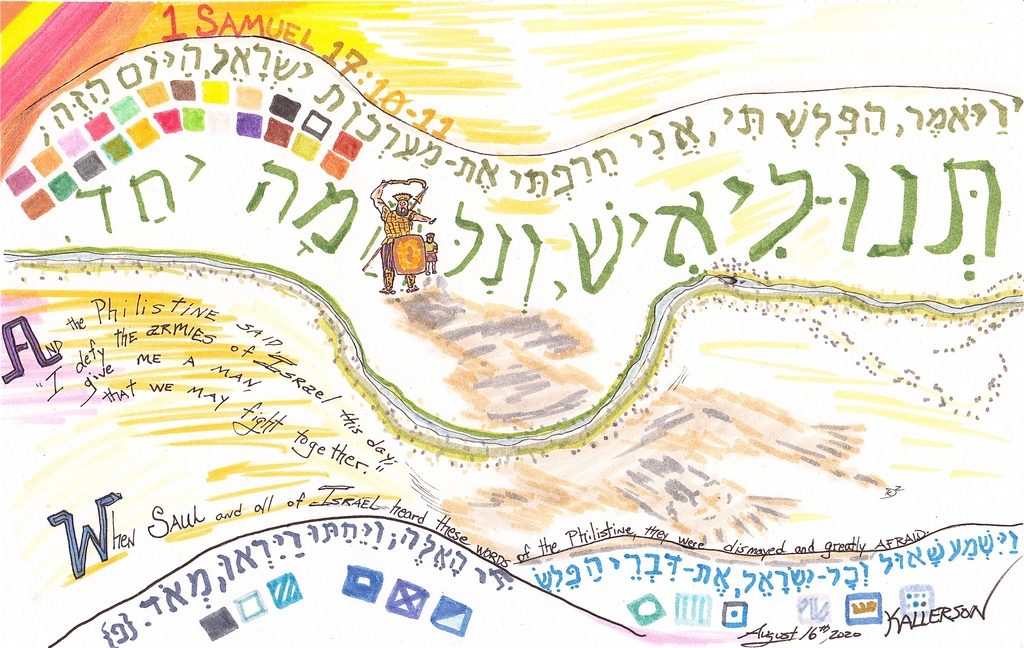
Artwork by Douglas Kallerson
1 Samuel 17:1-11
David and Goliath, Part I
(Typed 17 November 2025) 1 Samuel 17 is one of the most stirring and memorable passages in all of Scripture. It sets the tone for the life of David, who becomes king in Israel. It also demonstrates the concepts of faith in the Lord and trust in His guiding hand in a way that is almost unmatched in the pages of the Bible.
But more, it deals with one of the most beautifully messianic, or Christological, passages in the Bible as well. Great themes of the redemptive narrative are contained within it, revealing what God would do, based on what He promised to do, in a unique and beautiful way.
The context of the passage is necessary to understand what occurs here. In Chapter 15, King Saul disobeyed the Lord, failing to follow through with His command to utterly destroy the Amalekites, devoting them and all of their possessions to God through destruction.
Instead, it said, “And he commiserated, Saul, and the people, upon Agag, and upon best the flock, and the cattle, and the doubles, and upon the lambs, and upon all the good, and not he acquiesced – caused to anathematize them. And all the deputyship – disesteemed and being wasted, it they caused to anathematize” 1 Samuel 15:9 (CG).
Because of this, Samuel came to Saul and said, “Because you spurned word Yehovah, and He spurned you from king” 1 Samuel 15:23 (CG). Then, in Chapter 16, the Lord said to Samuel –
“Until when you mourning yourself unto Saul, and I spurned him from reigning upon Israel? You must fill your horn – oil, and you must walk. I will send you unto Jesse – House the ‘My Bread.’ For I saw in his sons: to Me – king” 1 Samuel 16:1 (CG).
Samuel obeyed, and David, the son of Jesse, was selected and anointed. After that, it noted, “And Spirit Yehovah, it veered from with Saul. And it affrighted him, breath evil from Yehovah” 1 Samuel 16:14 (CG).
In order to calm the distressing spirit, David was selected to play the harp for Saul. That is where the chapter ended. As was seen, the thoughts were not necessarily chronological, but categorically placed in this order. That is where we enter Chapter 17.
Text Verse: “Also the neighbor women gave him a name, saying, “There is a son born to Naomi.” And they called his name Obed. He is the father of Jesse, the father of David.” Ruth 4:17
David is noted more than 930 times in Scripture between Ruth 4:17 and Revelation 22:16. He isn’t mentioned in the verses today, but they set up the scenario for us to see and understand why he was considered so great throughout the rest of the Bible.
The scene is the Valley of the Elah, a beautiful valley lined with low mountains, in the middle of which is a ravine. On my trip to Israel with my mom in 2003, it was one of my most cherished stops. While there, I whipped out the Bible and read the passage we will be looking at for the next few weeks.
Everyone gathered around and listened – almost the whole tour group. Afterwards, many of them came up and thanked me. What astonished me is that nobody else brought a Bible, including the tour guides who had conducted almost 70 tours. To me, it seemed like a no-brainer – go to Israel, take your Bible.
Apparently, I’m in the minority, but I cannot even fathom why. The central point of faith for every true Christian on the planet is Jesus Christ. And the only way to know Him is to know the Bible. None of Scripture makes sense without Him, and all of it makes complete sense when viewed from His life.
If you don’t believe this, just look at Israel. They have absolutely no idea what their own Scriptures say because they don’t know who Jesus is in relation to what those Scriptures are saying. And the truth is that if anyone picked up only the Old Testament without the New Testament, it really wouldn’t make much sense.
But in knowing Jesus, every single story comes into clear focus. This is a certain truth that is discovered when you pick up and read His superior word. And so, let us turn to that precious word once again and… May God speak to us through His word today and may His glorious name ever be praised.
I. Valley of the Elah (verses 1 & 2)
Now the Philistines gathered their armies together to battle,
vayaasphu phelishtim eth makhanehem lamilkhamah – “And they gathered, Philistines, their camps to the battle.” Philistine comes from the verb palash, to roll, as in an act of mourning. In this state, a person will roll in the dust or ashes because of their intense grief. Thus, the name signifies Griever, Burrower, or something akin to that.
However, this can also be interpreted as an active action. Thus, it would be those who cause grief. Hence, the name Weakeners would be the result. This use is explained by Abarim –
“The name Philistine comes from the verb פלש (palash), which originally described the digging of burrows in river banks by rodents such as rats. By doing so, these creatures weaken the shore and may ultimately cause it to collapse.” Abarim
They are first mentioned in Genesis 10 in the Table of Nations. They are noted in the area of Canaan as early as Genesis 21 at the time of Abraham. They are believed to be displaced descendants of the Minoans who entered the land of Canaan and gained a foothold there.
They lived along the coastal areas, but they gathered their armies inland for battle against Israel. As it next says…
1 (con’t) and were gathered at Sochoh, which belongs to Judah;
vayeasephu sokhoh asher lihudah – “And they were gathered – Sochoh, which to Judah.” Sochoh comes from the verb suk, to hedge or fence up. Thus, it means Hedge or Fence. One commentary says it comes from the noun sek. If so, it would mean Thorn, which is less likely.
This area belongs to Judah, meaning Praise. Thus, the Philistines are seeking to expand into Israelite territory. In this clause, Sochoh is spelled שֹׂכֹ֖ה. From this point, the account becomes more specific…
1 (con’t) they encamped between Sochoh and Azekah, in Ephes Dammim.
vayakhnu ben sokhoh u-ven azeqah beephes damim – “And they inclined between Sochoh and between Azekah in Ephes Dammim.” In this clause, the name Sochoh is spelled with an additional letter, a vav: שׂוֹכֹ֥ה.
Azekah comes from the verb azaq, a word used only once, in Isaiah 5:2. It signifies to dig about, or till –
“Now let me sing to my Well-beloved
A song of my Beloved regarding His vineyard:
My Well-beloved has a vineyard
On a very fruitful hill.
2 He dug it up [azaq] and cleared out its stones,
And planted it with the choicest vine.
He built a tower in its midst,
And also made a winepress in it;
So He expected it to bring forth good grapes,
But it brought forth wild grapes.” Isaiah 5:2, 3
Ephes Dammim comes from two words signifying “to cease” or “come to an end,” and the plural of the word “blood.” Thus, it means something like “The Boundary of Blood Drops.” James Strong also defines it as “The Two Extremities,” meaning the soles of the feet or the ankles, but I have no idea why.
Boundary of Blood Drops probably refers to the fact that this is the boundary where there was constant warfare between Israel and her brutal neighbors. This is the only time the name Ephes Dammim is seen in Scripture. Elsewhere, such as in 1 Chronicles 11:13, it is known as Pas Dammim.
This area is about sixteen miles southwest of Jerusalem. It is also thirteen miles west of Bethlehem, the place from which David came.
2 And Saul and the men of Israel were gathered together,
veshaul veish Yisrael neesphu – “And Saul, and man Israel, they were gathered.” Although David was anointed, Saul was still the king of Israel, despite disobeying the word of the Lord. He has been told that his rule will end and the kingdom will be granted to another. Saul, or Shaul, comes from the verb shaal, meaning to inquire or ask for.
Thus, it means Asked. However, without the later-added vowel points, it is identical in spelling to the word sheol, the place of the dead: שאול. Because of this, one can imagine the grave calling out for the souls of humanity, asking them to come and join it.
The army of Israel came together because of the Philistines threat. After that…
2 (con’t) and they encamped in the Valley of Elah,
vayakhanu beemeq ha’elah – “and they inclined in Valley the Elah.” In order to face the Philistines, Saul and his army come to, and encamp at emeq ha’elah, Valley of the Terebinth. There are several words translated as valley in Scripture. This one, emeq, comes from amoq, signifying deep. Thus, it is a broad depression.
Elah comes from ayil, a ram. Thus, it denotes strength. It signifies an oak or a terebinth, trees known for their strength. There is an article before Elah, Valley of the Terebinth. With both camps properly settled into their respective locations, it next says…
2 (con’t) and drew up in battle array against the Philistines.
vayaarkhu milkhamah liqrath pelishtim – “And they arranged battle to encounter Philistines.” One can feel the tension when such words are presented. There are two camps, each confident in its abilities. The Philistines are the aggressors. The Israelites would have sued for peace if they thought they could not match the forces that had come against them.
Therefore, either the Philistines will realize their mistake and back out of the encounter, or there is only the anticipation of a battle which is sure to come.
Here they come again! The Philistines are looking for war
They have camped between Sochoh and Azekah in Ephes Dammim
They have it out for us, and they are pretty sore
They are like buzzing wasps, or so it would seem
But with Saul leading the many ranks of Israel
Surely this will be a quick rout, and we will be home soon
We’ll all sit around the table, our stories to tell
And maybe write a war song with a catchy tune
Here we are, camped on one side of the ravine
With the ranks of the Philistines on the other side
But now! There is someone standing in between
By the look of him, our quick victory may be denied
II. The Middleman (verses 3-11)
3 The Philistines stood on a mountain on one side,
u-phelishtim omedim el ha’har mizeh – “And Philistines standing upon the mount from this.” This tells us that the valley is sided with mountains. On one mountain, the Philistines are standing, facing Israel. In Scripture, a har, mountain, is a lot of something gathered. In typology, it is synonymous with a large but centralized group of people. Like the Philistines…
3 (con’t) and Israel stood on a mountain on the other side,
veyisrael omedim el ha’har mizeh – “And Israel standing unto the mount from this.” On the opposite side of the valley is another mountain where Israel is standing on its slope, facing the Philistines. Between them lies a natural border…
3 (con’t) with a valley between them.
vehagay benehem – “And the ravine between them.” Here, a word which is also unfortunately translated as “valley” is completely different than that of verse 2. The emeq, or valley, is a broad and deep valley between the mountains. In this verse, the gai, a ravine or gorge, is narrow and precipitous.
Thus, we have a natural border between the two forces, which is, at times, running with water. It is a ravine within a valley. This explains how these two armies could stand against one another for an extended period of time without actually engaging in battle.
First, crossing any distance to the ravine would leave them exposed to archers. Once at the ravine, those crossing would be at a continued disadvantage as they traversed the gorge. Depending on its depth, while they crossed through it, the opposing forces, being stationed on the other side, would easily destroy them as they struggled down one side and up the other.
The word gai, ravine, comes from gevah, meaning exaltation. Figuratively, it speaks of arrogance or pride. That comes from gaah, exaltation, or triumph.
With this ravine between the forces, the Philistines begin to make the first move in the battle…
4 And a champion went out from the camp of the Philistines,
Rather: vayetse ish ha’benayim mimakhanoth pelishtim – “And he went out, man – the middleman, from camps Philistines.” The use of the plural “camps” signifies various divisions of camps that formed the entire camped army. From these camps, one comes forward. To describe him, the word benayim, middleman, is used. It will only be seen in the Bible here and in verse 23.
The word is the plural of bayin, a space or interval, used in verse 1 and translated as “between.” This word signifies a double space or double interval.
He is the one to step forward, thus leaving a space between himself and his own army, and between himself and the opposing army. Therefore, he is the middleman and thus the champion of the armies allied against Israel. In this capacity, he is the one to challenge the opposing army to a single combat to decide the entire battle. He is…
4 (con’t) named Goliath,
galeyath shemo – “Goliath his name.” His name comes from galah, to uncover or remove, but it also means to lead away into exile. The word was first used in Genesis 9:21, where it says of Noah, “Then he drank of the wine and was drunk, and became uncovered [galah] in his tent.”
It is often used in Leviticus and Deuteronomy to refer to uncovering the nakedness of another. At times, it speaks of the Lord revealing himself. Thus, in the case of Goliath, his name means Uncoverer, or Exposer.
But the secondary meaning, exile, also applies because when one is exiled, he is left open and exposed in that state. To call him Exiler is not inappropriate. However, the primary meaning of Exposer carries the weight of the meaning of his name. He is the one who intends to expose the weakness of Israel. He is…
4 (con’t) from Gath,
migath – “from Gath.” Gath comes from the noun gath, winepress. His description continues, saying…
4 (con’t) whose height was six cubits and a span.
gaveho shes amoth vazereth – “His elevation six cubits and span.” Here is a new word in Scripture, govah, height. The word signifies excellency, elation, grandeur, and so forth. It can also figuratively signify haughty. In this case, it speaks of his literal height, which is six cubits and a span.
EW Bullinger defines the meaning of the number –
“Six is either 4 plus 2, i.e., man’s world (4) with man’s enmity to God (2) brought in: or it is 5 plus 1, the grace of God made of none effect by man’s addition to it, or perversion, or corruption of it: or it is 7 minus 1, i.e., man’s coming short of spiritual perfection. In any case, therefore, it has to do with man; it is the number of imperfection; the human number; the number of MAN as destitute of God, without God, without Christ.” Bullinger
A cubit, or ammah, is a unit of measurement that is the length of the forearm below the elbow. It comes from em, mother. Thus, it is the mother measurement. Its exact length is debated, but it is about 16-18 inches.
The zereth, span, is a rare word seen just seven times in the Bible. It comes from zarah, to scatter or winnow. Thus, it is the distance between the tip of the little finger and the end of the outstretched thumb, as if the fingers are scattered.
If you spread your hand in that fashion and place it on your arm at the tip of your middle finger, and then do the same where your hand ended, you will see that it ends at your elbow. In other words, a span is one-half a cubit.
Assuming the cubit is 16 inches, multiplied by 6, plus 8 inches, he would be 104 inches. Divide that by 12, and this guy is around 8’ 7” tall. He would probably be a descendant of Anak. Very few of them remained, but this is stated in Joshua 11 –
“And at that time Joshua came and cut off the Anakim from the mountains: from Hebron, from Debir, from Anab, from all the mountains of Judah, and from all the mountains of Israel; Joshua utterly destroyed them with their cities. 22 None of the Anakim were left in the land of the children of Israel; they remained only in Gaza, in Gath, and in Ashdod.” Joshua 11:21, 22
These Anakim lived among the Philistines and are regarded as Philistines. The account continues to describe this champion…
5 He had a bronze helmet on his head,
vekhova nekhosheth al rosho – “And helmet, bronze, upon his head.” The kova, helmet, is introduced into the Bible. It comes from an unused root meaning to be high or rounded (as in arched). It is a variant of qova, helmet, which will be used in verse 38 of this chapter. The difference between the two is the initial letter, either a kaph or a quph.
Bronze mainly symbolizes judgment, but also endurance. Such judgment can be positive or negative. If positive, it results in purification and justification. If negative, it results in punishment or even death.
However, positive judgment for a sinful person requires the death of an innocent in his place. Therefore, the positive judgment still carries a negative aspect.
5 (con’t) and he was armed with a coat of mail,
veshiryon qasqasim hu lavush – “And breastplate, scales, he wrapped.” The word qasqeseth means scales. It is only seen elsewhere in the dietary laws of Leviticus, Deuteronomy, and Ezekiel 29:4. Each use refers to scales, thus some translations rightly call it “scale armor.” Of this, Charles Ellicott says –
“This armour has been sometimes understood as ‘chain armour,’ but it is more probable that the Philistine armour was made of metal scales, like those of a fish, whose defensive coat was, no doubt, imitated at a very early date by this warlike race, who dwelt on the sea-shore, and whose life and worship were so closely connected with the great sea. This coat of mail, or corselet, was flexible, and covered the back and sides of the wearer.”
Next, the detailed information about Goliath says…
5 (con’t) and the weight of the coat was five thousand shekels of bronze.
u-misqal hashiriyon khamesheth alaphim sheqalim nekhosheth – “And weight breastplate five thousands shekels bronze.” The word shekel comes from shaqal, to suspend or poise. Therefore, it probably signifies a weight, as if suspended. One thousand shekels would weigh a bit more than 25 pounds. Therefore, five thousand shekels would be a bit more than 125 pounds. Next…
6 And he had bronze armor on his legs
u-mishkhath nekhosheth al raglav – “And frontlet, bronze, upon his feet.” A word used only here in the Bible is mitskhah, translated as frontlet. It comes from an unused root meaning to be conspicuous. Thus, it is bronze armor that covered the feet, but probably extended over his shins, as the greaves of a knight’s armor. Further…
6 (con’t) and a bronze javelin between his shoulders.
vekidon nekhosheth ben kethephav – “And javelin, bronze, between his shoulders.” The word translated as javelin is kidon. It comes from the word kid, meaning calamity or misfortune. It is used elsewhere and translated as either a spear or a javelin, such as in Joshua 8 –
“Then the Lord said to Joshua, ‘Stretch out the spear [kidon] that is in your hand toward Ai, for I will give it into your hand.’ And Joshua stretched out the spear [kidon] that was in his hand toward the city.” Joshua 8:18
Because it is kept between his shoulders as a quiver would be, it is a smaller weapon than the sword he also carried, which will be noted in verse 45.
It could have been either on his back or on the front. If it were long enough, it would be kept on his back. If it were shorter, for close-in fighting, it might be on the front. The exciting details continue…
7 Now the staff of his spear was like a weaver’s beam,
vekhats khanitho kimnor oregim – “And arrow his spear according to beam, weavers.” There is a variation between the written and the spoken text here concerning the word staff. The written uses the word khets, a piercer. As such, it signifies an arrow. The spoken uses the word ets, wood.
This shaft is described as kimnor oregim, or “beam, weavers.” The size of a weaver’s beam, both in thickness and in length, is unknown, as they vary greatly. However, the fact that it is described as such tells us that it was certainly very thick, or there would have been no point in conveying this.
Further, it would have been rather long. One commentator notes that “it is conjectured that, in proportion to the stature of Goliath, his spear must be twenty-six feet long” (John Gill). If this is so, it would have to be thick enough to stay straight, even with a great weight at the end of it, as is next noted…
7 (con’t) and his iron spearhead weighed six hundred shekels;
velaheveth khanito shes meoth sheqalim barzel – “And flame his spear six hundreds shekels iron.” The word laheveth, flame, signifies the part of the spear that flashes like a flame, thus its head. This flame is said to be made of barzel, iron, which in the Bible represents strength, be it in binding together, in government, in hard service, in bondage, etc.
Six hundred shekels is about 15 pounds. With the added weight of the wood, the spear would be extremely heavy to carry along with the sword, javelin, and all of the body armor. Amazingly, this is how he was arrayed.
The khanith, spear, was introduced in Chapter 13. It is from khanah, to incline (and thus to camp) or decline (as the sun in the afternoon). The connection is that a spear is for thrusting, like pitching a tent. That is from the same root as khanan, to stoop or bend in kindness to an inferior, as in God dealing graciously with someone.
There is more to the word, though. It is the same word as the feminine form of the word grace, khen, the word from which Hannah, Grace, is ultimately derived.
All of this detail concerning Goliath is to show that he was not only a huge man, but also extremely strong, being able to wear an immense amount of weight in armor and weapons. And more, the armor and weapons mean that he was both heavily defended and exceptionally well-armed.
It is worthy of note that some claim that Goliath must be a picture of the Antichrist based on the first number of the weights of each implement noted in verses 6 and 7: 6, 6, and 6. However, that has been passed along without those teaching it checking. The first numbers are 6, 5, and 6.
Others try to justify this by using two of the numbers, conveniently leaving out the third, saying he had 6 pieces of armor. This not only fudges the numbers, but it is also incorrect:
Helmet
Breastplate
Frontlet (2, because there is one on each leg)
Javelin
Spear
Shield (borne by the lifter)
One could say the use of the single “frontlet” signifies only one item. That is a reasonable proposition, but why would only his height and the weight of the tip of his spear be counted while not counting the weight of the breastplate?
Unfortunately, instead of verifying before passing on information, such sensational things become supposed standards that don’t match what the Bible is telling us. Sometimes, in our attempt to find “the key” to a passage, we may be a bit overzealous in our interpretation of it.
The description of Goliath and his armament has been given to make a complete contrast to the one he will eventually face in battle. In addition to all of his own personal armament, we read of one more thing accompanying him…
7 (con’t) and a shield-bearer went before him.
venose ha’tsinah holekh lephanav – “And lifter the shield walking to his faces.” The tsinah, shield, is introduced. It comes from the word tsen, meaning a thorn or barb. It is a guard against that which pierces. Cambridge, citing the scholar Layard, says –
“The archers, whether on foot or in chariots, were accompanied by shield-bearers, whose office it was to protect them from the shafts of the enemy. The king was always attended in his wars by this officer; and even in peace, one of his eunuchs usually carried a circular shield for his use. This shield-bearer was probably a person of high rank as in Egypt.” Layard
With all of Goliath’s strength, protection, offensive weapons, and secondary assistance, the Exposer is ready to challenge the enemy to battle. What will he uncover concerning the state of Israel?…
8 Then he stood and cried out to the armies of Israel,
vayaamod vayiqra el maarkhoth Yisrael – “And he stood, and he called unto arrangements Israel.” The word maarakah signifies an arrangement, thus its plural, used here, means ranks or battle lines. This giant dude stepped forward and called out to the entire army of Israel, who are formed on the other side of the ravine, readied for battle…
8 (con’t) and said to them, “Why have you come out to line up for battle?
The translation is spot on: vayomer lahem lamah thetseu laarokh milkhamah – “and he said to them, ‘To why will you come out to arrange – battle?” His words are a taunt. “I have stepped forward, and you are all arranged for battle. But why would you enter into battle against us? I am one man who represents all of the people behind me. One of you should come out and fight me. So far, no one has stepped out of your ranks.”
The fact that he had to call out shows that nobody was willing to come forward. And so, he taunts a bit more…
8 (con’t) Am I not a Philistine, and you the servants of Saul?
halo anokhi hapelishti veatem avadim leshaul – “Not I the Philistine? And you, servants to Saul!” He sets forth both national pride and faith in a leader as a challenge. He has declared himself “the Philistine,” while they are Israel.
Further, Goliath is not a king, but Saul, who leads Israel, is. If Saul hasn’t stepped forward, then who else is likely to? His words are chosen to dishonor the nation, the king, and also each individual who fails to step forward and meet his challenge.
But what is more important, and has as yet been left unstated, is that this is an attack against the God of Israel. The name Israel means He Strives with God. Who will strive with his God to defend the name that he bears? Is there even one who will come forward to meet the champion of the Philistines?
8 (con’t) Choose a man for yourselves, and let him come down to me.
beru lakhem ish veyered elay – “You must eat, to you, man, and he descended unto me.” The word, barah, normally translated as choose or select, is perplexing. It means “to eat,” and it is always translated that way except here. The context is obvious, even if the word’s meaning isn’t.
It comes from a word bar, grain of any kind. That is from barar, to clarify, purify, polish, choose, etc. Thus, the grain, when winnowed, is cleaned up. The connection between these words is found in Ecclesiastes 3:18, where this root is used –
“I said in my heart, ‘Concerning the condition of the sons of men, God tests them [barar], that they may see that they themselves are like animals.’”
In this, man can discern something. Goliath is asking them, using this word in an odd way, to discern who is capable of coming against him. In the use of this word, he could be making a pun.
If so, it would be, “Do you all have enough confidence to eat one of yours for strength? Then let him come down to me!” In essence, “If whoever is sent is enough to feed all of you as an army, fine. However, I assure you, it is he who will be my meal.”
Again, this is an attack against Saul. If the king won’t come out to battle, then they should choose someone more fit than he is to come and fight, making the decision for him.
Saul had fought against and driven back the Philistines in the recent past, and yet now he must be tiring. Surely someone competent could come take his place. And so, Goliath petitions for someone capable of coming down and facing him…
9 If he is able to fight with me and kill me, then we will be your servants.
im yukhal lehilakhem iti vehikani vehayinu lakhem laavadim – “If he will be able to battle with me, and he caused to strike me, and we became to you to servants.” Goliath is obviously taunting them, intending to embarrass Israel.
If either side felt they could win the battle, they would have engaged in it. But the layout of the land made it impossible to say who would win or how many would die in the process. And whichever side engaged first would be at a disadvantage.
Therefore, it was Goliath’s day to shine. Nobody else in the Philistine ranks was moving forward, and no opposing individual would come forward. He knew this. And so, to embarrass them by showing that no one could kill him, he taunts, “I’m just one man. If one of you kills me, we will be your servants!”
The temptation is given first, knowing that it would not be met with a response. After the temptation, then comes the warning…
9 (con’t) But if I prevail against him and kill him, then you shall be our servants and serve us.”
veim ani ukhal lo vehikitiv vihithem lanu laavadim vaabadtem othanu – “And if I, I will be able to – him, and I caused to strike him, and you became to us to servants, and you served us.” In what would be a certain defeat in a clash between the two men, the army of Israel would thus be defeated.
The only option left to either side is to continue to wait while Israel endures the tauntings of Goliath. If they picked up and left, the Philistines would move forward and gain ground. And so, the stalemate would, for now, remain. But not without continued tauntings…
10 And the Philistine said, “I defy the armies of Israel this day;
vayomer hapelishti ani kheraphti eth maarkhoth Yisrael hayom ha’zeh – “And he said, the Philistine, “I, I expose arrangements Israel the day, the this.” The verb kharaph is translated as to taunt, reproach, defy, and so on. However, it comes from the noun khoreph, harvest time, or autumn, as in the time of a gathered crop.
Thus, his words are as if he has stripped the ranks of Israel as a reaper would strip the fields at harvest, laying them bare and exposing them. Such a taunt is intended to show that he knows nobody will come forward. They are like the sheaves in the field that are easily cut down. If not, prove it! To do so…
10 (con’t) give me a man, that we may fight together.”
The verb is imperative: tenu li ish venilakhamah yakhad – “You must give to me man, and let us be fought unitedly.” To allow them to prove they aren’t chicken, he states his demand. Ignoring Saul, who will no doubt refuse to come, or even choose a person, he is asking “all of you” (it is plural) to give him a man.
In his words, we see that he is taunting everyone, he is taunting all together, and he is pitting them against one another. Nobody will even be willing to say, “Hey, I might not be able to beat you, but this guy can!” No one is confident enough in himself, or in anyone else.
11 When Saul and all Israel heard these words of the Philistine,
vayishma shaul vekhal Yisrael eth divre hapelishti ha’eleh – “And he heard, Saul and all Israel, words the Philistine, the these.” The battle was obviously unwinnable by either side when pitting army against army, and because of the ravine that ran between them.
Therefore, the only option to end the stalemate would be a solitary battle between the two forces’ best. The champion of the Philistines came forward and defied the king of Israel and every individual soldier of Israel. Indeed, he also implicitly defied the God of Israel because His name is upon them.
However, instead of trusting in the Lord, we see a sad conclusion to our verses for today…
*11 (fin) they were dismayed and greatly afraid.
vayekhatu vayiru meod – “And they were prostrated, and they feared vehemently.” The word khathath, discouraged, was introduced in Deuteronomy 1:21. Its principal meaning is to prostrate. It is translated as shattered, dismayed, beaten down, affrighted, and so on. It has been used five times since it was introduced –
- “Look, the Lordyour God has set the land before you; go up and possess it, as the LordGod of your fathers has spoken to you; do not fear or be discouraged [khathath].” Deuteronomy 1:21 (Moses speaking to the people when they originally stood at the door to Canaan).
- “And the Lord, He isthe One who goes before you. He will be with you. He will not leave you nor forsake you; do not fear nor be dismayed [khathath].” Deuteronomy 31:8 (Moses speaking to Joshua just prior to him taking over the leadership of Israel).
- “Have I not commanded you? Be strong and of good courage; do not be afraid, nor be dismayed [khathath], for the Lordyour God iswith you wherever you go.” Joshua 1:9 (The Lord speaking to Joshua after the death of Moses).
- “Now the Lordsaid to Joshua: ‘Do not be afraid, nor be dismayed [khathath]; take all the people of war with you, and arise, go up to Ai. See, I have given into your hand the king of Ai, his people, his city, and his land.’” Joshua 8:1 (The Lord speaking to Joshua after Israel resolved the matter of Achan).
- “Then Joshua said to them, ‘Do not be afraid, nor be dismayed [khathath]; be strong and of good courage, for thus the Lordwill do to all your enemies against whom you fight.’” Joshua 10:25 (Joshua encouraging Israel after the defeat of the five kings).
In all five examples, the Lord is the One who provides the victory if the people will simply trust Him and follow His lead. All five instances were recorded in Israel’s history. And all five times, the word dismayed was joined to the thought of being fearful: Do not be afraid and do not be discouraged.
Here, exactly the opposite is seen. The people are not only discouraged, but they are also greatly afraid. The key point that we are to see from this passage is that all of Israel failed.
They failed to remember the Scriptures given for their admonishment, and thus they failed to trust the Lord who gave them the word. He assured them that they would prevail if they trusted Him.
It is a sad note to end on, but it is only the beginning of this marvelous chapter that details the heroic deeds of a shepherd boy in the Valley of the Elah.
So far, we have gotten a bit of background and mechanical information needed to determine what is going on. We have also been readied for the introduction of a very special figure into the narrative. He will be presented as soon as we continue our journey through the chapter next week.
For now, the main lesson I want you to consider is that God wants us to trust Him. He is there with us even if the enemy we face is large, well-defended, and well-armed. In comparison to the Lord, the enemy is nothing.
But in order for us to trust the Lord as we should, we have to know Him as He is. Muslims certainly trust their false god, Allah. Anyone willing to blow up himself and a bunch of other people in order to supposedly gain entrance into paradise has trust in what he thinks is true.
The Japanese were told the same thing in WWII as they flew airplanes into the side of warships. People all over the world trust in one “god” or another. The problem isn’t trust. Rather, it is misdirected trust. That needs to be straightened out.
The God of the Bible, the one true God, isn’t like those other false gods. Instead of asking us to do something for Him, He promises to accomplish the work for us instead. All He asks of us is to know who He is, and in knowing Him, to then trust Him.
The problem is sin, and sin came through the lies of the devil. In order to correct that, God promised to destroy the works of the devil and, in turn, the power of the devil. Eventually, the devil will be cast out of our presence forever, where he will endure an eternal swim in the Lake of Fire.
God has accomplished all of this through the Person and work of Jesus Christ. As we continue through this chapter, keep remembering this. Keep asking, How does this point to Jesus? In the end, the story of David is a part of the story of the coming Messiah – our Lord Jesus Christ.
It is He who will get us to those fair shores of the better land which God has prepared for us. Let us trust Him to do so. Through this, God will be pleased to call us His children.
Closing Verse: “I, Jesus, have sent My angel to testify to you these things in the churches. I am the Root and the Offspring of David, the Bright and Morning Star.” Revelation 22:16
Next Week: 1 Samuel 17:12-27 Jesse sent David on a journey, and you may ask “whyeth,” so I will explain it to you… (David and Goliath, Part II) (36th 1 Samuel sermon)
The Lord has you exactly where He wants you. He has a good plan and purpose for you. He is the One who abases the haughty and exalts the humble. He regards the lowly, and the proud, He knows from afar. So yield yourself to Him, trust Him, and believe His word. In this, He will do great things for you and through you.
1 Samuel 17:1-11 (CG)
1 And they gathered, Philistines, their camps to the battle. And they were gathered – Sochoh, which to Judah. And they inclined between Sochoh and between Azekah in Ephes Dammim. 2And Saul, and man Israel, they were gathered, and they inclined in Valley the Elah. And they arranged battle to encounter Philistines. 3And Philistines standing unto the mount from this. And Israel standing unto the mount from this. And the ravine between them.
4And he went out, man – the middleman, from camps Philistines. Goliath his name, from Gath. His elevation six cubits and span. 5And helmet, bronze, upon his head. And breastplate, scales, he wrapped. And weight breastplate five thousands shekels bronze. 6And, frontlet, bronze upon his feet. And javelin, bronze, between his shoulders. 7And arrow [k.] his spear according to beam, weavers. And flame his spear six hundreds shekels iron. And lifter the shield walking to his faces. 8And he stood, and he called unto arrangements Israel, and he said to them, “To why will you come out to arrange – battle? Not I the Philistine? And you, servants to Saul! You must eat, to you, man, and he descended unto me. 9If he will be able to battle with me, and he caused to strike me, and we were to you to servants. And if I, I will be able to him, and I caused to strike him, and you were to us to servants, and you served us.” 10And he said, the Philistine, “I, I expose arrangements Israel the day, the this. You must give to me man, and let us be fought unitedly.” 11And he heard, Saul and all Israel, words the Philistine, the these. And they were prostrated, and they feared vehemently.
1 Samuel 17:1-11 (NKJV)
1 Now the Philistines gathered their armies together to battle, and were gathered at Sochoh, which belongs to Judah; they encamped between Sochoh and Azekah, in Ephes Dammim. 2 And Saul and the men of Israel were gathered together, and they encamped in the Valley of Elah, and drew up in battle array against the Philistines. 3 The Philistines stood on a mountain on one side, and Israel stood on a mountain on the other side, with a valley between them.
4 And a champion went out from the camp of the Philistines, named Goliath, from Gath, whose height was six cubits and a span. 5 He had a bronze helmet on his head, and he was armed with a coat of mail, and the weight of the coat was five thousand shekels of bronze. 6 And he had bronze armor on his legs and a bronze javelin between his shoulders. 7 Now the staff of his spear was like a weaver’s beam, and his iron spearhead weighed six hundred shekels; and a shield-bearer went before him. 8 Then he stood and cried out to the armies of Israel, and said to them, “Why have you come out to line up for battle? Am I not a Philistine, and you the servants of Saul? Choose a man for yourselves, and let him come down to me. 9 If he is able to fight with me and kill me, then we will be your servants. But if I prevail against him and kill him, then you shall be our servants and serve us.” 10 And the Philistine said, “I defy the armies of Israel this day; give me a man, that we may fight together.” 11 When Saul and all Israel heard these words of the Philistine, they were dismayed and greatly afraid.